The Z machine at Sandia National Laboratories is an extreme device. Its ring of capacitors fill a room about the size of two basketball courts. When they fire, they unleash an electrical pulse that, for a few billionths of a second, delivers more power than is generated by all the world’s power plants at any given moment. This pulse triggers a shockwave that subjects anything at the machine’s centre to pressures equivalent to those found deep inside giant gas planets and nuclear explosions.
Earth’s oldest crystals suggest an early start for plate tectonics
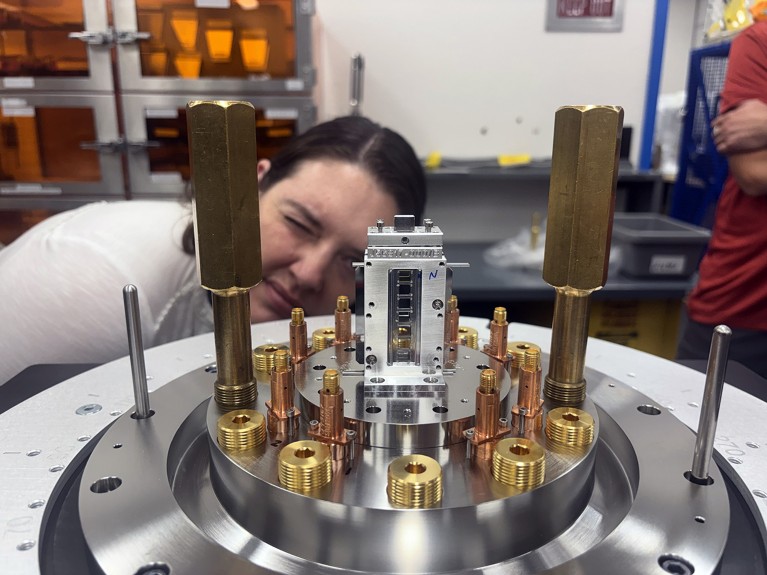
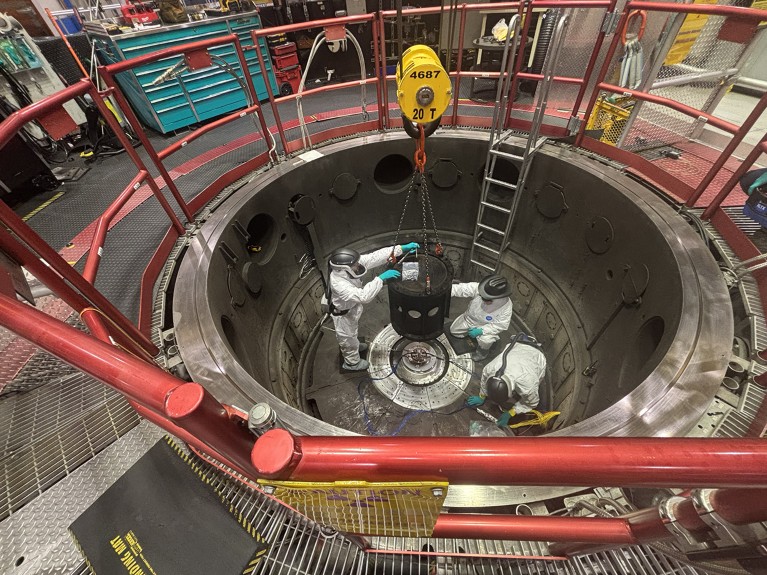
Late last month, Alisha Clark, a mineral physicist at the University of Colorado in Boulder, harnessed the power of the Z machine to study something closer to home: Earth’s interior. Nature joined her to observe the final ‘shot’ taken with the machine in a multi-year project to better understand the origins of water on Earth.
This focus on Earth is unusual for the Z machine. Located on the Kirtland Air Force Base in Albuquerque, New Mexico, the device was originally built for testing materials to guarantee the reliability of the US stockpile of nuclear weapons without having to detonate bombs. That’s still mostly what it’s used for. But about 10% of the shots taken with the device each year are set aside for fundamental research.
Firing the machine requires months of preparation and input from more than a hundred people. Each shot takes a full day to set up and costs around US$250,000. As a result, few requests to use the machine are approved for researchers studying planets, and even fewer for people investigating Earth.
But the Z machine is crucial for Clark’s work. She suggests that during the early, chaotic days of Earth’s formation, melted rock inside the planet trapped and held onto water — counter to the origin story that geoscientists usually tell. “Earth is a sponge,” she told Nature.
To test this idea, Clark needed to simulate how melted rock behaves under the conditions near Earth’s core as it formed. And that’s where the Z machine came in.
Magma ocean
Around 4.5 billion years ago, Earth — freshly formed from cosmic dust and gas — would have been completely molten, heated by radioactive elements and collisions with other planetary debris, geoscientists say. Given these conditions, one long-standing theory about Earth suggests that any water molecules accumulated inside the planet would have steamed or been blasted off into space and lost. If this were true, all of the water on the planet’s surface today would have been delivered later, by icy comets and asteroids, after the crust cooled. And any water currently in the interior would have been carried there by tectonic plates sinking down into Earth’s mantle.
But there is an alternative possibility. Early Earth, in its molten form, might have held on to some of the original water molecules that it had accumulated from cosmic dust and gas. If this were true, much of the water on Earth’s surface today might have been released from its hot interior through volcanoes over geological time. And even greater volumes — oceans’ worth of water — might have remained in the planet’s interior.
Diamond delivers long-sought mineral from the deep Earth
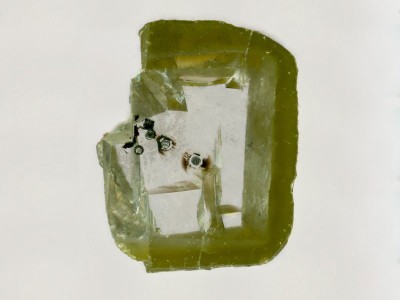
This idea was inspired by a number of geophysical and geochemical discoveries from the past decade or so that have pointed to a larger reservoir of water in Earth’s interior than could have been delivered by plate tectonics alone. For instance, in 2014, scientists analysed1 a diamond that came from deep in Earth’s mantle. They found that it had a mineral impurity that contained a surprising amount of water dissolved inside its crystal structure.
But researchers have struggled to explain how so much water could have stayed trapped inside a molten Earth. Clark’s work on the Z machine puts forward one idea from a pool of possibilities2 that scientists are considering.
She has been using the machine to test how the presence of water affects the compressibility of molten glass — a proxy for melted silicate rock — under extreme pressures. This involves sending a shockwave through glass samples infused with water to briefly recreate the conditions that occur near Earth’s centre.
In experiments that she had run previously, she found that the glass, when infused with a lot of water, seems to become stiffer, but as pressure increases, it becomes easier to compress. “It becomes more squishy the more you squish it, which is not normal behaviour,” she says. This, she thinks, could mean that melted rock is good at trapping water under the pressures found inside Earth’s mantle, suggesting a way that the planet could have held onto water even during its molten ‘magma ocean’ phase.
Enjoying our latest content?
Log in or create an account to continue
- Access the most recent journalism from Nature's award-winning team
- Explore the latest features & opinion covering groundbreaking research