For many members of the C-suite these days, sustainability is a top three agenda item alongside technology and AI adoption, according to research from Deloitte.
In fact, the report says, technology is considered a vital means of hitting organizational goals here, with the implementation of IT solutions being the most common approach for doing so.
The importance of tech's role in this context is reflected in the views of IT decision-makers themselves. A recent survey, conducted by Barco ClickShare, revealed that 96 percent of the 500 US tech leaders questioned consider their sustainability activities to make a significant and positive global contribution to strategy here.
A further 98 percent feel their departments should lead the way in such activities. Indeed, more than four out of five felt so strongly about the situation that they would turn down a job offer at a new employer if it did not have a strong sustainability track record, they said.
She believes IT functions have this central role to play in tackling sustainability issues because many of their "day-to-day technology choices directly influence an organization's environmental footprint".
"Sustainability is about practical decisions: buying reliable technology, extending product life, reducing complexity, and ensuring devices can be managed, repaired and responsibly recycled," Laleeuwe explains.
Sustainability as a collaborative practice
But given that technology-related decisions are rarely made by IT leaders alone, it is clear they cannot tackle sustainability challenges alone either. As Barco ClickShare's report indicates, a mere 6 percent of IT departments are the sole decision-makers on tech investments, which includes meeting room systems.
This means that collaboration with other stakeholders is vital. Such stakeholders include not only sustainability and environmental affairs teams. They also consist of procurement, finance, facilities management, operations, and executive leaders.
"Working together, it's possible to balance security, usability, cost, lifecycle impact, energy efficiency, repairability and end-of-life recovery before a purchase is even made," Laleeuwe points out.
In other words, by collaborating, it becomes much easier to embed sustainability considerations into day-to-day activities. This includes maintaining and upgrading equipment properly to extend its life. It is these everyday IT decisions that can make all the difference in shaping behavior in the digital workplace.
One example of this relates to the procurement process itself, which is often complex. But top of the list on any sustainable shopping list should be ensuring that technology in general, but meeting room equipment in particular, is secure, reliable, and easy to integrate with other systems. This is important because if kit is not durable and interoperable, it will come up for replacement sooner rather than later.
But such an approach not only generates waste, it also necessitates purchasing new items. These tend to have a high carbon footprint due to the required extraction of raw materials and high energy usage during both manufacturing and transportation processes.
Essential sustainable procurement considerations
As for the key questions prospective buyers should be asking their suppliers upfront here, these include which methodologies their products are based on and what certifications they hold. Valid certifications in this context include TCO Certified's global sustainability for IT products marque and the US government's Energy Star symbol for energy efficiency.
In fact, sustainability certifications ranked joint second with cost as the most important factor when purchasing hardware, according to participants in Barco ClickShare's survey. They were topped only by security.
However, it is essential to ensure that certifications and carbon-neutral claims offer "transparency, not just reassurance", Laleeuwe warns. As such, "they should show how the product performs, which lifecycle stages are covered, how claims are validated, and what concrete design choices reduce impact," he says.
In other words, it is essential to understand whether suppliers have taken environmental factors into consideration across their entire product lifecycle. Such factors include product design, which should ideally be modular so that individual components can be repaired or replaced as required.
They also include which materials have been used in the manufacturing process and whether they are recyclable or at least have a low environmental footprint. The same rules apply to packaging.
Other essential considerations for IT leaders during the procurement process, meanwhile, include the energy consumption of their chosen conferencing and communication platform during usage.
Just as important is whether individual vendors offer take-back programs or other responsible disposal routes for products at end-of-life, such as repair and recycling. The aim here is to ensure that old equipment does not pollute the environment by ending up in landfill.
As Laleeuwe points out: "Prioritizing repair and recycling extends product life, avoids premature disposal and turns ESG [environmental, social, and governance] goals into repeatable IT practices."
Unfortunately, though, such activities tend to be all too frequently overlooked today. For example, Barco ClickShare's research reveals that only 42 percent of IT leaders currently select equipment that can be repaired by their manufacturer to extend its life. Even fewer (16 percent) rank repairability as a top concern.
The figures are even worse in terms of recycling (11 percent) being prioritized. Unsurprisingly then, just over a third of respondents indicated their department does not always go down this route.
A key problem here, says Laleeuwe, is that such activities are often simply "less visible at the initial point of purchase", which means they are rarely front of mind.
The problem with hybrid working
Another common challenge, meanwhile, relates to the ongoing shift towards hybrid and remote working.
But according to the Barco ClickShare report, some 95 percent of IT leaders believe such practices have had an impact on their organization's sustainability efforts, ultimately making them more complex. This is at least partially due to meeting room equipment now being spread across office, home, and flexible workspaces.
On the downside, this means it has become more difficult to manage and recycle e-waste from remote locations (48 percent). The growing use of personal devices has also made it trickier to ensure the adoption of energy-efficient hardware (46 percent).
But on the plus side, there has been an increase in uptake of more energy-efficient cloud services compared to on premise systems (63 percent of respondents). Even here though, things are not always clear cut.
As Laleeuwe explains: "IT teams need to look at the full setup: utilization, energy performance, device longevity, security, manageability and end-of-life recovery. The most sustainable choice is the one that delivers the required experience with the least avoidable footprint."
The benefits of standardization
One approach that does produce much more reliable results in sustainability terms though is standardizing equipment across the organization, especially in a meeting room system context.
In the past, individual business departments all too often purchased such kit without consulting IT, leading to the deployment of fragmented, siloed systems. But standardization has shown it can offer various benefits.
On the one hand, Laleeuwe explains: "It limits the number of device types, spare parts, support processes and replacement cycles IT has to manage, while making updates, remote management and lifecycle planning easier."
On the other, organizations can benefit from economies of scale - although to what extent depends on how much e-waste or energy usage they can cut based on the size of their IT estate, usage patterns, refresh cycles, and recycling processes.
A further benefit of standardization is that it provides organizations with "the control needed to measure, manage and reduce impact consistently", Laleeuwe adds.
Embedding sustainability goals into the day-to-day
What this demonstrates is that when ensuring sustainability goals are translated into day-to-day IT decision-making, routine choices matter. In other words, sustainability must become part of procurement requirements, implementation checklists, and lifecycle management as standard.
"That means setting shared criteria for certifications, energy efficiency, durability, repairability, recyclability, vendor take-back, and lifecycle reporting," Laleeuwe says. "It also means giving IT, procurement, facilities, finance and sustainability teams joint ownership of the process."
One organization that successfully embedded just this kind of approach into its workplace strategy is the Flemish Government. When renovating its Marie-Elisabeth Belpaire headquarters building in Brussels, Belgium, the Agency for Facility Operations took a multi-layered approach to sustainability.
For instance, the building itself became the first in Flanders to conform to circular construction practices. This included using 68 percent reclaimed, reused, or recycled materials from the original site in its renovation activities.
The building is also close to operating at net zero. This is partly due to its Thermal Energy Storage system, which captures and stores thermal energy for later use. It is also partly because of the introduction of solar panels on its roof and side walls.
But another key consideration in ensuring a sustainable headquarters was the widespread adoption of green ICT. This included the introduction of a hyper-efficient Wi-Fi network to help the Government save the equivalent of 550 households-worth of electricity each year.
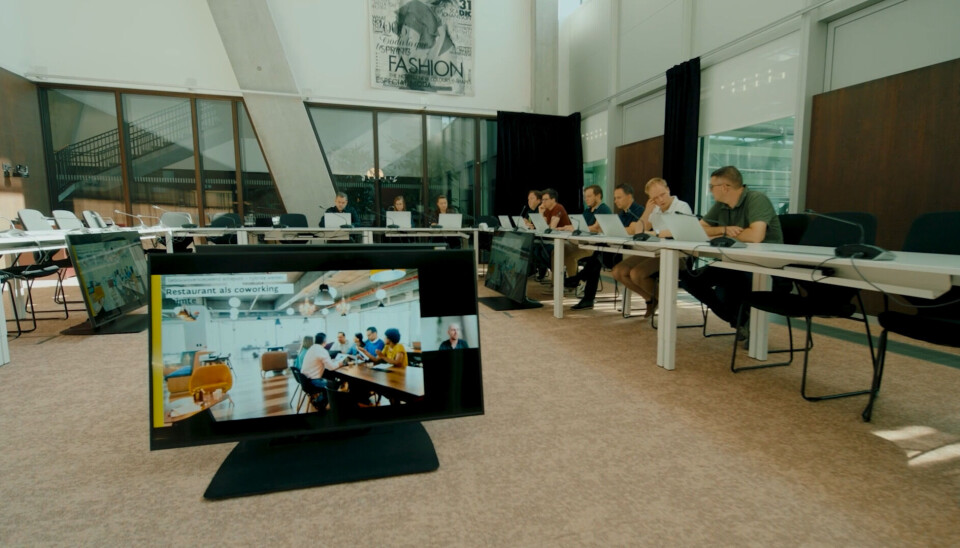
Just as important was the standardization of the Government's meeting room technology using certified sustainable technology. To this end, more than 1,000 ClickShare wireless conferencing and collaboration devices were implemented in more than 1,000 different meeting spaces. The aim of standardizing equipment in this way was both to cut energy usage and the meeting room infrastructure's overall carbon footprint.
As Laleeuwe concludes: "The lesson is clear: sustainable meeting rooms work best when technology, workplace design, user experience and lifecycle management are all planned for together and implemented in tandem."
Sponsored by Barco