It’s boom time for billionaires. In the next few months, the world could see a fresh crew of technology entrepreneurs join that club, and the numbers of multi-millionaires would swell even more.
How a new wave of science philanthropists can have the greatest impact
Two giants of artificial intelligence, OpenAI and Anthropic, plan to go public in the next year or so, floating stocks that are expected to rocket some of their employees into the ranks of the ultra-wealthy. Some analysts have projected that Anthropic’s initial public offering (IPO) might bring in US$2 trillion, the largest in history. OpenAI is reportedly targeting $1.4 trillion for its IPO, although the company delayed going public until 2027 amid renewed concerns about AI safety.
If these IPOs go as planned, the effects might extend well beyond sales of superyachts, mansions and private jets. The windfall would probably also add to the flurry of private investments and philanthropic donations from tech-savvy entrepreneurs who are eager to jump-start their favoured areas of biomedical research, such as cancer biology, longevity and reproductive technologies. “It’s a very exciting time,” says Andrew Lo, who studies entrepreneurship at the Massachusetts Institute of Technology in Cambridge. “We’re going to see the creative energy of the tech sector unlocked.”
Wealthy technology entrepreneurs have long put their cash and creative energy into medical research. And as their fortunes have grown, so has the scale of their investments, and the variety of ways in which their funds are doled out. One major player is Altos Labs, a longevity-focused company in Redwood City, California, which launched in 2022 with $3 billion in funds raised from tech titans Yuri Milner and Jeff Bezos, among others — an unprecedented sum for a fledgling biotechnology company with no drug candidates. The Chan Zuckerberg Initiative (CZI) , founded by Facebook co-founder Mark Zuckerberg and his wife, physician Priscilla Chan, has spent about $4 billion on basic scientific research and other causes, and plans to spend up to $10 billion more over the next decade.
Ultra-wealthy research investors follow a different strategy than do government funding agencies such as the US National Institutes of Health (NIH). Organizations such as the CZI and Altos Labs boast a commitment to high-risk, long-term research. Tech entrepreneurs are also often keen to invest in new technology, and to harness the power of AI for biomedicine. In April, for example, the CZI announced that it would spend $500 million on funding predictive AI models of human cells. Last year, OpenAI Foundation, the non-profit arm of OpenAI in San Francisco, California, pledged to spend $25 billion on health, disease cures and AI resilience. The foundation has announced more than $100 million for Alzheimer’s disease research and another $125 million for life-sciences data projects this year.
But this investment comes at a time when the public is suspicious of the tech elite and its political influence. It is difficult to assess the success of philanthropic programmes, and many are geared towards encouraging the use of the same technology the philanthropists profited from developing. Meanwhile, high-profile private investment in firms that study longevity or controversial reproductive technologies, such as gene editing in human embryos, raises questions about whether tech entrepreneurs will skew research towards applications that benefit the wealthy, rather than helping a broader swathe of society. “In philanthropy, no one gets elected,” says Rob Reich, a political scientist at Stanford University in California. “There’s no way of holding them accountable.”
A new gilded future
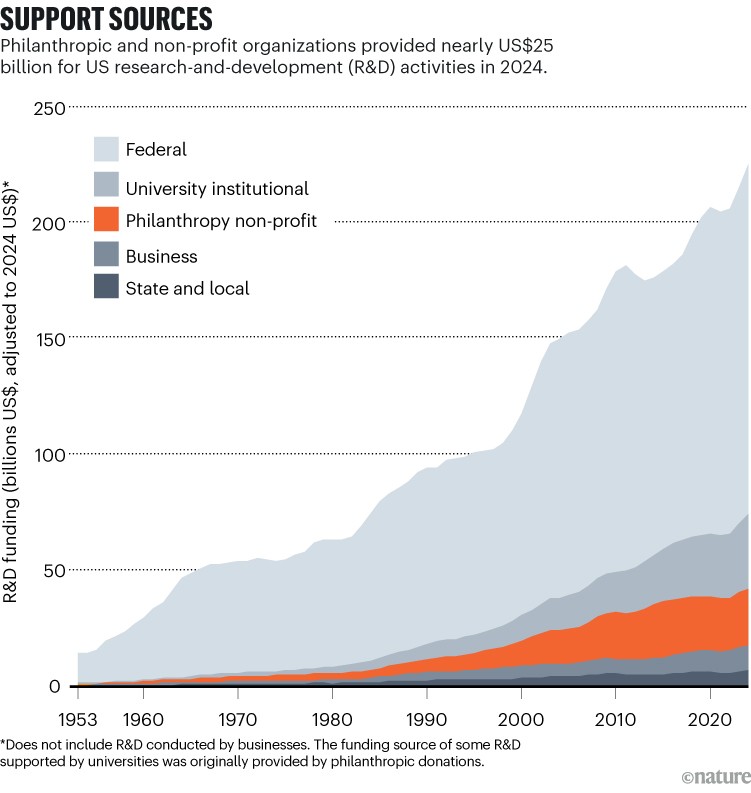
US philanthropists have a long history of influencing what research gets done, and how. In the early twentieth century, grants from industrialists such as Andrew Carnegie and John D. Rockefeller helped to transform higher education and solidify the role of US universities in scientific research. Their giving focused on ensuring that the institutions they supported succeeded; today’s philanthropists are more likely to seek a particular outcome rather than support the long-term health of a university, says Eric John Abrahamson, a historian at Johns Hopkins University in Baltimore, Maryland. In 2024, non-profit organizations, including philanthropies, supported an estimated $25 billion in research and development — about 11% of total research funding in the United States, according to the Science Philanthropy Alliance (see ‘Support sources’).
It is difficult to track all donations from technology magnates comprehensively, but individual examples show that their influence has been sizeable. In 2000, Microsoft co-founder Bill Gates established the Gates Foundation (formerly called the Bill & Melinda Gates Foundation), which made massive investments in vaccine development and the study of infectious disease, among other fields. It remains an influential behemoth: last year, Gates announced that he would donate about US$200 billion over the next two decades.
Other large tech donors include Sergey Brin, a co-founder of Google, who has donated more than $1 billion to Parkinson’s disease research. Sean Parker, an early executive at Facebook, has given hundreds of millions to cancer-immunotherapy research. In 2021, several philanthropists, including tech entrepreneurs, donated $650 million to found the Arc Institute in Palo Alto, California, in the heart of Silicon Valley, to understand the root causes of complex diseases. And US software magnate Larry Ellison announced that he will spend billions of pounds over ten years on a new campus near the University of Oxford, UK. The campus will focus on health care, as well as agriculture, climate change and AI.
In addition to charitable donations, tech entrepreneurs have been fuelling biomedical innovation through private-sector investments, such as funding Altos Labs. Another company, Calico Life Sciences, was founded in 2013 with backing from Google. With a focus on combating ageing and curing disease, Calico, in South San Francisco, California, was conceived as a long-term ‘moonshot’ programme. Sam Altman, a co-founder and chief executive of OpenAI, has invested about $180 million in Retro Biosciences, another longevity-focused company, in Redwood City, California.
In some cases, the line between for-profit investments and philanthropic donations are becoming more blurred, says Louis Shekhtman, a network scientist at Bar-Ilan University in Ramat Gan, Israel. The CZI, for example, was set up as a limited liability company (LLC), rather than as a tax-exempt foundation. Doing so comes at a cost: depending on how they are constructed, LLCs might not be eligible for the tax breaks that more-conventional charities enjoy. But an LLC can be more flexible in how it spends its money, and has fewer requirements to publicly disclose its activities, says Joan Heminway, a business-law scholar at the University of Tennessee in Knoxville.
In a 2015 statement shortly after the launch of the CZI, Zuckerberg said the LLC structure would give the initiative “the flexibility to give to the organizations that do the best work — regardless of how they’re structured”. He also said that any net profits from CZI investments would be put towards furthering its philanthropic mission.
How to spend $25 billion on science: OpenAI’s staggeringly rich research charity gets under way
Favourable US tax policies and a high concentration of billionaires — many of them in the technology industry — mean that the United States is unmatched among wealthy nations for charitable giving, says Shekhtman. It is also a major hub for biomedical research, and home to nearly half of the world’s biopharmaceutical companies.
And US tech entrepreneurs have a penchant for experimentation in how they structure their investments, says Keith Yamamoto, vice-chancellor of science policy and strategy at the University of California, San Francisco. When it comes to philanthropy, private donors are more able to take risks with their investments than are government funding agencies, which are beholden to taxpayers to ensure that their money is spent wisely. “Public money limits your activities,” says Harold Varmus, a former director of the NIH, who has also been on advisory boards for the Gates Foundation and the CZI. “There is a freedom of motion that is associated with private money.”
Some tech titans have experimented with various ways of structuring their grants. The Arc Institute, for example, boasts a “no-strings-attached” funding system that gives its investigators more freedom than do standard government grants awarded to biomedical researchers.
Philanthropists are also able to fund long-term, interdisciplinary projects that can be difficult for government grants to take on. Convergent Research, a non-profit organization funded in part by Eric Schmidt, the former chief executive of Google, is forming ‘focused research organizations’ that bring teams together to solve important scientific or engineering challenges that could benefit a wide swathe of research. “We’re looking for the pieces of critical, fundamental infrastructure missing from a particular field,” says Anastasia Gamick, a co-founder and president of Convergent Research, which is headquartered in Cambridge, Massachusetts.
Projects include developing cheap ways to map the neurons in mammalian brains, and large-scale screening to catalogue the off-target effects of small-molecule drugs.
Meanwhile, Yamamoto points to the CZI’s Institute for Advanced Biological Imaging as another example of a long-term, high-risk project that aims to develop pivotal technology. He hopes that the team there — which has brought engineers, physicists and computer scientists together with biologists — will succeed in refining a difficult technique called cryo-electron tomography so that it can image processes in a cell at the level of individual proteins.
Tolerance for risk is also evident in some tech entrepreneurs’ investments in for-profit companies. Some investors hope to reshape how fundamental research is conducted. Arcadia Science in Emeryville, California, for example, was launched with backing from Altman and from Jed McCaleb, a cryptocurrency entrepreneur in the United States, and pledges to “rethink the entire research cycle” by branching out from the usual laboratory model systems, such as mice and the bacterium Escherichia coli, to study more diverse organisms. Like Calico Life Sciences, the company warned investors from the start: this will take time.
Arcadia has also taken an unusual step for a for-profit company and embraced open science to a degree not typically found in industry, says Yamamoto. Its lab protocols, computer code and data sets are published directly online.
Silicon Valley investors are also sometimes willing to wade into controversial territory. Last year, Brian Armstrong, chief executive of the cryptocurrency exchange Coinbase, helped to fund a company dedicated to developing methods to edit the genome in human embryos to prevent disease. The company, named Preventive and based in San Francisco, will first have to grapple with the fundamental science of heritable gene editing to learn whether and how it can be done safely, says Lucas Harrington, a co-founder of Preventive. Private investment will enable the company to do that research, which US legal restrictions prohibit government grants from funding.
Enjoying our latest content?
Log in or create an account to continue
- Access the most recent journalism from Nature's award-winning team
- Explore the latest features & opinion covering groundbreaking research