No more propping your phone up and trying to beat the timer to get in the picture.
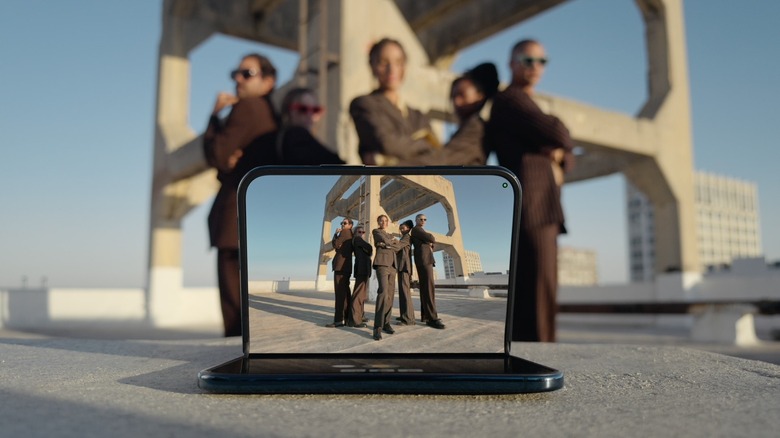
It was inevitable that Apple would hype every new camera trick with the iPhone Duo, no matter that Samsung and others have been doing similar things for years. One thing that wasn't so expected was how hard it would lean into group selfies. Its September event devoted at least a minute or two to the topic — which might not seem like much, but given that the Duo was just one product on the slate, that's saying something about what Apple thinks will sell.
There is some merit to the attention, since iPhone owners have had relatively little flexibility in group selfies until now. Even on the iPhone 18 Pro, the front-facing Center Stage camera is limited to 18 megapixels. You can get 48 megapixels with one of the rear cameras, but of course those are less than ideal for group shots you need to participate in. At most, you can find an object to prop your phone on, frame the shot and hope your timer lasts long enough for you (and everyone else) to get a proper pose in.
The Duo, shipping on October 23, aims to fix these deficiencies through the combination of a foldable form factor and a couple of new iOS 27 features. It's questionable how often people will really take advantage of these, especially with a $2,000 entry price — but it is a glimpse at the future of iPhone photography.
Going foldable means a better sensor and better software
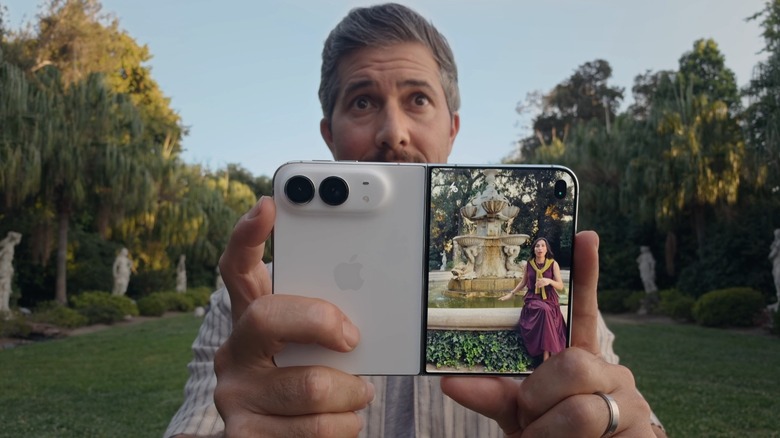
The ability to tent an iPhone Duo and use the 48-megapixel rear cameras shouldn't be undersold. While 18 megapixels — or just 12, on the Duo's internal Center Stage camera — is sharp enough, more megapixels can translate into sharper images or extra space for cropping. More importantly, it's always the rear sensors where Apple puts its best technology in terms of low-light sensitivity and focus tracking. Indeed, one of the smaller upgrades the company is touting is "smart" focus tracking, really a rebranding of the focus lock standalone cameras have had for some time. Once you tap on a subject, the Duo's AI systems will follow it and adjust focus on the fly, even if it temporarily leaves the frame.
There's a connection between that and the centerpiece of Apple's group selfie features: Smart Take. In theory, at least, this eliminates the need for timers by scanning for motion. When triggered, Smart Take automatically takes a snap whenever everyone freezes for a moment, the assumption being that they've adopted a new pose. This seems likely to take as many bad shots as good ones, given that people may have their eyes closed or be standing around waiting for direction. Nevertheless, it's a welcome alternative to selecting a timed shot, checking the results, then rinse and repeat.
You can find the Smart Take option in the Camera app's extended settings menu. Since iOS 27 finally lets you customize the app's controls — tap the in the lower-right corner, then — you should also be able to have a Smart Take button permanently at the ready, if you somehow find yourself taking group selfies on a regular basis. Naturally, this is useful for solo selfies as well; it's just that coordinated group shots are often the most difficult, as any pro wedding photographer knows.
The other big software addition is Duo Preview. When activated during a shot, this displays a real-time preview on the front screen, allowing the subjects to see themselves and make their own pose adjustments. Expect this to be a double-edged sword. Some people will inevitably ham things up, or do what they think works instead of what you actually want. Still, this is undeniably a step forward, to the point that some candybar iPhone owners may feel a little jealous.
You can expect a few limitations
There are some flaws in Apple's first-generation foldable selfies, beginning with the fact that there's no telephoto lens. Admittedly, most group shots are best taken with a wide or even ultra-wide lens. One of the chief rules of good composition, however, is to fill the frame with your subject(s). Sometimes you may not be able to sit your Duo close enough to make that happen.
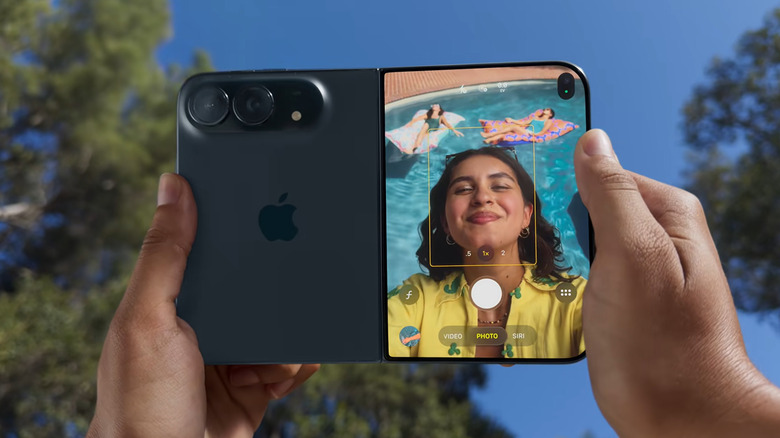
Another issue is handheld selfies. You're encouraged to open the Duo all the way and flip it around to get those 48-megapixel cameras, but the grip needed seems a little awkward, mostly because of the thin bezels on the front display. It could be tough to get a good handle without accidentally triggering touchscreen commands. To Apple's credit, though, this mode automatically brings all of the Camera app's controls to the front, so there's no blind shooting involved.
A big concern for some people with group selfies might be the vulnerability of a Duo left standing by itself. On top of the theft risk, we'll have to see how stable the Duo is in real-world situations. At 8.96 ounces, it's light enough to be tipped over by the wind or a nearby bump. Meanwhile, Apple's notion that some group shots should be taken with the front display touching the ground is going to be a non-starter for many users, probably, unless perhaps you buy a case that creates a protective lip. The Duo's Ceramic Shield 2 glass may be scratch-resistant, but no display is scratchproof.