Earlier this year, education researcher Lixiang Yan realized that students could outsource all of their work for his university course to artificial intelligence.
In praise of human teachers: universities must resist outsourcing everything to AI
Yan, who teaches at Tsinghua University in Beijing, China, was using an agentic AI called Codex to set up an online course on a learning-management platform. But it quickly became clear that the adept AI could independently complete all the assignments, answer questions and participate in discussions, “without the learner being intellectually engaged” at all, Yan says.
The experience made Yan think that teaching students to reason and think for themselves “is more critical than ever”, he says. And he is hardly alone. In a 2025 survey of more than 1,000 US faculty members, conducted by the American Association of Colleges and Universities, 90% said they thought that generative AI will reduce students’ critical-thinking skills. Around 20% of higher-education students who use AI said that they already find it harder to work through problems without it, according to more than 8,000 respondents to a global survey this year.
“Learning happens as a consequence of cognitive processing. Cognitive processing is typically effortful, and that’s what AI effectively removes,” says cognitive psychologist Daniel Willingham at the University of Virginia in Charlottesville. “People are really worried about that.”
And science — in which people need to critically evaluate theories and data — is one important area that’s under threat from the AI revolution in large language models (LLMs). ”There is a risk that students outsource precisely the activities through which scientific thinking develops: formulating hypotheses, interpreting evidence, considering alternatives and struggling with uncertainty,” says Thomas Nygren, who studies education and critical thinking at Uppsala University in Sweden.
But all is not lost. Specialists in education and cognition have been studying critical thinking and how to develop it for years, and some have useful tips on how to stay cognitively sharp in the age of AI. “The building of critical thinking and higher-order thinking skills have become even more important,” says Stéphan Vincent-Lancrin, who led a ten-year programme on critical thinking at the Organisation for Economic Co-operation and Development (OECD) in Paris.
What is critical thinking?
Ask five people to define critical thinking, and you’ll get five different replies. (I tried.) “Critical thinking is sort of the pinnacle” of human cognition, says Willingham. “It’s kind of a basket term that captures instances in which people are thinking well.”
Is AI ruining our skills? Early results are in — and they’re not good
One reason for the varied definitions is that the term is used widely in education and everyday discourse, but less by researchers who study cognition. Instead, they talk of separate high-level processes such as memory, reasoning, decision-making and problem-solving, which involve differing but overlapping mechanisms in the brain.
Some general strategies are common in critical thinking, say researchers. An important one is the ability to consider alternative possibilities or perspectives to our own — as a scientist would when weighing up different hypotheses.
But practising critical thinking requires skills and knowledge in the relevant domain — so being able to do it in one field doesn’t mean someone can in another. Neurologists, for example, are not particularly good at diagnosing cardiology cases, as one study showed1.
Is AI dulling this skill?
Concerns that students are intellectually under par are not new. In 1983, a report by the US National Commission on Excellence in Education warned that many 17-year-olds lacked “the ‘higher order’ intellectual skills we should expect of them”.
Over the past few decades, critical thinking has become a goal in many education systems, says Vincent-Lancrin. It is now considered an educational priority by the United Nations cultural organization UNESCO and is part of school curricula in almost all OECD countries. He points to the example of a course in which students investigate the causes of type 2 diabetes, revising their ideas as they learn about different perspectives, such as the contributions of genes and environmental influences to the disease.
But this doesn’t mean the goal is being met. “There’s not much reason to think we were doing a fabulous job” of teaching critical thinking in the past, says Willingham, gloomily, “and now AI has come in and wrecked everything that we had achieved” for students today.
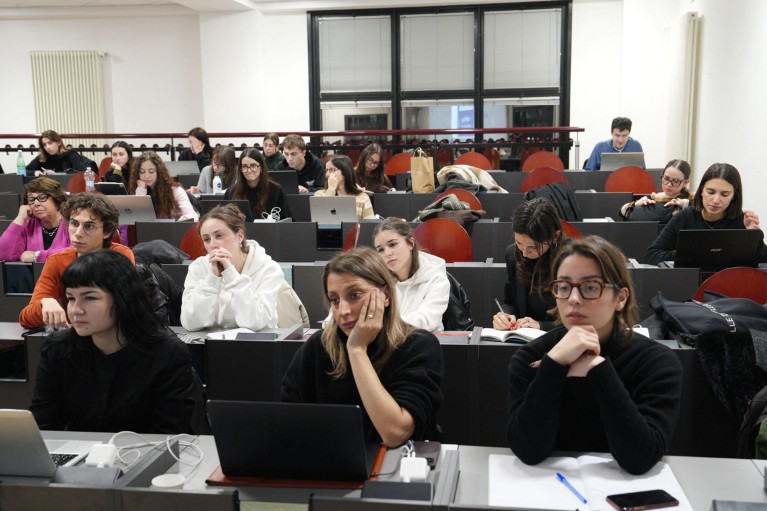
Teachers in schools and universities are brimming with stories of students who, they say, are poor at problem-solving and evaluating information themselves because they’re outsourcing the work to AI. And some research supports the idea that AI can erode skills.
A 2024 study found that secondary-school students were better at solving mathematics problems when given access to a ChatGPT-like generative AI — but after it was taken away, they performed worse than those who never had access to the tool2.
Overall, research does not yet show clearly what impact generative AI is having on learning and critical thinking. This is because AI tools are relatively new and varied, the studies so far are conflicting, and too few rigorous or long-term studies have been done, researchers say3. “Tools can help but can also have a negative effect,” says Yan, who has assessed the literature. “It’s actually in both directions.”
Some studies suggest that AI tools can help people to learn if, rather than supplying ready-baked answers, they give feedback or tasks that encourages students to think and problem-solve. “It’s about how we structure the task,” Yan says.
But Willingham and Yan acknowledge that people tend to seek quick answers rather than using AI in ways that demand hard work. When Yan asked students to use an AI designed to prompt their own thinking, he saw some of them shut it down and switch to ChatGPT instead. “It’s a bit shocking, but that’s the truth, right?” he says.
Future research might help. In June, the Education Endowment Foundation (EEF), a non-profit research organization in London, announced that it would spend up to £2.5 million (US$3.4 million) on rigorous studies to investigate the impacts of generative AI on learning, understanding, memory and problem-solving.
“It’s good someone is doing these studies,” Willingham says — although he still expects the outlook to be grim. “It’s going take a while before you see this slippage, “he says, “but the slippage feels pretty inevitable.”
How do you teach critical thinking?
The fact that critical thinking differs between domains is one reason that teaching it is hard, say researchers. “It’s not generic and free-floating — you have to teach it within specific subjects,” says educational psychologist Paul Kirschner, who is at the Open University of the Netherlands and based in Heerlen. This means giving people the specific knowledge and reasoning skills needed in that field.
In history, thinking critically might involve corroborating records and artefacts, he explains, whereas doing so in science could require an understanding of the relationships between theory, hypothesis, method and evidence.
A second problem is that critical thinking often involves recognizing reasoning strategies in the abstract, and that’s hard. For instance, a student might learn in class about the difference between correlation and causation — but then fail to recognize one being mistaken for the other the next time they see it in the real world.
Willingham therefore recommends that teachers work out the reasoning skills that are most important, embed them in curricula and ensure students get plenty of practice, including on problems of different types. Another important aspect, says Kirschner, is having a coherent curriculum that builds knowledge, skills and critical thinking across different subjects and through the years.
The OECD project led by Vincent-Lancrin was one of the biggest efforts — involving some 800 schoolteachers — to scrutinize critical-thinking instruction in schools and develop and test materials, such as example lesson plans and syllabuses.

Are the Internet and AI affecting our memory? What the science says
Vincent-Lancrin acknowledges that there is not much rigorous evidence on what works best to teach critical thinking. That’s partly because the skills are harder to measure in a standardized way — which is necessary to test whether a strategy is working — than are mathematics or reading skills. The OECD is now working with an education company called Macat, in London, to develop a standardized assessment of critical thinking for secondary-school students and undergraduates.
Enjoying our latest content?
Log in or create an account to continue
- Access the most recent journalism from Nature's award-winning team
- Explore the latest features & opinion covering groundbreaking research