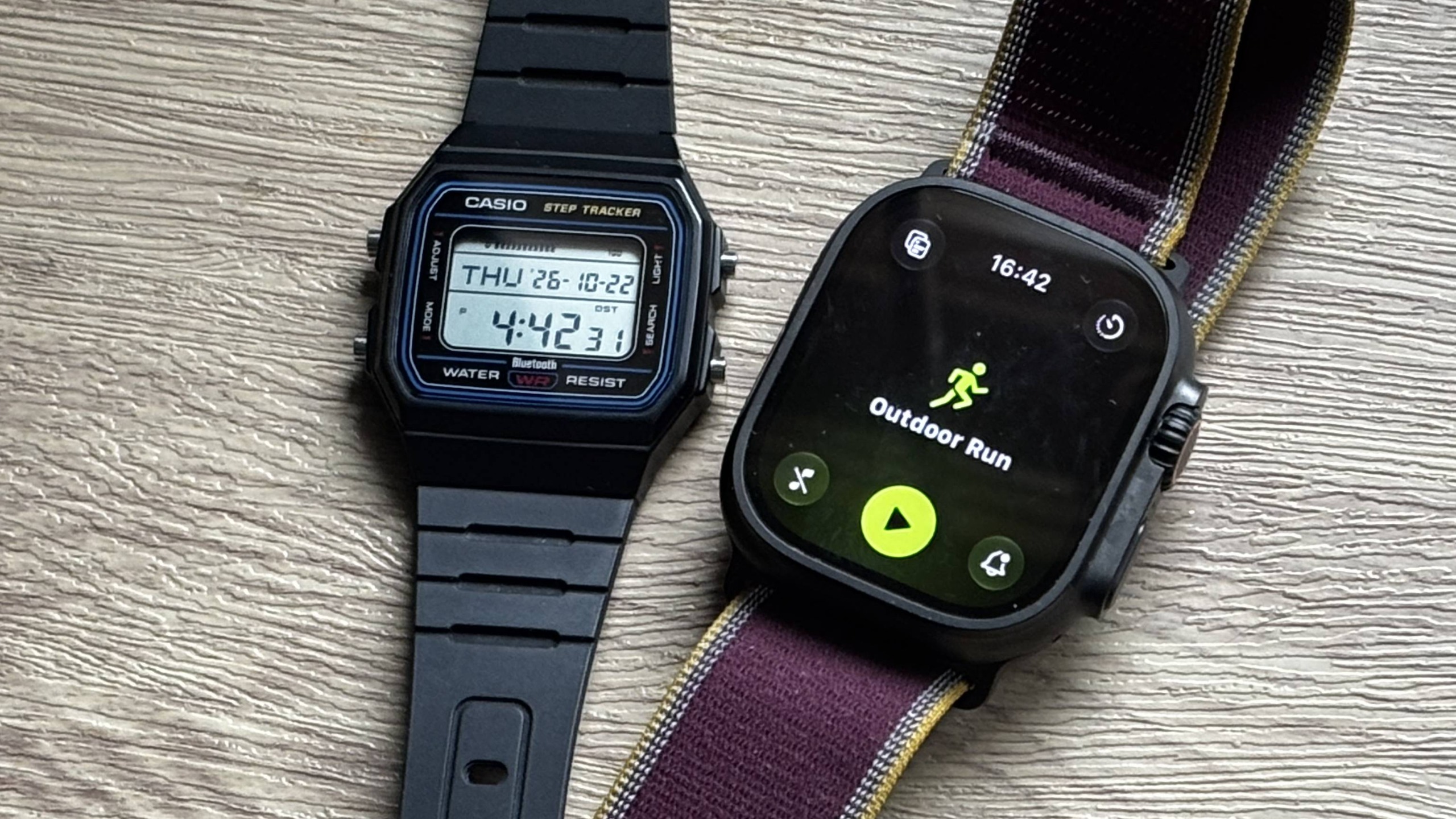
If you've been following TechRadar's fitness coverage over the last couple of months, you'll have heard about the Casio F-B100W.
It's a cheap Bluetooth digital watch — ($65 / £55 / AU$119) and despite looking very similar to the classic, extremely cheap F-91W, it's got some differences. It's a little bit bigger, it's got an additional button, a dual time-zone mode, and, crucially for our purposes, a few smart features thanks to its Bluetooth capability: Find My Phone, and a step tracker.
This stripped-back approach to smartwatches is great for people who are looking to increase their activity levels, but don't want to pay for a smartwatch or use all the bells and whistles of a full-fledged fitness tracker. In fact, it reminds me of the very first Fitbits, which were simple pebble-shaped Bluetooth-enabled step trackers that clipped to your clothes.
I had a lot of fun with this watch, as I loved the retro styling, and it had just enough smarts to be useful. As a perpetual phone-misplacer, Find My Phone functionality is an essential for me for any smartwatch, while the most basic movement-based metric of step tracking remains useful even today. In the app, your step counts are broken into bar charts over a week, month or year to analyze trends.
But, considering the extraordinary cheap price of the watch, I was wondering how accurate it could be. So I decided to test it against this year's best smartwatch, the Apple Watch Ultra 4. The Ultra 4 costs $799 / £749 / AU$1,349, a far cry from the cost of the Casio, and is equipped with top-of-the-range fitness metrics for every eventuality.
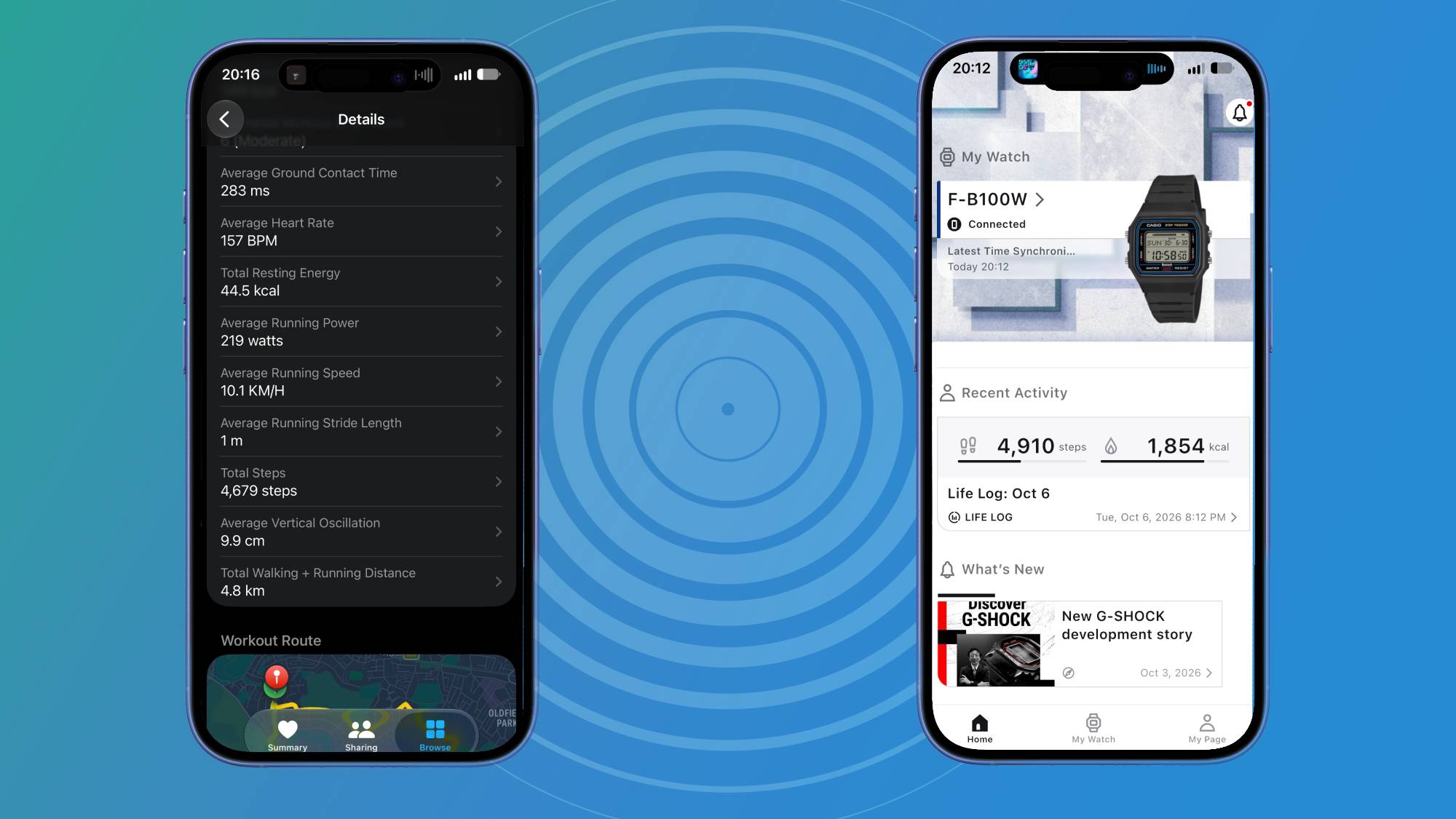
To start with, it's worth noting that I can't separate the Casio's daily step counter into a specific workout, so by the time I'd strapped both watches on, and gone up and down the stairs putting my shoes on, finding my keys and earphones, and stepping out to the starting point of my run, I had already walked 269 steps, and that was reflected in the Casio's score. Not the best start to the experiment.
However, after the run was complete, I checked the scores on both apps immediately. Once the Apple Watch's workout was marked as 'complete' it stopped tracking my steps, so I didn't want to make the same mistake again and inflate the Casio's score. The moment I finished my workout on the Apple Watch, I screenshotted both apps.
And I was impressed. The Casio recorded a score of 4,910 steps. Minus my initial 269 steps, that leaves us at 4,641 steps in total for the Casio F-B100W.
The , a difference of just 38 steps. That's a teeny margin of error for two completely different watches in two completely different price brackets, operating solely on estimations from their onboard sensors, and I'm thrilled with this result.
What does this mean in practice? It means that if all you're interested in is tracking your steps, and you like the retro digital watch vibe (after all, retro tech has been making a comeback for a while now) I can say that the humble Casio F-B100W was just as good a step counter as the most expensive Apple Watch on the market, and I can double-down on my recommendation. It's a great watch.
Admittedly, it doesn't have the other advanced metrics of the Apple Watch (or any other metrics, for that matter), but this test was an exercise in testing the Casio step counter's quality, not objectively comparing the two watches — and it passed that test with flying colors.

Matt is TechRadar's expert on all things fitness, wellness and wearable tech.
A former staffer at Men's Health, he holds a Master's Degree in journalism from Cardiff and has written for brands like Runner's World, Women's Health, Men's Fitness, LiveScience and Fit&Well on everything fitness tech, exercise, nutrition and mental wellbeing.
He is the author of the upcoming book , set to be published by Bloomsbury in 2027. When he’s not training or writing about health and fitness, he can be found reading doorstop-thick fantasy books with lots of fictional maps in them.