The problem
A few months ago, I started a PhD at a university in North America. I have a disability that affects both my physical and my mental capacity, and its impact on me fluctuates. The more I can rest, the fewer symptom flare-ups I experience.
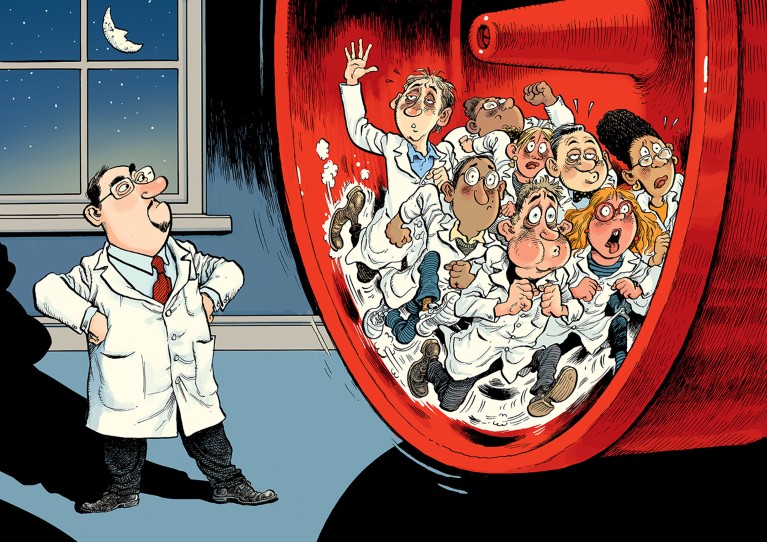
Unfortunately, my laboratory has a severe problem with overwork. Most students work 50–60 hours a week and sometimes more. We’re constantly asked to take on new tasks for the projects of our principal investigator (PI), often with tight deadlines. I’ll go into the lab intending to work on my experiments and end up spending all day on my PI’s tasks.
My PI, to whom I have not disclosed my health status, has repeatedly expressed disappointment in my work ethic. I have worked in other labs with different supervisors without facing issues (during my master’s degree, for example), and I know I’m not the only person struggling in this environment: my lab-mates are also burnt out.
Many of my issues are tied to being unable to take breaks while working long hours, often 12–16 hours per day for several days in a row. In previous jobs in which my colleagues and I worked overtime, we could take the equivalent amount of time off either the following week or as holiday time. But in my current lab, we’re expected to come back to work immediately. Sometimes we’re called in on weekends. I can barely keep up because I’m given no time to rest. A task that would take me an hour now takes longer because I’m fighting through pain. When I asked for time off, I received a firm no.
I’m nervous about what I might face in the rest of my programme. I know that I can have the success I want if I find the right environment. I plan to seek accommodations by contacting someone at my university. But should I disclose to my PI? I fear it might make things worse, and that I will face disability stigma. What can I do to make sure myself and other students are well cared for and protected? — A disabled graduate student
The advice
“Disability stigma contributes to power imbalances between graduate students and advisers,” says Bonnielin Swenor, director of the Johns Hopkins Disability Health Research Center in Baltimore, Maryland. That stigma is evident from discrepancies in earnings1 and grant outcomes2 between disabled and non-disabled researchers in science, technology, engineering and mathematics (STEM) fields, according to her research on US scientists. Understandably, then, “taking action can feel intimidating, and many disabled scientists fear retribution”, she says.
“What you describe is not a personal failure of work ethic,” emphasizes Deepti Sharma, a management researcher at Ahmedabad University in India. You’re in a dysfunctional work environment, in which “your disability made the dysfunction visible to you earlier and more painfully than it did for others”.
Nature’s careers team asked Sharma, Swenor and two other researchers for advice on how disabled graduate students and other people facing similar challenges can protect themselves.
Assess university resources
Rebecca Williams, an environmental-law researcher and disability officer at the University of Glasgow, UK, says that there should be staff members who can offer support to students. She recommends investigating what resources are available at your university. These could be from a graduate-student union, a director of graduate studies or university disability services.
In many regions, there is a legal duty not to discriminate against people with disabilities, Williams adds. She also suggests checking whether your university offers any grants or other financial support for the resources that you might need. One source of guidance could be the Job Accommodation Network, a US website providing information on workplace accommodations.
Sharma distinguishes between formal and personal disclosure: “Registering with your university’s disability-services office is a formal, documented process that establishes the accommodations you are entitled to.” At most institutions, the office should inform supervisors only of the accommodations required, not the diagnoses that prompted them. “Personal disclosure to a PI is a separate, discretionary act,” says Sharma, who strongly encourages formal registration as a first step. “Regardless of what you decide about your PI, informal goodwill evaporates under pressure, while documented accommodations do not.”
Williams recommends pausing before deciding whether to approach your PI: “You may want to wait until you have a better sense of your new PI’s supervisory style before you decide how much or little you want to disclose beyond the accommodations that you need.”
To make best use of institutional resources, all four disability advocates stress the importance of documentation. “Keep written records such as e-mails confirming verbal instructions and notes on refused leave requests,” advises Sharma. “Patterns documented over time carry far more weight with a department than any single complaint.” Doing this could also help other students who face similar issues with your PI.
Swenor notes that “keeping detailed records of e-mails and interactions in which disability discrimination occurs is often necessary. As with any form of discrimination, this information provides the needed support if or when you choose to file a complaint or grievance,” she says. “It is also essential to understand your rights and legal protections.”
But, she cautions, keeping a record is only one step. “Formally documenting your needed accommodations does not eliminate bias or discrimination,” she says.
Connect with others
Sharma suggests “building a support structure outside your supervisor’s control: a thesis committee member you trust, a mentor in another department, peers in your cohort”. This support structure could include your head of department or, if it exists, a staff disability network that can connect you to supportive staff members or graduate students who might have relevant lived experience, says Williams.
“Disability in academia is often about finding ‘your people’, who understand what it is to manage health difficulties,” notes Williams, who has written about her own experiences of dealing with chronic illness in academia. “Sometimes finding people that ‘get it’ will help you feel less alone during the process of your PhD, and gauge what a realistic daily or weekly PhD routine might be for you.”
Enjoying our latest content?
Log in or create an account to continue
- Access the most recent journalism from Nature's award-winning team
- Explore the latest features & opinion covering groundbreaking research