As communications, computing, virtualization, software development, and AI converge, smaller technology firms face customers who need expertise across multiple layers at once. Synchresis Solutions works across all of them. Its SynchresisVM project provides a management plane for KVM and bhyve with a REST API, standard disk formats, shared storage, and a migration wizard for organizations moving from Proxmox, Hyper-V, or VMware, all without per-socket pricing or proprietary lock-in.
As organizations become increasingly dependent on interconnected digital systems, the boundaries between communications, computing infrastructure, virtualization, software development, and artificial intelligence are becoming less distinct. For smaller technology firms, that environment can create an unusual challenge: customers may need expertise across several technical layers at once, while the systems themselves continue to become more specialized.
Synchresis Solutions, a technology company founded as a commercial business in 2023, operates within that broader shift. Its work spans communications infrastructure, server environments, virtualization, web development, technical support, infrastructure as a service, and AI-related technology. Rather than being defined by a single product category, its development reflects the increasingly multidisciplinary nature of managing modern IT environments.
The company’s origins predate its commercial formation. Founders Nick Giannak III and David Quinn Ebert initially connected through technology and volunteer internet-radio projects. Their collaboration expanded into web products and an internal telephone system between 2018 and the pandemic, eventually developing into work for paying customers. Doron Beit-Halahmi, known as Doc, later joined the group through connections formed in internet-radio and audio communities.
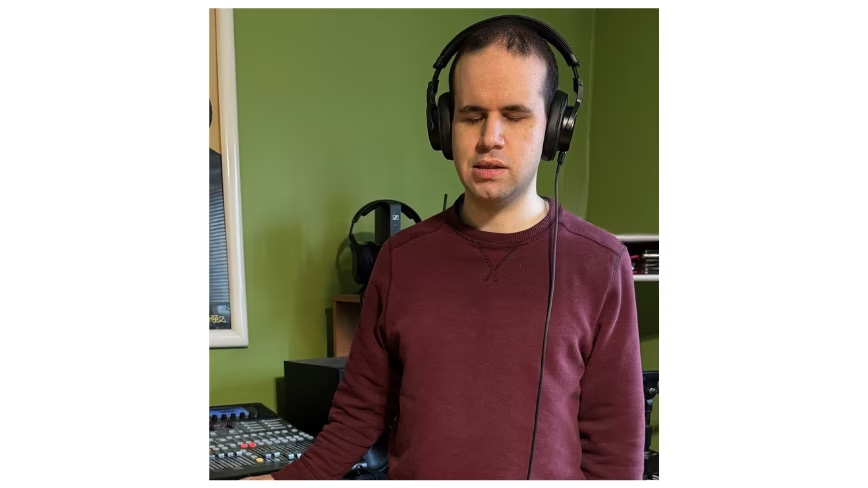
That background helps explain the breadth of technical interests within the company, but it is distinct from Synchresis Solutions’ formal operating history. The founders brought years of individual experience in areas including broadcasting, telephony, server administration, hosting, corporate IT, and systems engineering before the company began serving customers commercially.
For Giannak, that experience has reinforced the value of understanding technology beyond its individual components. “We’ve always been people who enjoy figuring out how things work,” he says. “Our culture at Synchresis has been built through years of hands-on experimentation and shared projects.” His background includes technology, audio engineering, broadcasting, and projects examining the relationship between technology and society.
Ebert’s background includes telephony, data centers, hosting, Linux, Windows, UNIX-derived systems, and IT infrastructure. His perspective similarly emphasizes the relationship between technical systems and the organizations using them. “The customer is where the technical conversation has to begin,” he says. “You have to understand the problem they’re trying to solve before you can decide what the technology should do.”

That approach becomes particularly relevant as infrastructure becomes more interconnected. A voice system can depend on networks and servers. A virtual machine can depend on storage and networking. Software development can depend on the infrastructure underneath it. As those relationships multiply, technical decisions in one area can affect systems elsewhere.
Virtualization is one example. The founders’ experience with virtual-machine environments extends back more than 15 years, predating the establishment of Synchresis Solutions itself. That distinction matters as organizations evaluate how much of their virtualization strategy should depend on particular platforms, operating systems, or management layers.
The company’s SynchresisVM project addresses that question through a management plane for KVM and bhyve. It provides a common interface and REST API for managing virtual machines across Linux and FreeBSD environments. Guests can be created, assigned disks and networks, started, and moved between nodes through API calls, allowing administrative processes to be incorporated into scripts and operational runbooks.
The underlying approach is also notable for its reliance on standard technologies. SynchresisVM uses qcow2 disk images, VirtIO devices, and Linux bridges, without placing proprietary components in the data path. It can operate on Linux or FreeBSD hosts that organizations already administer, with KVM or bhyve managed through the same interface.
The platform also supports shared storage, centralized guest definitions, and automated placement across a cluster. These capabilities address practical questions that arise as organizations manage multiple hosts, including where workloads should run, how they can be moved, and how much manual configuration is required when infrastructure changes.
That architecture reflects a broader discussion in infrastructure management: how much control organizations should retain over the systems they operate, and how portable their workloads should remain when technology requirements change. SynchresisVM is designed as software that organizations can run on their own infrastructure, without per-socket pricing or a separate vendor appliance.
Migration is another consideration. Organizations moving from platforms such as Proxmox, Hyper-V, or VMware may need to account for existing virtual machines, disk formats, networks, and configurations. SynchresisVM includes a migration wizard intended to assist with that process, while its use of standard disk formats is designed to keep virtual-machine storage accessible outside the management platform.
The same infrastructure perspective extends into communications. Synchresis works with cloud PBX systems, enterprise SIP infrastructure, cloud fax, and VoIP environments, alongside conventional server and network infrastructure. In practice, these systems frequently overlap. A problem that appears to involve voice service, for example, can also involve networking, server configuration, virtualization, or hosting architecture.
AI represents another emerging layer of that environment. The founders’ earlier technical work included software and language-related applications, but that history should not be conflated with a long-standing track record in today’s large language models. More recently, AI tools have become part of the team’s software-development and experimentation processes, alongside broader work in automation and technical systems.
For a small technology company, this breadth can create both opportunities and constraints. Maintaining expertise across several infrastructure layers requires continuous learning as platforms, standards, and development methods change. It also places greater importance on understanding how individual systems interact, particularly when organizations are maintaining infrastructure assembled over many years.
Synchresis Solutions therefore offers a window into a broader development in the technology sector. Smaller firms are increasingly operating in an environment where communications, virtualization, software, infrastructure, and AI cannot always be considered separately. The technical challenge is not simply adding another tool, but understanding how those tools fit within systems that organizations already depend on.
For Synchresis, that process began with hands-on experimentation among its founders and has developed into commercial work spanning several areas of infrastructure. As technology environments continue to evolve, questions surrounding portability, interoperability, ownership, and operational control may remain relevant well beyond any single platform or company.