What we usually call "speed" isn't what you might expect.
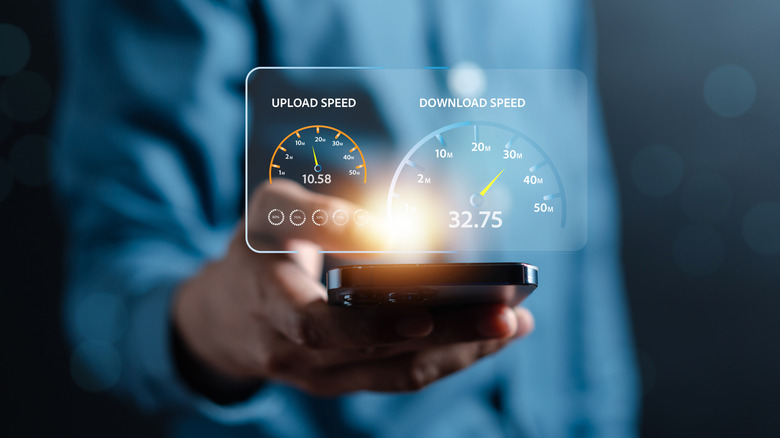
Understanding the differences between internet speed and bandwidth can be confusing, given that internet service providers (ISPs) typically sell bandwidth as "speed" and use both terms interchangeably. Also, both are measured in megabits per second (Mbps) and gigabits per second (Gbps), making it even less clear which is being referenced. Knowing exactly what these terms refer to and what role they play in the quality of your internet connection will help you make better choices when selecting an internet plan for your home.
Internet speed, in a nutshell, is the amount of data your network sends and receives at any given moment. Bandwidth is the theoretical maximum capacity of data your connection can carry per second. Your bandwidth sets the ceiling for your internet speed; it can get close to the bandwidth but never go past it.
Understanding bandwidth
Think of your internet connection like a highway. Your bandwidth sets how many lanes it has, while internet speed is how many cars reach their exit each second. The number of lanes determines how many cars can pass at a time; if too many try to use the road simultaneously, it'll cause a traffic jam and lead to a slowdown. Bandwidth works the same way: it's your internet plan's total capacity. When the activity on your network exceeds that capacity, it causes a slowdown because the data from your devices doesn't have enough space to move freely.
Say your internet plan caps out at 100 Mbps. If three people are streaming 4K movies on Disney+ (25 Mbps each), another person is on a video call and a fifth is downloading a large game update, your network is pretty much maxed out. The streams alone use 75 Mbps, video calling uses around 4 Mbps and the game update will take up whatever's left. At that point, the streams may start to buffer or lower their resolution and the video call may freeze. Nothing went wrong with your connection; your household simply hit the plan's ceiling.
Unlike internet speed, bandwidth is not something you test. It's a fixed capacity that's determined by your internet plan and connection type. Fiber generally offers the highest bandwidth, while DSL and traditional satellite services (newer satellite internet options like Starlink are much faster) offer the least. Confusingly, bandwidth is what is usually advertised in internet plans and marketed as "speed."
Internet speed explained

What most people refer to as internet speed is actually throughput. It's the rate at which data reaches your device at any given moment. Using the highway analogy, a superhighway with 12 lanes should, in theory, allow a certain number of cars to reach the exit at once. But in reality, factors including a narrow exit ramp (your Wi-Fi or router) and rush-hour traffic (network congestion) reduce how many cars actually make it.
Relating this back to the above: bandwidth is the maximum capacity available to you, but when you factor in slowdowns, what actually reaches your device is the throughput (internet speed). So when you run a speed test to measure your internet speed, the number it shows is your throughput, which can never exceed your bandwidth.
Meanwhile, latency is how long it takes for data to move from your device to the server that holds the information you're fetching and back. The farther the server (physically), the higher the latency. This is why a connection can feel sluggish even when downloads are fast. This delay is measured in milliseconds (ms), and in tests it shows up as ping (lower is better).
Using the highway analogy again, latency is how long it takes a single car to complete a round trip. Adding more lanes lets more cars make the trip, but it doesn't shorten the distance. Latency is especially important in online gaming and video calls because they rely on real-time data.
Network congestion can increase latency because every device has to wait its turn. Also, your internet connection type affects ping. For example, fiber internet generally offers lower latency than traditional satellite internet; a wired connection has much less delay than traveling thousands of miles to an old-school satellite and back.
Why more bandwidth won't always make your internet feel faster
A new higher-bandwidth plan isn't always the right solution for sluggish internet, because sometimes bandwidth isn't the issue. If you're a gamer or make a lot of video calls and experience poor performance, you're likely dealing with a latency issue. To improve that, try using an Ethernet connection. Gamers should always connect to the closest server available. If you're willing to pay and it's available in your area, switching to fiber can yield significant improvements in this department too.
If your network constantly has congestion issues, that could be reason to upgrade your plan. But before you make a purchase, use Waveform's bufferbloat test to confirm congestion is actually the issue. Also, walk through the speed-boosting settings available on your router, like the Quality of Service (QoS) function. QoS tells your router which devices and apps to prioritize in times of network congestion.
Lastly, if speed tests consistently give results far below your plan's bandwidth even when there's no congestion, then your Wi-Fi router, not your bandwidth, is likely the bottleneck. Bandwidth in your Wi-Fi router's settings refers to channel width and is measured in MHz, not Mbps. The wider the channel, the more data it carries, but that makes it more prone to interference from other Wi-Fi networks and devices. If you can't use Ethernet, use the 5GHz band (or 6GHz if available) for faster wireless performance.