If I handed you the new iPad mini, you might not immediately notice how different it is compared to the 2024 model. At first glance, it has a similar enough physical impression and display, and its aluminum unibody and glass front are just as solid as ever. This year, you can only get the iPad mini in the all-business "midnight" and "starlight" shades, which is a bit of a bummer. But there are nips and tucks throughout that add up to a refreshed experience. While the iPad mini still has relatively large display bezels, they're noticeably thinner than before thanks to the 8.5-inch screen Apple included (compared to the 8.3 inches on the prior mini). Apple also reduced its thickness from 6.3mm to 5.4mm, and its weight from 0.65 pounds to 0.56 pounds (or 0.66 to 0.58 for the cellular-enabled models). More screen in a thinner and lighter package is always a win, and Apple has come the closest it ever has to making an iPad that you can truly carry with you everywhere without thinking about it.
While those physical tweaks are small but welcome, the new display tech is more significant. The iPad mini's OLED screen offers twice the peak brightness when viewing HDR content at 1,200 nits, while SDR brightness has been slightly increased from 500 to 600 nits. It can also go all the way down to 1 nit minimum brightness. And thanks to OLED, blacks look exceptionally black and overall contrast is excellent. It has a 2,000,000:1 contrast ratio, which far surpasses what you'll get on an LCD like the older iPad mini used (Apple doesn't specifically list the contrast ratio for older iPad mini models, but its recent LCD screens are in the 1000:1 range).
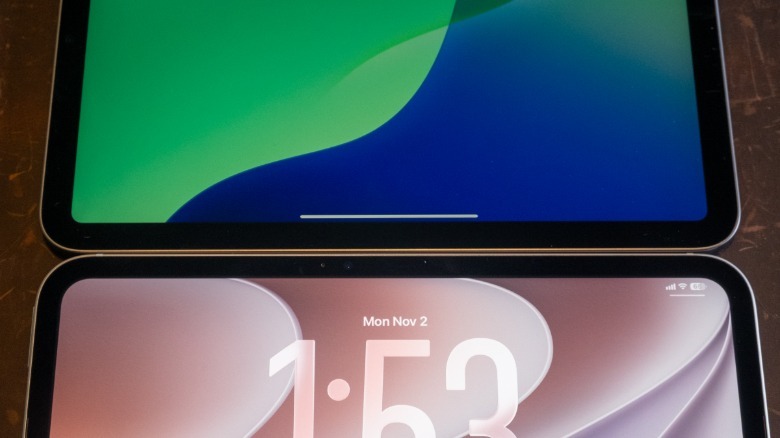
What this means in practice is that the iPad mini is an even better portable cinema than ever. If you're going to use this tablet to watch movies on the plane, it's a notable upgrade. It's not the most technologically advanced OLED screen you've ever seen, but its dark blacks, HDR performance and excellent overall contrast makes even dimly-lit scenes much sharper than what you'll get on an LCD-equipped iPad mini. You'll notice this the most when watching video, but it makes everything you do with the iPad mini, whether that's playing games or just browsing the internet, look much more visually appealing.
One place where I will ding this screen is its refresh rate: Apple stuck with 60Hz here, compared to the 120Hz "ProMotion" screen on the iPad Pro. It's pretty evident at this point that a high refresh rate screen is going to be limited to the iPad Pro, but it's still a bit of a let-down — especially when you consider the fact that the iPhone 17 got a ProMotion screen in 2025. That said, the smartphone market is far more competitive than the tablet market, so while Apple may have felt the pressure to finally put a high refresh rate screen in the standard iPhone, that still isn't the case on the iPad.
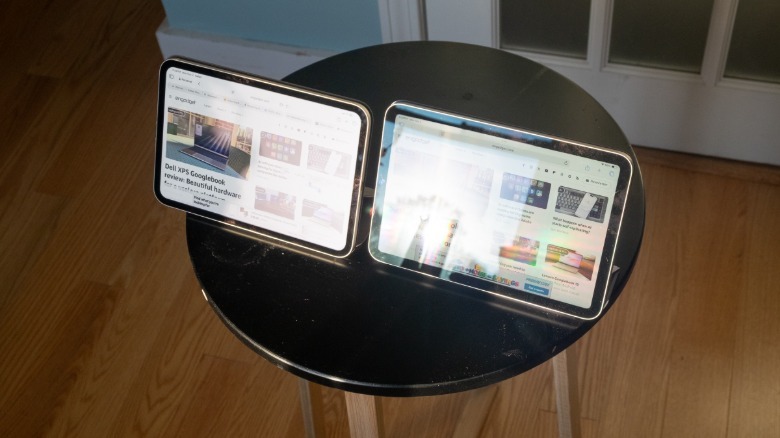
The iPad mini I tested also has a nano-texture glass front. The timing for trying this was impeccable, as I just reviewed Amazon's new Alexa Tablet 12 Pro, which also has a "nanomatte" display that was lovely to use. The etching on the glass front scatters reflections in a way that makes the iPad mini much easier to use when there's a bright light source nearby. And while the Alexa Tablet sticks with an LCD, the combo of OLED and the nano-texture glass made for an exceptional viewing experience here.
As you can see below, the new iPad mini with its nano-texture glass disperses strong light, while the one on the right with standard glass is a mess of reflections as the sun was setting.
As is typical, but still unfortunate, the nano-texture option costs a pretty penny. It's not an option on the base iPad mini with 128GB of storage, so you'll need to spend at least $899 to get the 256GB model with the nano-texture glass (or $1,049 for 256GB, nano-texture and 5G connectivity). That's a of cash for an iPad mini, no matter how nice it is.
Other subtle tweaks include the new "Acoustic Display," which Apple says places tweeter and woofers beneath the display enclosure for improved audio performance. This also allowed Apple to remove the speaker holes on either side of the iPad mini so that it could achieve that IP67 dust- and water-resistance rating.
I remember being surprised at the iPad mini's audio performance when I reviewed it in 2024 — it wasn't something I wanted to listen to for long periods of time, but it was definitely better than I expected given the small space Apple has to work with. Well, the new Acoustic Display speakers are another step forward, with a much stronger bass presence and overall more pleasing audio profile. The older iPad mini now sounds positively tinny by comparison. It's not the kind of thing that's going to radically change how you use the device, but it's a nice quality of life improvement.
The same can be said for the front-facing camera, which is now located on the landscape edge of the iPad mini. It's the same 12-megapixel Center Stage camera that most iPads use, but at least if you use a case like Apple's Smart Folio, the iPad mini's camera will be properly lined up for a video call. Like all other iPads except the Pro, though, that camera doesn't support Face ID. You'll need to use the Touch ID power button (or a numerical PIN) to unlock the iPad mini.