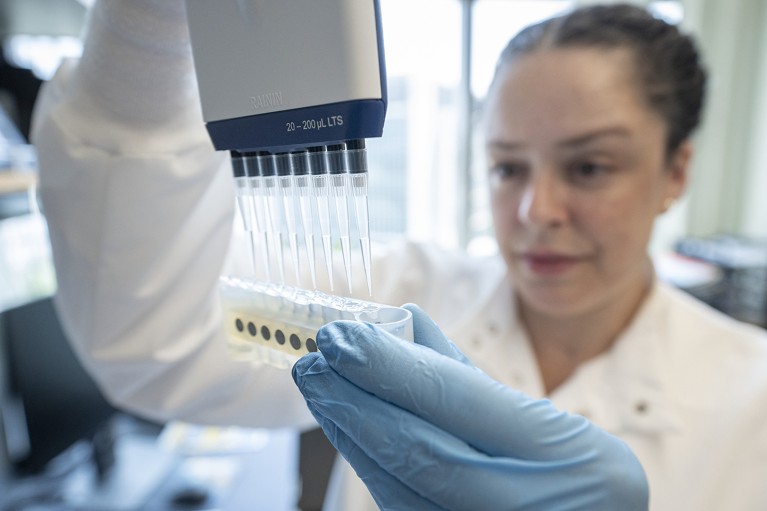
The year is 2050. During routine medical visits, patients provide blood and urine samples, their postal code and a description of their lifestyle and habits. The samples are analysed to detect nutrients and pharmaceuticals that the person has consumed, the bacterial and viral infections they have had and any chemicals they have encountered. Their location reveals key details about air pollution, noise and chemical exposure. By combining this information with the individual’s genome details, clinicians will be able to swiftly tally unique disease risks — as well as the actions or treatments that can best slow, or even quell, disease progression.
That’s the future that exposome researchers are working to create.
The exposome is the sum of environmental exposures and lifestyle factors that, in concert with genetics, shape the risk of a person developing many common conditions, including cancer, heart failure, diabetes and dementia. The term was coined in 2005 by Christopher Wild, a now-retired cancer epidemiologist at the International Agency for Research on Cancer in Lyon, France. He described a “desperate need to develop methods with the same precision for an individual’s environmental exposure as we have for the individual’s genome”1.
Environmental exposures are responsible for between 70% and 90% of the risk of developing chronic disease2. “Genetics load the gun, but the environment pulls the trigger,” said Francis Collins, former director of the US National Institutes of Health (NIH) in Bethesda, Maryland. Exposures can turn certain genes on or off, and these epigenetic changes can result in disease. For example, tobacco smoke can silence tumour-suppressor genes, increasing the risk of cancer.
Each individual’s exposure and genetic profile shapes their unique disease risks, and researchers say it is time to fill in the missing details. “If one does not address lifestyle factors, diet, medications, environmental exposures and other factors, care is not personalized,” says Gary Miller, director of the Center for Innovative Exposomics at Columbia University in New York City.
Exposomics research, however, is no small task. Any rigorous endeavour must offer a comprehensive assessment of as many non-genetic disease factors as possible. And understanding these will require researchers to collect and collate data from various sources, including biobanks and long-term cohort studies; surveys of diet, medications and physical activity; and environmental data sets such as geospatial models of air pollution.
Some exposures can be measured using biomarkers including sugars, proteins or chemical-breakdown products in the blood or urine that link biological changes to environmental triggers. “The signatures of past exposures stay in the body,” says Miller. Persistent organic pollutants, for example, leave a signature in fatty compounds called lipids in the blood. Smoking adds chemical tags, or epigenetic markers, to DNA, and these persist even if someone has not smoked for 30 years.
Advances in high-throughput mass spectrometry — a technique that allows scientists to analyse a large number of samples — have made it easier than ever to track proteins and metabolites in blood samples. This can be used alongside transcriptomics data, which shed light on the active genes in cells, to tease out and validate biochemical markers of disease from the cocktail of exposures.
Personalized CRISPR therapies could soon reach thousands — here’s how
Exposomics has its sceptics and misconceptions. Some critics suggest, for example, that it is simply a new term for an old discipline, environmental epidemiology (a field often focused on the impacts of individual exposures). Others say it is impossible to measure the totality of human exposures. Regardless, enthusiasm for exposomics has surged over the past decade. Searching the PubMed literature database for ‘exposome’ reveals that at least 830 papers have already been published this year, up from 261 in the whole of 2020.
Scientists are coordinating efforts to develop much-needed standards and protocols, and to create the capacity to continuously monitor dynamic exposures. Kyle Walsh, director of the US National Institute of Environmental Health Sciences in Research Triangle Park, North Carolina, says that there is growing enthusiasm at the NIH to fund a multi-year, multimillion-dollar Human Exposome Project, a comprehensive molecular-level assessment of the full suite of exposures to identify the most important drivers of disease.
If exposomics succeeds, it promises to usher in a new era of precision medicine — and precision prevention.
A quantified world
In March, Chirag Patel, an exposomics researcher at Harvard Medical School in Boston, Massachusetts, and his colleagues published one of the largest studies yet to match exposures with disease risks3. The team compared 619 markers of exposure, ranging from blood mercury content to vitamin B12 levels, with 305 measurable characteristics, including lung function and blood sugar level, using data from ten cohorts of the 55-year-old US National Health and Nutrition Examination Survey. Taken individually, environmental exposures accounted for less than 1% of the variation in disease outcomes, but that increased to an average of 3.5% when the researchers combined the effects of 20 exposures. It might not seem like a huge difference, but this figure rivals the predictive power of genetic variants that influence disease — and affirms the need to study real-life exposures to improve disease management, says Patel.
For example, 43% of participants’ triglyceride levels, a predictor of cardiovascular disease, were explained by a unique combination of 20 exposures — including trans fats and polychlorinated biphenyls. Advanced cellular ageing — structural or molecular damage to cells — was most strongly associated with smoking, minimal physical activity and exposure to heavy metals.
Patel says the next step is to find ways to narrow down which exposures are meaningful — the ones that perturb a biological pathway. If the link between environmental exposures and changes to biological pathways can be found at a population level, those results could be used to predict outcomes at an individual level, he says. A population study linking a cell mutation to an air pollutant could be used to identify people at risk of lung cancer, for example.
Personalized gene editing helped one baby: can it be rolled out widely?
This is where biobanked samples and cohort studies can prove pivotal. Walsh suggests that the All of Us programme, an NIH initiative to collect health data from more than one million US volunteers to accelerate precision medicine, is an obvious starting point for a Human Exposome Project. All of Us has so far enrolled 883,000 participants, making it the world’s largest integrated genomic and electronic health record database. It houses more than 600,000 physical measurements and 747,000 responses to surveys about social circumstances, behaviour and environment.
The fundamental challenge is to connect all the dots to understand how that information translates into an individual’s disease risk. “It’s a data-analysis problem,” says Walsh. But he says it will become much more tractable courtesy of artificial-intelligence tools.
High-resolution mass spectrometry on blood or urine samples typically returns a spectrum with 10,000 to 100,000 distinct peaks. Identifying — and quantifying — which chemical compounds correspond to the peaks is one of the biggest bottlenecks in exposomics. However, machine-learning models can sift through the data to decode them with ease. Furthermore, they can predict adverse biological effects from a chemical’s structure, which will allow researchers to include as-yet-unknown chemicals in disease-risk assessments.
As AI tools are adopted, researchers are eager to increase the scale and scope of projects. Miller predicts that in the next three years, scientists will conduct a state-of-the-art exposomics study using data from around 100,000 people. “If we did that across ten major human diseases, we would see which exposome profiles are related to different outcomes in different diseases.” And that could help clinicians to determine whose disease will progress fastest, or who will see the most improvement from taking one drug or another.
Towards prevention
The clinical potential of exposomics is starting to come into focus. The Exposome-Scan facility in Leiden, the Netherlands, launched in 2024 to create exposome profiles for researchers and clinicians. At the moment, it can identify roughly 700 chemicals in exposome scans — including pesticides and flame retardants, says Roel Vermeulen, an exposome researcher at Utrecht University in the Netherlands, who co-leads the facility. He estimates that this is roughly 10–20% of the few thousand chemicals that lead to significant exposures in people globally. “I strongly believe that we should not wait until we can measure everything,” he says.

Open data is key to genomics research — if the information can be kept safe
Enjoying our latest content?
Log in or create an account to continue
- Access the most recent journalism from Nature's award-winning team
- Explore the latest features & opinion covering groundbreaking research