A 62% growth in applications to one of the world’s most prestigious research-grant programmes could result in an exceptionally low success rate, raising fears that quality scientific ideas will go unfunded. This rise is attributable, in part, to the ease of writing applications with artificial-intelligence tools.
When the best decision is no decision: the rise of randomization in grant funding
“The number is a bit scary,” says Maria Leptin, president of the European Research Council (ERC) in Brussels, noting it’s increasingly difficult for their staff and peer reviewers to tackle so many applications.
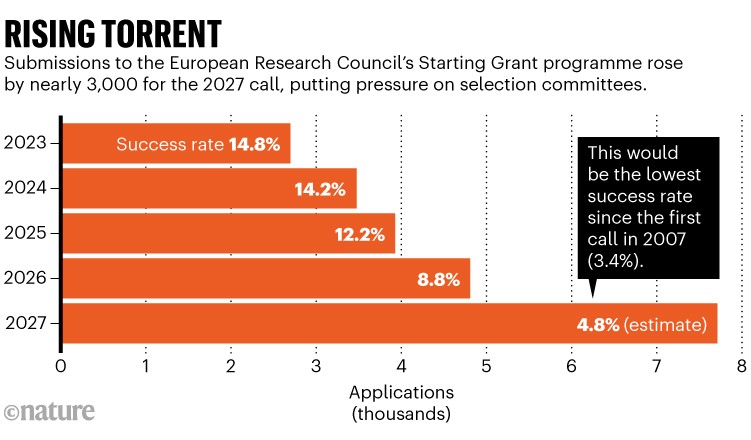
The ERC’s Starting Grant programme — which offers base funds of up to €1.5 million (US$1.7 million) over five years to early-career scientists — received 7,710 proposals for 2027 grants before the deadline on 14 October, up from 4,807 last year (see ‘Rising torrent’).
With up to 373 grants available, down from 421 last year because of funding constraints, that will mean a success rate of less than 5%, compared with 8.8% for the 2026 grant call. “It’s almost a lottery,” says Devang Mehta, a systems and synthetic biologist at the Catholic University of Leuven in Belgium who applied for a Starting Grant this year.
Submissions rocket
The ERC is the Europe Union’s elite funder of basic research with an annual budget of nearly €3 billion. It offers three grant categories — Starting, Consolidator and Advanced — for individual researchers at growing stages of seniority. All have seen significant increases in applications in recent years.
Europe as science superpower: what it will take to rival the US and China
Similar rises in research-grant applications are happening worldwide, says Lynn Kamerlin, a molecular biologist at the Georgia Institute of Technology in Atlanta who has studied grant success rates. An ideal success rate for grant programmes is about 20%, she says. Any lower and it becomes increasingly difficult to select the best research without subjective judging, meaning that a lot of good science will go unfunded, she adds. “People can’t tell the difference between the top 6, 8, 12%.”
She suggests that one solution is to have a panel select the top 20% of applications and then pick winners at random, as is being done by some funders. Anything below that threshold “is a lottery anyhow”, she says.
The rise in submissions has been attributed in part to AI making it simpler to write grant applications. “It’s just so much easier to generate text,” says Kamerlin. That’s putting huge pressure on the system, she says, because “it can spin absolute nonsense”, meaning that reviews of applications require greater scrutiny.
Enjoying our latest content?
Log in or create an account to continue
- Access the most recent journalism from Nature's award-winning team
- Explore the latest features & opinion covering groundbreaking research