Jane Eyre may describe herself as “plain, and little”, but how do you make a little musical about a literary heroine who looms so large? That question lies at the heart of Jane Eyre: a Musical, currently on at London’s Southwark Playhouse.
Adapted by John Caird and Paul Gordon from Charlotte Brontë’s novel, the production has itself undergone a process of dramatic reduction, from a lavish 30-member cast in a large theatre in 1996 to this intimate “chamber” version.
Caird’s justification for this reduction is compelling. In an interview, he described Jane Eyre as “fundamentally an intimate, emotional, small-scale work”, pointing to the novel’s first-person narration and its intensely interior focus.
But Jane Eyre is not a “small-scale work”. Certainly, Jane’s journey takes her through only a handful of Yorkshire houses and a school. Yet Brontë’s imagination repeatedly exceeds these confines. The novel conjures supernatural forces, wild landscapes and sweeping moorland. Its emotional world is equally expansive, moving from the warmth of passion to the terror of fire and freezing wastes. Its Yorkshire landscapes convey a strange, almost supernatural power. The result is a novel that constantly stretches beyond the limits of Jane’s confined domestic world.
Through elemental forces Brönte invokes the gothic mode which had fascinated her and her siblings since childhood. In Jane Eyre, she tempers gothic madness and passion with domestic realism. Jane’s narration dwells on clothes, food, weather, teaching and the gentle boredom of Thornfield before Rochester’s tumultuous arrival. Yet beneath this prosaic world lies a more dangerous emotional intensity.
The adaptation
Taking my seat at Southwark Playhouse, I was struck by how effectively Morgan Large’s set balances intimacy with gothic grandeur. It captures the small scale Caird sought for this chamber production, while suggesting a much wider and eerier world beyond the stage.
The palette is black and white. The set backdrop is a video screen showing a slowly moving landscape of clouds, bare trees and wintry moorland. There is even a bit of mist rising.
Stage right and left are clothes horses draped with everyday cloaks, pristine white shirts, nightshirts and caps. These have a prosaic quality and bring the audience close to a theatrical version of Brönte’s domestic realism. However, even these well-starched clothes are imbued with a ghostly quality, bereft as they are of wearers and lit in sharp contrast to the black backdrop. It is a clever combination of the ghostly and the mundane, which renders the most familiar things uncanny.
Jane Eyre: a Musical abounds in excellent performances, exciting staging and orchestration, but despite the verve of the ensemble cast and the vocal crescendos, the heart rarely skips a beat in fear – and certainly not in gothic terror.
This is largely due to the awkwardness and confusion in the representation of Bertha, who is little more than an obstacle in Jane and Rochester’s romance. Played by Hannah Lindsay, she appears veiled in pale lace wedding clothes, her face obscured. Even when she attacks Rochester, Lindsay’s long blonde curls hide her face.
Brönte’s creation of the violent, swollen-featured, monstrous Bertha who also has bad breath and hasn’t brushed her hair is problematic to a modern audience. She is Creole and she is insane. What may once have appeared as a gothic representation of madness, now raises difficult questions about race, colonialism, gender and confinement.
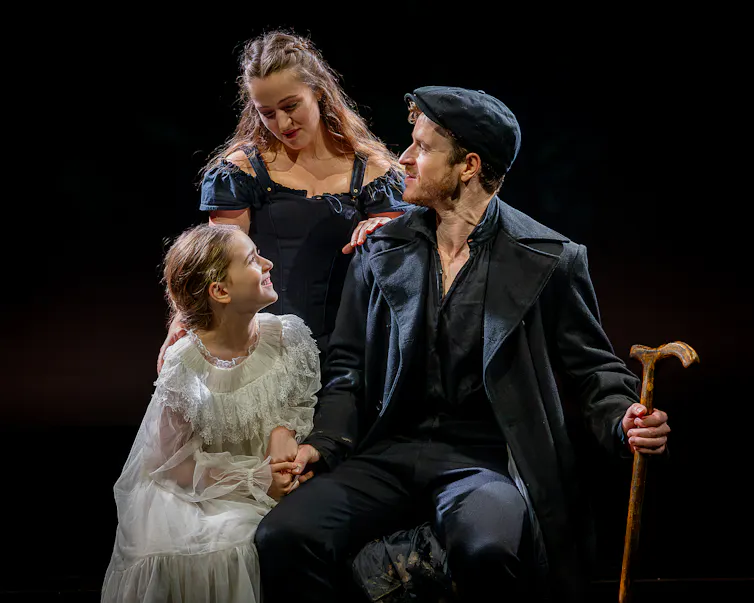
Even without having read Jean Rhys’s Wide Sargasso Sea (1966) or the seminal feminist study The Madwoman in the Attic (1979), modern audiences approach Bertha with a different understanding of colonial history than that of Brontë’s time.
However, the answer is not to erase Bertha as a gothic force, which this production does. At one point we even see Bertha carrying a doll. If directors John Caird and Megan McGinnis choose to depict her as a childish innocent our sympathies must lie with her – but this sympathy goes nowhere and she is still removed as an obstacle to the romantic plot.
The shadow narrative
Jane Eyre is so rich in imagery and intricate plot that three hours can never do it justice. However, more could have been done in this production.
The musical offers a touching love story and a moving tale of a young woman’s struggles. Yet the novel’s much darker narrative is absent. Brontë creates this shadow narrative through gothic elements including dreams, Bessie’s local folklore and folk song, premonitions and monstrous night visitations, mysterious voices and uncanny laughter. A reference to Bessie’s folksong about the “orphan child” crossing the cold moors could have enriched the music.
Most crucially, Brontë mirrors Bertha and Jane throughout the novel, but this mirroring is largely absent from the production. That is particularly striking because of the set’s prominent bird imagery. A plinth around three sides of the stage bears Jane’s declaration to Rochester: “I am no bird; and no net ensnares me: I am a free human being with an independent will.”
Bird imagery is rife throughout the novel. It is often associated with wildness, rebellion and pain. Jane makes her declaration after Rochester likens her to “a wild, frantic bird”. Bertha, too, is associated with birds and their wildness. Her confinement culminates in her escape through fire and flight from Thornfield’s roof.
The production’s confused portrayal of Bertha leaves little room for this gothic threat. Yet the novel repeatedly uses images of wildness and savagery to align the two women. These connections matter, particularly when Bertha’s role is so heavily downplayed.
The musical misses the alignment of the two women. In Sweet Liberty, Jane (played beautifully by Charlie Burn) sings of “boundless skies” and declares: “I will fly.” Yet there is no reference to Bertha, the woman literally confined at Thornfield who ultimately flies from its roof. Bertha has no voice, and she certainly does not get a song.
Jane Eyre: a Musical is on at the Southwark Playhouse until the 24 October
This article features references to books that have been included for editorial reasons, and may contain links to bookshop.org. If you click on one of the links and go on to buy something, The Conversation UK may earn a commission.