Every autumn, the British Film Institute celebrates the best in cinema with a ten-day festival in London and across the UK. This year showcased a slate of compelling films – some of which are exceptional and look certain to garner industry accolades in the coming year.
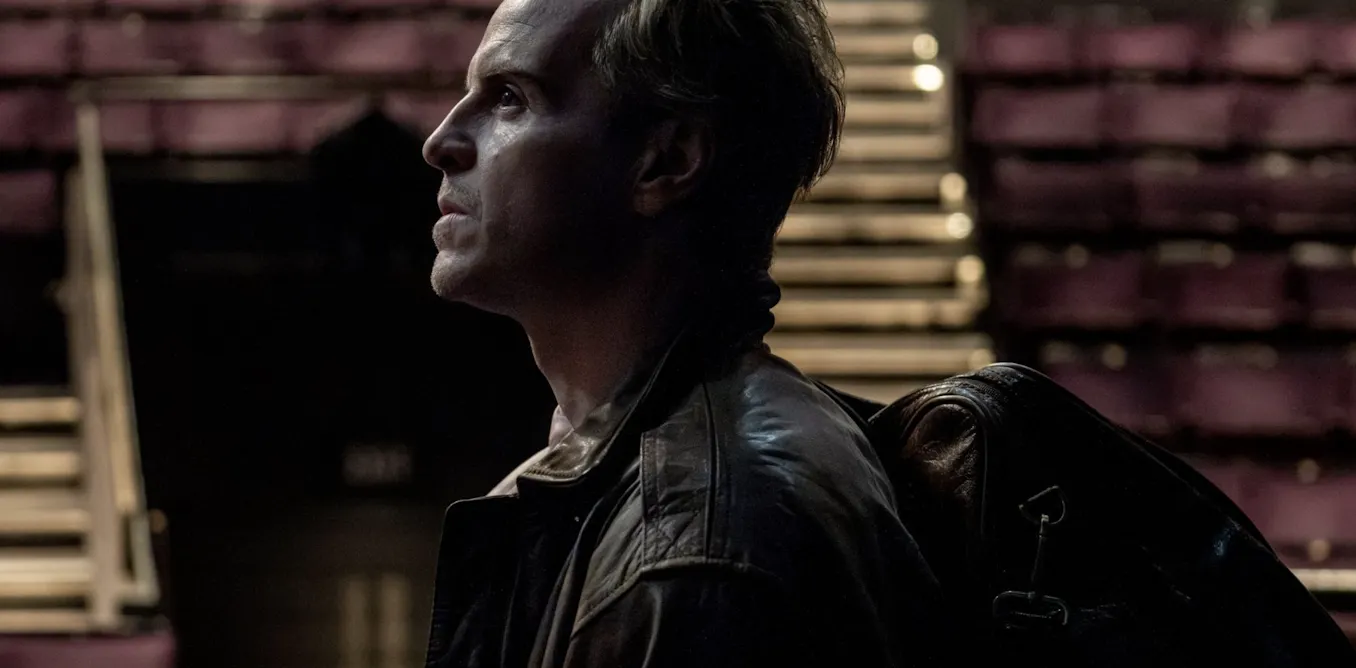
The big stand-out is Elsinore, which was presented in the opening gala screening. Directed by Simon Stone, the film is likely to be Britain’s main Oscars contender, with special recognition going to its star Andrew Scott.
Scott plays the Scottish actor Ian Charleson as he prepares for the 1989 National Theatre production of Hamlet. Charleson, best known for his 1981 role as the Olympic athlete Eric Liddell in the Oscar-winning Chariots of Fire, was seriously ill with Aids at the time. He died in January 1990, soon after completing the run.
Hamlet is famously a tragedy of self-doubt, and Elsinore thus lifts the conventional biopic contrast of public triumph with private tragedy by demonstrating the potential of drama to both express and elevate reality. Through his transcendentally emotional performance, Scott reveals an actor at the top of his game. Expect tears.
The festival’s closing gala The Debut provides a fitting bookend, with Jesse Eisenberg’s comedy of a timid housewife who belatedly finds her voice when auditioning for a community theatre musical.
Where Elsinore finds the tragic parallels between stage and life, The Debut offers the pleasures of theatre’s consoling fantasy. The film’s star, Julianne Moore, conveys the subtle gradations from fragility to strength in her character’s onstage transformation into a woman about to take control of her life.
The relationship of art to reality has a more political significance in another of the festival’s triumphs, La Bola Negra. Javier Calvo and Javier Ambrossi’s historical drama weaves together three timelines revolving around a frustrated playwright who has been left a mysterious document in the will of his estranged grandfather.
The film shifts between this story and that of his grandfather’s experience as a somewhat reluctant fighter for the fascist forces in the Spanish civil war, and then to a visualisation of a lost work, La Bola Negra, by gay socialist poet and playwright Federico García Lorca. Regarded as modern Spain’s most influential literary figure, the poet and dramatist was killed at the age of 38 by the fascists at the beginning of the war.
As well as historical periods, the film interweaves feelings of political commitment, queer desire, and poetic imagination, thereby intermingling visions of better futures, past possibilities, and the danger that we might lose what we hold most dear.
Behemoth! was one of the festival’s big Hollywood premieres, starring Pedro Pascal as a professional cellist and oddly passive Lothario. Its classical music milieu recalls 2022’s Tár, but Behemoth! is both far straighter and less weighty.
I enjoyed it as a film whose real star is its eclectic collage of musical genres that give rhythmic propulsion to its tale of an admittedly listless protagonist undergoing a midlife crisis. Although Pascal is the star, the show is stolen by an uproariously unhinged performance by Olivia Wilde.
Critics gave unanimous praise to Carol Morley’s semi-autobiographical depiction of post-punk Manchester, 7 Miles Out. But they reserved unanimous disdain for Klara and the Sun, an adaptation of Kazuo Ishiguro’s speculative meditation on companionship, mortality and robot intelligence. Director Taika Waititi made the, shall we say, brave decision to translate the source novel’s compassionate understatement into whimsical farce, eschewing its sensitivity without any discernible gain in humour.
A few other films I found disappointing suggest a difficulty that contemporary culture has in narrating its own origin. One of these was Ink, Danny Boyle’s adaptation of the stage play charting the first year of Rupert Murdoch’s acquisition of The Sun newspaper.
This was undoubtedly a fateful moment in the making of modern Britain, but the film’s hyperactive visual style fails to make up for its attention deficits as it skirts everything from the decline of deference to the sexual revolution, trade union power, the morality of sensationalism, demagogic populism and a kidnap plot that merits a separate film of its own.
Such confusion also mars Primetime, a dramatisation of NBC’s reality series To Catch a Predator and its unscrupulous quest for top ratings.
Much slower than either of these, but also failing to live up to its own self-importance, is Fjord, Cristian Mungiu’s Cannes winner about a Romanian family that emigrates to Norway only to find their conservative religious beliefs punished by the self-styled liberal state.
A few films got the balance between dramatic depth and political breadth right. One is Artificial, which casts Andrew Garfield in the role of OpenAI co-founder Sam Altman, portraying him as an evil schemer who sold artificial intelligence to the devil.
Another is Wild Horse Nine, a fictional black comedy from Martin McDonagh set in 1973 in pre-coup Chile. The plot revolves around a dysfunctional couple of CIA agents taking part in covert US operations to destabilise the Allende government. Played by Sam Rockwell and John Malkovich, the bickering agents take a trip to Easter Island so the elder of the pair can see the stone heads before he dies.
We can end however with a special commendation for a film whose depth is not achieved through the grandeur of its subject matter but its deliberate smallness. Korean director Lee Chang-dong’s Possible Love begins with a documentary filmmaker assuring a sceptical producer that public interest exists for a film about corporate restructuring.
This opening forms in essence a bet that Possible Loves makes with its audience. The film follows the uneasy friendship between the documentarist and a working-class woman, its only plot point whether her monosyllabic and apparently violently troubled husband, who was laid off several years earlier, will consent to give an interview.
This deliberate smallness opens out onto the question of what remains when the great battle to save his job is long in the past, but whose resentment remains, determining family, class, friendship and self-worth in ways that are no less devastating for being intimately personal.