Just as Christopher Nolan’s blockbuster The Odyssey sent sales of Homer’s original text surging, cinematic epics have a way of reigniting our appetite for the history behind the drama.
Paul Greengrass’s medieval epic The Uprising, starring Andrew Garfield, brings the chaos, tension and raw fury of the peasants’ revolt straight to the screen.
The film is inspired by the real peasants’ revolt of 1381, a major English uprising triggered by economic hardship, social inequality and a series of heavy poll taxes following the black death. Thousands of rebels, led by Wat Tyler (played by Cosmo Jarvis in the film) and others, marched on London to demand feudal reform and lower taxes. The rebellion collapsed after Tyler was killed and the 14-year-old King Richard II reneged on promises of concession.
If the film left you wanting to dig deeper into the real story, you’re in luck. Below is a curated reading list – from gripping narrative histories to immersive fiction and digital archives – to help you explore the peasants’ revolt and the brutal, tumultuous world of 14th-century England.
Read more: The Uprising: the real medieval revolt that inspired Andrew Garfield’s new film

The Summer of Blood by Dan Jones provides an accessible starting point for anyone interested in the events of the revolt. Jones’s first published history book, it examines the grievances of the peasants and the brutal violence that followed.
Although situated within the broader history of the period, it is a narrative history focused on the dramatic events of the summer of 1381, moving with the rebels from Blackheath to Mile End and Smithfield.
It is also a fitting companion piece because Jones was himself a historical consultant on The Uprising film.

England, Arise is a great book to turn to if you want a more detailed dive into the revolt. A more scholarly and lengthy affair, it is nevertheless written in an engaging fashion.
Barker provides a general introduction of the state of nation on the eve of the revolt. War with France was going poorly. A young king had ascended to the throne. New and unpopular taxation was introduced. It was a recipe for disaster.
Her book also delves into flash points of the revolt, following events that took place across the country. Particular attention is paid to the actions of the rebels in Cambridgeshire, Norfolk and especially at St Albans and Bury St Edmunds.

If you want to know more about medieval England in this period, you can’t go far wrong with the many books by Ian Mortimer on the subject. The Time Traveller’s Guide to Medieval England, in particular, provides an accessible general overview of life in 14th-century England.
Mortimer’s more recent book Medieval Horizons (2023) takes a broader look at the period. In it, he challenges many of the popular stereotypes and misconceptions of the Middle Ages as a period of violence, ignorance and superstition.

The Red Prince provides fascinating insights into John of Gaunt, the man so hated by the rebels in 1381. Widely blamed by contemporaries for his role in the government and the introduction of the poll taxes, the rebels destroyed Gaunt’s Savoy Palace in their march on London.
Carr’s latest offering, Sceptred Isle (2025) is another great place to go for the tumultuous history of the 14th century. Although every century can stake a claim to experiencing unprecedented crises, the 14th century experienced famine, disease and warfare on a terrifying scale.

Any attempt to explain the origins of the revolt must grapple with the impact of the Black Death of 1346-53. The World the Plague Made offers an important reinterpretation of the social and economic consequences of plague.
Belich demonstrates how medieval society was turned upside down after the Black Death. Because the demographic collapse killed roughly half the population while leaving physical wealth, land, livestock and infrastructure fully intact, the availabile capital and resources essentially doubled overnight. As Belich concludes, “‘revolution’ may be an over-used term, but if the sudden halving of people and the doubling of everything else is not potentially revolutionary, what is?”

For those who prefer their history with a dash of fiction, there is A. K. Blakemore’s new novel Doom Painting. Condensed into just 16 days, she unpacks what it might have been like to be swept up in those fateful summer days of 1381.
Blakemore brings her signature poetic intensity and lush, sensory prose to the medieval landscape, telling the story of the uprising through a broad ensemble of perspectives – most notably the enigmatic rebel figure Wat Tyler.

And for those who want to dive into the academic debates and sources surrounding the peasants’ revolt, try Rodney Hilton’s Bond Men Made Free. It’s often out of print and difficult to find, but Hilton’s book is a cornerstone of the field.
Underpinned by his Marxist interpretation of the revolt, Hilton’s study is a classic upon which most modern scholarship is based. Phillipp R. Schofield provides a foreword to the 2024 paperback edition.
For those short on time but who want to know more about the period, there are two great projects to investigate. The People of 1381 is an excellent place to go for those interested in discovering more about the everyday people involved in the revolt. For example, their database highlights the important role many women played during the revolt.
Read more: Who were the ‘peasants’ of the 1381 Peasants’ Revolt? New database has answers
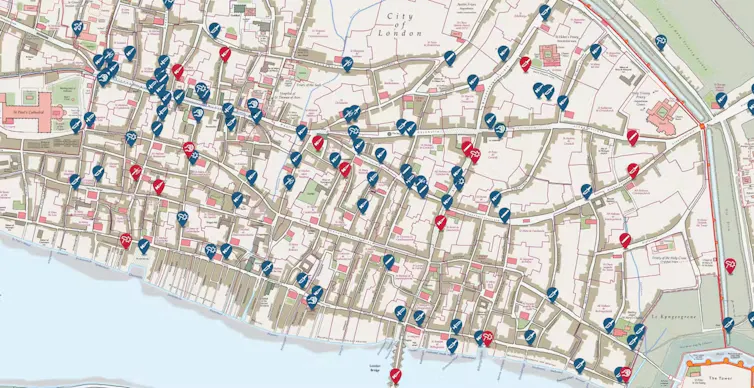
The website Medieval Murder Maps, by comparison, provides fascinating insights into law, justice and criminality in late medieval England more broadly. It shows murder hotspots in the 14th century cities of London, York and Oxford.
Read more: Our medieval murder maps reveal the surprising geography of violence in 14th-century English cities
Finally, Stephanie Brown’s forthcoming book, Murder in the Middle Ages, is sure to be one to watch out for.
Following the investigations of Thomas de Lincoln, a coroner in York, the book will explore how our medieval ancestors dealt with murder, criminal investigations and the dispensation of justice.
This article features references to books that have been included for editorial reasons, and may contain links to bookshop.org. If you click on one of the links and go on to buy something, The Conversation UK may earn a commission.