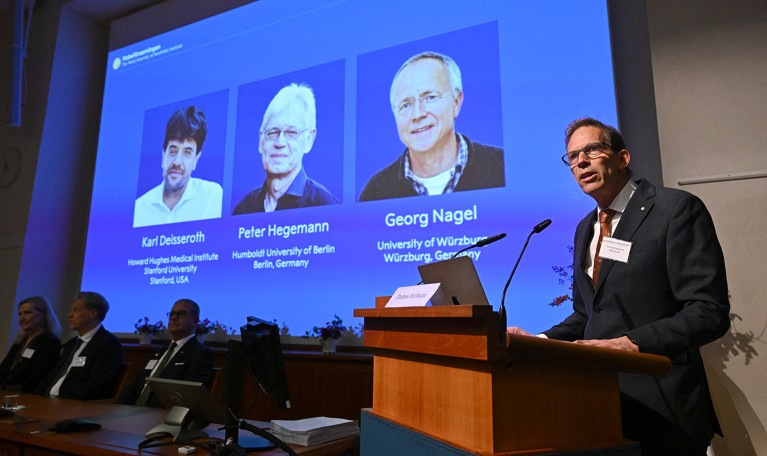
After being on many scientists’ shortlists for years, the 2026 Nobel Prize in Physiology or Medicine has recognized optogenetics — a technology that allows researchers to control the brain’s neurons with pulses of light.
The winners are Karl Deisseroth at Stanford University in California, Peter Hegemann at Humboldt University of Berlin, and Georg Nagel at the University of Würzburg in Germany.
“Optogenetics provides opportunities for mapping the brain in a way that we could once only dream of,” says Per Svenningsson, chair of the Nobel Committee for Physiology or Medicine, in its press release announcing the prize.
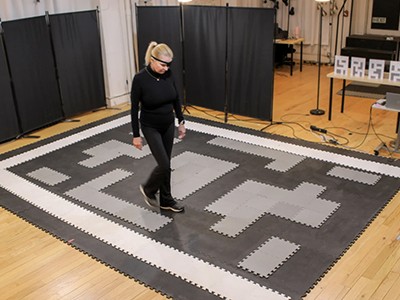
Restoring vision with optogenetics
Working together in the early 2000s at Germany’s Max Planck Institute for Biochemistry in Martinsried, Hegemann and Nagel discovered a light sensitive protein in the alga Chlamydomonas reinhardtii, called channelrhodopsin1,2. In response to blue light, the protein opens to allow charged molecules to flood into cells, creating a tiny electrical charge.
Deisseroth and his colleagues inserted the gene encoding channelrhodopsin into neurons of rats, and found that it could cause the cells to fire and communicate with other neurons.
Optogenetics has revolutionized neuroscience, because it allowed researchers to precisely control the activity of individual neurons and brain circuits, to study the downstream effects on behaviour.
Enjoying our latest content?
Log in or create an account to continue
- Access the most recent journalism from Nature's award-winning team
- Explore the latest features & opinion covering groundbreaking research