As scrutiny of camera-equipped AI glasses intensifies, tighter privacy settings and clearer messaging will not be enough.
Jason Low, research director at Omdia, said that on Tuesday. The research firm had just published its count of the AI glasses market for the first half of 2026. Companies must define exactly what always-on cameras capture, he said. They must also show users how that content is used, and guarantee it never reaches third parties.
Omdia published the numbers the day before Meta’s Connect conference, where the company is expected to show a camera-free pair. The numbers also show a split at the top of the market. The leader sells glasses with a camera. The vendor in second place sells a pair without one.
4.2 million pairs in six months
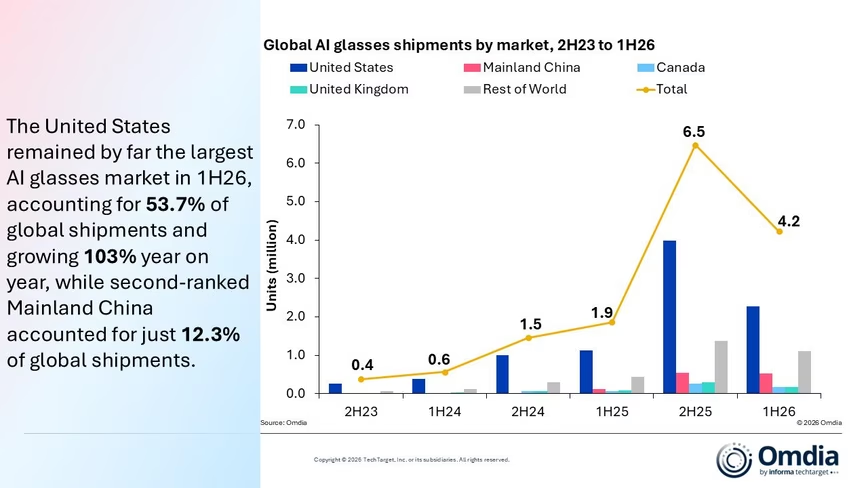
Global AI glasses shipments reached 4.2 million units in the first half of the year, according to Omdia. That is up 127% on the same period of 2025. The firm called AI glasses an emerging category, with growth stabilising as the market expands from a very low base.
It also said the sector faces a more complex environment. Omdia pointed to intensifying competition across different frame designs, and to mounting scrutiny over user privacy.
Omdia’s own chart puts the half below the second half of 2025, when shipments reached 6.5 million. The United States took 53.7% of the total and grew 103% year on year. Mainland China came second, with 12.3%.
Qiran Ju, a senior analyst at Omdia, credited Meta’s momentum and a wave of new entrants from China. He also named the features that sell the devices.
Just as critically, vendors have made the value proposition immediately clear to buyers by focusing on hands-free photo and video capture, open-ear audio, and AI assistance within everyday frames.
Meta ships four pairs in five
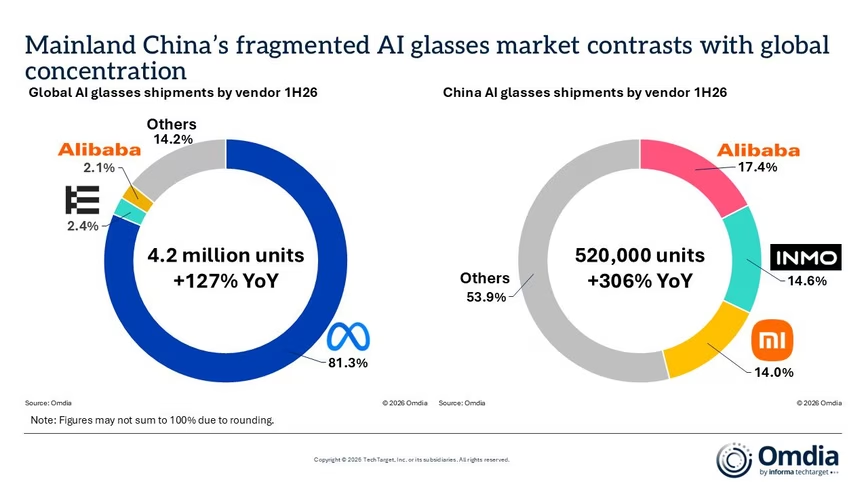
Meta shipped 3.4 million AI glasses in the half, for an 81.3% share of the market, Omdia said.
Even Realities climbed from fifth place in the second half of 2025 to second. It shipped 102,000 units, a 2.4% share. Omdia put that down to demand for its G2 series across North America and Western Europe. Omdia’s vendor chart names Alibaba next, with 2.1%.
The G2 has neither a camera nor speakers. Ju described the choice this way.
Even Realities takes a different frame design from most AI glasses. By removing both the camera and speakers, and focusing instead on a slimmer design, a small monochrome display and productivity features such as real-time transcription, it shows how vendors are exploring different ways to make AI glasses useful in everyday life.
Even Realities is not alone in that bet. Halliday relaunched with a camera-free pair aimed at meetings in July.
China has no Meta
Shipments in mainland China rose 306% year on year to 520,000 units. Omdia described the country as the main supply chain hub for the devices. It also called China a testbed for new combinations of display, camera and audio.
No vendor dominates there. Alibaba led with 17.4%, INMO took 14.6% and Xiaomi 14.0%. The three together accounted for 46.1% of shipments, against Meta’s 81.3% of the global market.
What we are seeing in China provides early but definitive signs that there is no single, one-size-fits-all solution in the AI glasses space.
Low said privacy, alongside varied user preferences, is a major driver of that fragmentation. Beijing has its own rules in progress, and wants a light on the glasses whenever they record.
Meta’s pair without a camera
The Information reported on 15 September that Meta plans camera-free glasses, codenamed Luna, citing people familiar with the matter. According to the report, the model has six built-in microphones. They let the wearer talk to Meta AI and to Muse, the company’s new AI agent. It also has a button on the side to call up Meta AI, and speakers similar to those in the current models.
Meta is targeting October for shipments, The Information reported. Reuters, which carried the report, said Meta did not immediately respond to a request for comment. TNW covered the Luna report the same week.
Mark Zuckerberg’s Connect keynote starts at 4pm Pacific time on Wednesday. Meta has not confirmed the product.
The pressure on camera glasses has moved from complaints to rules. Western Australia this week banned smart glasses from every public school, and councils in Sydney, Brisbane and Melbourne have barred them from pools.
The case for keeping the camera
Omdia listed hands-free photo and video capture first among the features driving sales.
Some analysts told Reuters on Wednesday they doubt a camera-free model can allay privacy concerns about devices that can still record audio. They also said dropping the camera could blunt demand, since photo and video capture ranks among the most popular features.
Analysts also expect Meta to show a new camera-equipped Ray-Ban model at Connect, Reuters reported.
The component makers are betting on voice
SonicEdge makes miniaturised audio components for wearables and smartphones, so it has a direct stake in glasses built around microphones and speakers. Its chief executive, Moti Margalit, said in a statement sent to TNW that Meta is investing heavily because it does not want to lose control of the voice-based interface.
We naturally talk to people, so why not talk to our glasses?
If Meta ships Luna in October, the first camera-free pair from the market leader will fall inside Omdia’s count for the second half of 2026. Last year, that half came to 6.5 million units.