Most large companies already listen to their employees. In mid-September 2026, Remesh, an AI-powered employee listening platform, surveyed 107 HR leaders in the US and UK on its own platform. And 80% said their organization had a formal listening program. Only 18% called their approach very effective, though, and 47% saw substantial room to improve it. So the open question is what all that listening actually produces.
Employees have their doubts, as reported by Gallup in November 2024. According to the firm’s researchers, only 8% of employees strongly agree their organization takes action on surveys. Another 38% couldn’t say whether it does anything at all. And collecting feedback is the easy part.
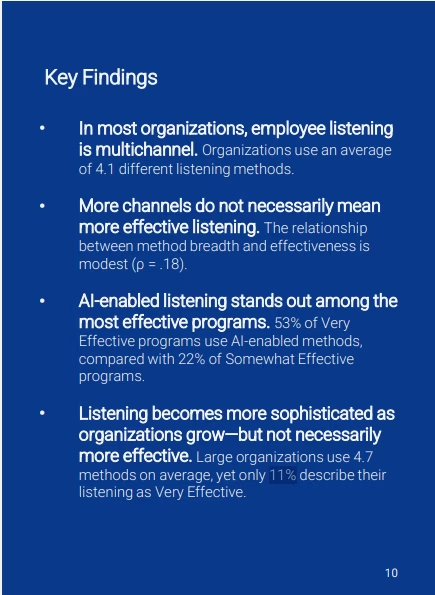
Look at how enterprise listening has grown and you’ll mostly find more instruments. The HR leaders in the study use 4.1 listening methods on average. Manager-led conversations (65%) and annual employee surveys (60%) lead. In large organizations, the average climbs to 4.7.
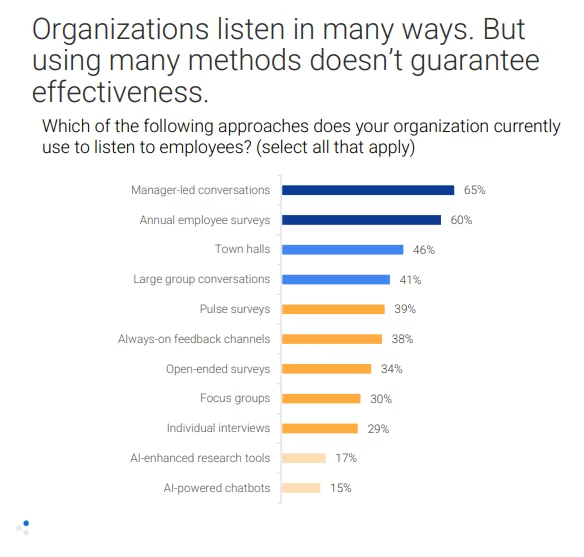
All those channels haven’t bought much confidence. The study found only a modest link between how many methods a program uses and how effective leaders rate it. The correlation was .18. And among HR leaders at large organizations, just 11% called their listening very effective.
Meanwhile, the stakes keep climbing. The State of the Global Workplace 2026 report found that global employee engagement fell to 20% in 2025, its lowest level since 2020. Researchers put the cost at about $10 trillion in lost productivity, which is 9% of global GDP.
“Measuring employee engagement is important, but it’s just the first step,” says Patrick Hyland, Managing Director of Employee Research at Remesh. “Real improvement requires talking with employees, understanding what’s behind the scores, and identifying meaningful opportunities for organizational change.”
This is where effective listening moves beyond measurement. Surveys can help organizations identify important patterns and areas of concern. Conversations with employees can help explain those patterns, reveal different experiences and perspectives, and identify where meaningful changes might make the greatest difference.
Yet that’s the quality these HR leaders rank lowest. Asked to rank ten attributes of effective listening, only 3% put “explains why employees think and feel as they do” first. It tied for last place.
How to Turn Employee Feedback Into Action
Feedback from an organization’s workers tends to lose value when a result has to turn into a decision. This means that a score can point a manager to the team or location with a problem. But it rarely says what’s driving it. And that’s exactly what someone needs to pick a fix.
HR leaders know this is the weak spot. Asked what their organizations do well and where they should improve, they put action and follow-through at the top of both lists (28% and 29%). Closing the loop came next, at 25% each time.
That job usually lands on managers, who are running low themselves. Gallup reports that global manager engagement dropped from 27% to 22% between 2024 and 2025. Five points, in one year. Hand the least engaged layer of management a bare number and ask for an action plan. You’ve set them up to guess.
A better route takes one specific finding back to the employees who produced it, in a live conversation. Why does the number look like this? What should change? Leaders can then see how many people back each explanation. After that comes the step most programs skip: going back to employees with what was decided, why, and what won’t change. These HR leaders want it built in, with 35% listing it among their top three priorities for an ideal listening program.
Done that way, a survey result turns into an agenda. Gallup’s best-practice organizations show where that can lead, with 79% of their managers engaged, nearly four times the global average.
What an Employee Listening Platform Has to Do Now
HR leaders shopping for a platform used to ask about channel count. The better question now is whether it can explain a result fast enough for someone to act on it. Open-ended answers have to be measured, with a count of how many employees back each theme, before anyone writes a summary. Anonymity has to be strong enough that people say what they really think. And results need to arrive while the issue is still live.
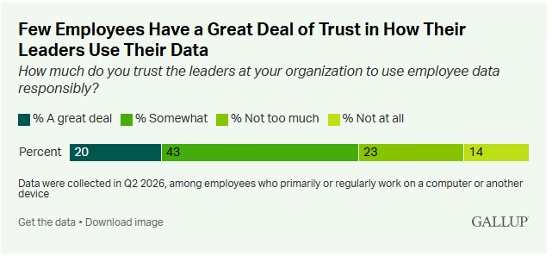
Candor may be the hardest part. A third of the HR leaders in the study (33%) named a safe, trusted environment for speaking up as a top-three priority. Employees aren’t there yet. Gallup reported on September 24, 2026, that among employees who work on a computer or other device, only 20% trust their leaders “a great deal” to use employee data responsibly. Just 19% of all employees say someone at work has spoken with them about the data their organization collects.
Remesh was built with those requirements in mind, with the company supporting live conversations with up to 1,000 employees and asynchronous conversations with a maximum of 5,000 across 46 languages. People respond in their own words and then anonymously react to colleagues’ answers so leaders see which ideas resonate widely and where views start to divide. It runs next to whatever survey platform a company already uses. The survey tells you where to look and the conversation tells you what you’re looking at.
Listening Is Measured by What Changes
Asked what makes listening effective, the 107 HR leaders put “leads to meaningful change” first: 23% ranked it number one and 47% placed it in their top three. It’s a high bar, and a fair one.
One finding is a reasonable place to start. Take it back to the people who gave it, ask what’s behind it and tell them what changed because of it. Leaders who want to benchmark their own program against these peers can find the complete results in the full study.