Francis Halzen of University of Wisconsin-Madison led development of IceCube Neutrino Observatory.
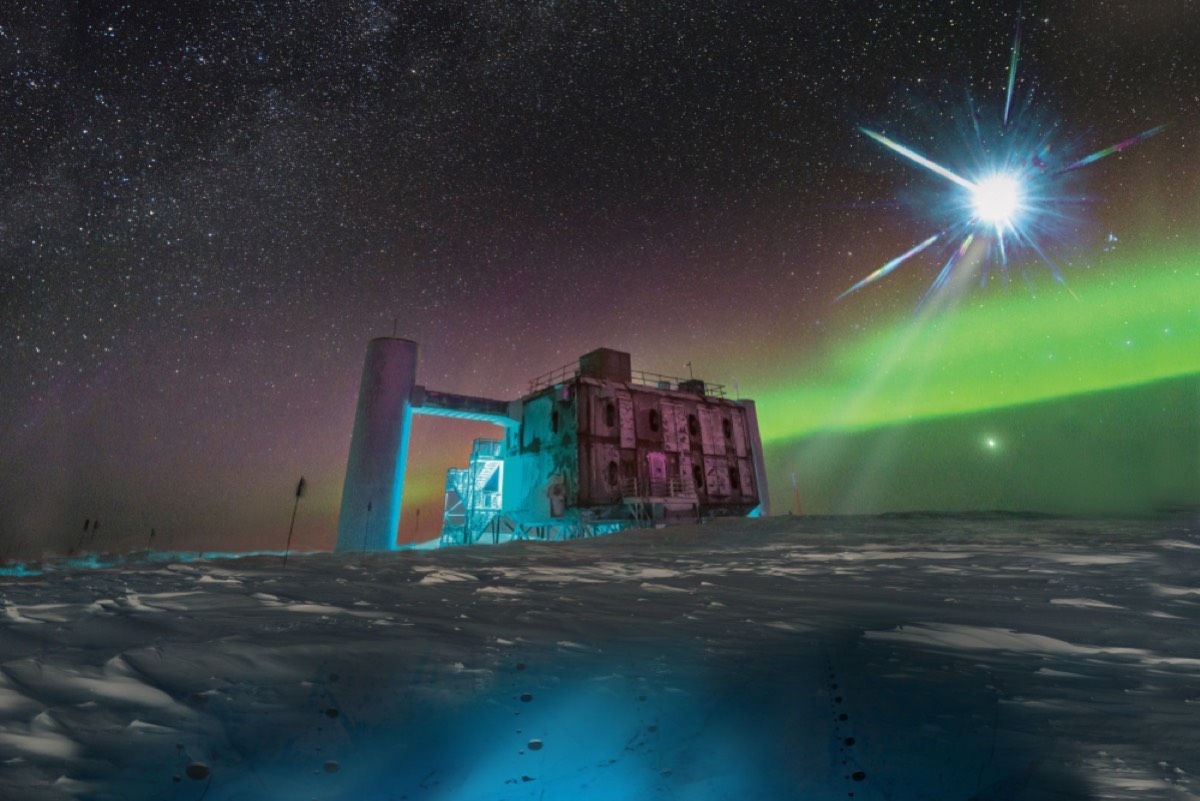
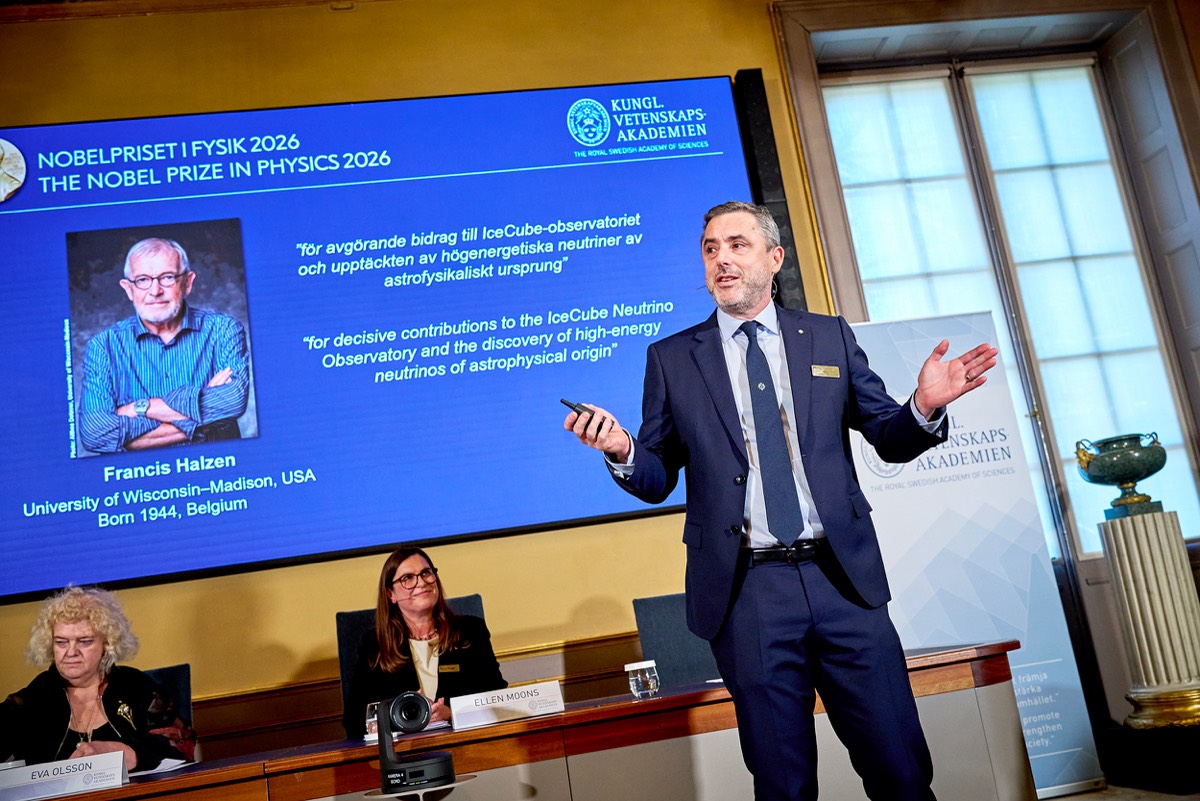
Francis Halzen, a physicist at the University of Wisconsin, Madison, has won the 2026 Nobel Prize in Physics “for decisive contributions to the IceCube Neutrino Observatory and the discovery of high-energy neutrinos of astrophysical origin.” Halzen spearheaded the development and construction of the IceCube Neutrino Observatory in Antarctica, enabling physicists to capture high-energy neutrinos created in the distant universe.
“It was a great surprise, and I obviously didn’t expect it,” Halzen said during a news conference in Stockholm, Sweden, speaking by phone from Italy. While the Nobel was awarded to Halzen, he emphasized that his work was the result of a “large collaboration” with other researchers.
“This reflects on the really courageous people who joined me in this project when really no respectable conservative physicist would have joined me. But many talented people did, and that’s why I’m here,” he said.
“I am shocked and absolutely delighted that Francis was awarded the Nobel this year,” said particle physicist Danielle Norcini of Johns Hopkins University in a statement. “He is the scientific visionary and driving force behind [IceCube]. It has transformed our understanding of the universe by detecting the first high-energy neutrinos from beyond our galaxy, opening an entirely new field of neutrino astronomy. The experiment is the extraordinary achievement of hundreds of scientists, engineers, and collaborators, but Francis was the person who dreamed big enough to imagine an experiment of this scale and then relentlessly pushed to make it a reality.”
Ghost particles
As previously reported, neutrinos travel near the speed of light. John Updike’s 1960 poem, “Cosmic Gall,” pays tribute to the two most defining features of neutrinos: They have no charge, and for decades, physicists believed they had no mass (they actually have a teeny bit of mass). Neutrinos are the most abundant subatomic particle in the universe, but they very rarely interact with any type of matter. We are constantly being bombarded every second by millions of these tiny particles, yet they pass right through us without our even noticing. That’s why Isaac Asimov dubbed them “ghost particles.”
That low rate of interaction makes neutrinos extremely difficult to detect, but because they are so light, they can escape unimpeded (and thus largely unchanged) by collisions with other particles of matter. This means they can provide valuable clues to astronomers about distant systems, further augmented by what can be learned with telescopes across the electromagnetic spectrum, as well as gravitational waves. Together, these different sources of information have been dubbed “multimessenger” astronomy.
Neutrinos were first proposed by Wolfgang Pauli in a 1930 letter to colleagues. He was trying to explain some baffling experimental results on radioactive beta decay in atomic nuclei, where energy appeared to be missing—something he deemed (correctly) to be impossible. He thought a new kind of subatomic particle with no charge and no mass may have carried away the missing energy; it was Enrico Fermi who later dubbed it a neutrino.
Clyde Cowan and Frederick Reines first observed these ghostly particles in 1956, thanks to fusion reactions in nuclear power plants that proliferated after World War II. Ten years later, physicists detected the first solar neutrinos. This snagged Ray Davis Jr. and Masatoshi Koshiba a Nobel Prize in 2002, shared with Riccardo Giacconi (who was honored “for pioneering contributions to astrophysics, which have led to the discovery of cosmic X-ray sources”).
The only problem was that far fewer solar neutrinos were detected than theory predicted, a conundrum known as the solar neutrino problem. In 1962, physicists discovered a second type (“flavor”) of neutrino, the muon neutrino. This was followed by the discovery of a third flavor, the tau neutrino, in 2000.
By then, physicists already suspected that neutrinos might be able to switch from one flavor to another, thanks in large part to 1998 observations by Japan’s Super-Kamiokande collaboration (Super-K). In 2002, scientists at the Sudbury Neutrino Observatory (or SNO) announced they had solved the solar neutrino problem. The missing solar (electron) neutrinos were just in disguise, having changed into a different flavor on the long journey between the Sun and the Earth. Arthur B. McDonald of SNO and Takaaki Kajita of Super-K shared the 2015 Nobel Prize in Physics for their respective breakthroughs.
An ingenious idea
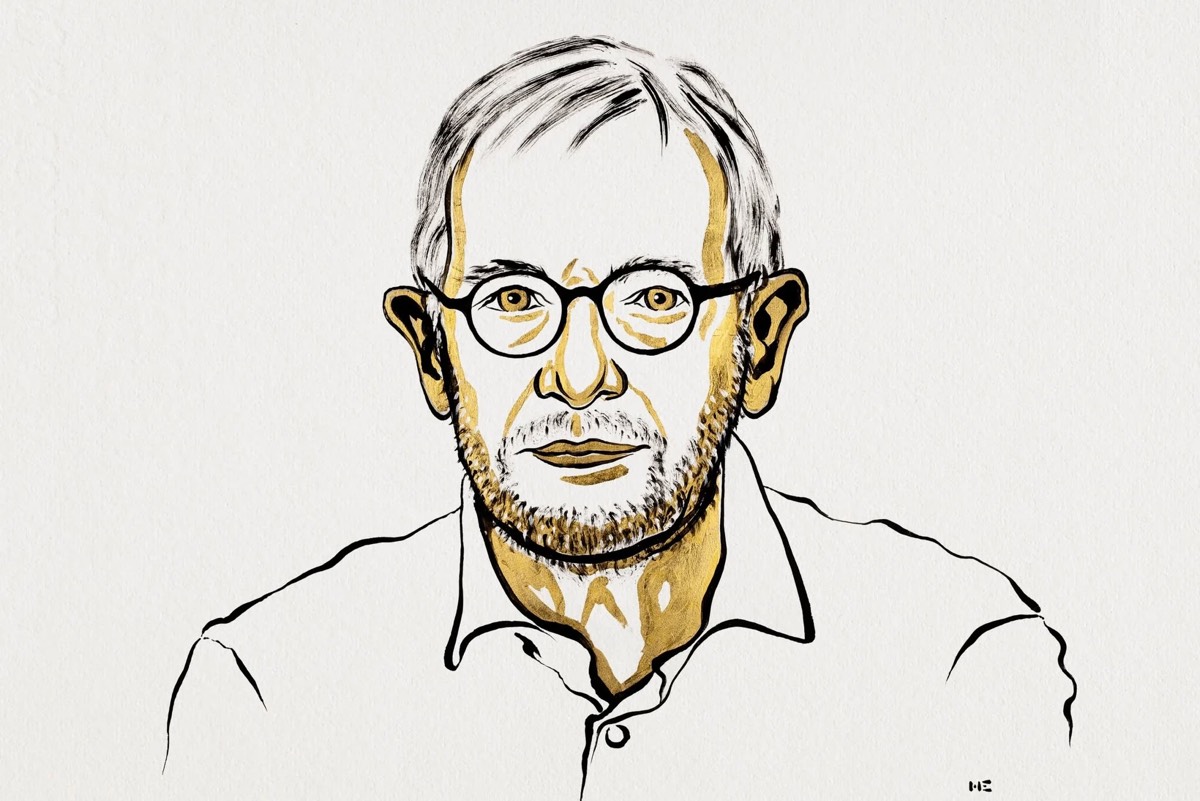
The Belgian-born Halzen has been at UW-Madison since shortly after earning his PhD and soon became fascinated by neutrinos. Most neutrino hunters bury their experiments deep underground to help cancel out noisy interference from other sources. Several physicists in the 1980s had proposed water as a good medium for detecting neutrinos from space, while Russian physicists had suggested using radio receivers to capture neutrino signals in Antarctica. Halzen combined the two ideas, reasoning that ice would be an even better medium. He proposed building a neutrino observatory at the South Pole in 1988, since there was already an established research station there.
Particle physicist Joanne Hewett, of the Yang Institute for Theoretical Physics at Stony Brook, was a postdoc at UW-Madison when Halzen first got the idea. “We went to lunch on a cold winter day at the student union, as usual, and sat next to the window looking out over frozen Lake Mendota,” she recalled. “In the elevator on the way back Francis exclaimed, ‘You could do it in ice!’ None of us knew what he was talking about, but he was terrifically excited about it. His perseverance in the early days to prove that his idea would work and to develop the instrumentation was inspiring.”
“Halzen had the audacious idea that you could turn an enormous volume of naturally occurring Antarctic ice into a telescope for neutrinos,” said American Institute of Physics CEO Michael Moloney. “He then led the decades-long effort that turned that idea into IceCube, which now provides an extraordinary window on the universe and some of its most distant and energetic phenomena. This prize highlights one of the great recurring stories of physics: When we find a fundamentally new way to observe nature, we often discover entirely new questions that we didn’t previously know how to ask.”
That didn’t make it an easy feat to embed the instruments deep in the ice. After conferring with glaciologists, Halzen and his team opted to create kilometer-deep holes using a hot water “drill” to melt the ice, then lowered a long cable with strings of light sensors into the hole.
The first neutrino observatory at the site was called AMANDA. The initial results were disappointing since the upper part of the ice had so many bubbles that the light diffused and blurred any relevant information about neutrino trajectories. But the ice was very pure below 1400 meters. However, AMANDA didn’t cover sufficient volume to reliably detect neutrinos, so IceCube eventually took its place.
“Our attitude was ‘let’s study the ice, let’s design a hot water drill, let’s see if it works,’” Halzen told the American Physical Society last year when he won the APS Medal for Exceptional Achievement in Research. “The ice had to be clear, the drilling methods we developed at Madison had to work, and we had to be able to reject backgrounds. We started small, and to our own amazement, we overcame all these hurdles. And suddenly, we had the tools to build a kilometer cube detector. In the almost 40 years of this AMANDA/IceCube adventure, nobody ever told us that this was uninteresting. It was really a question of the technology.”
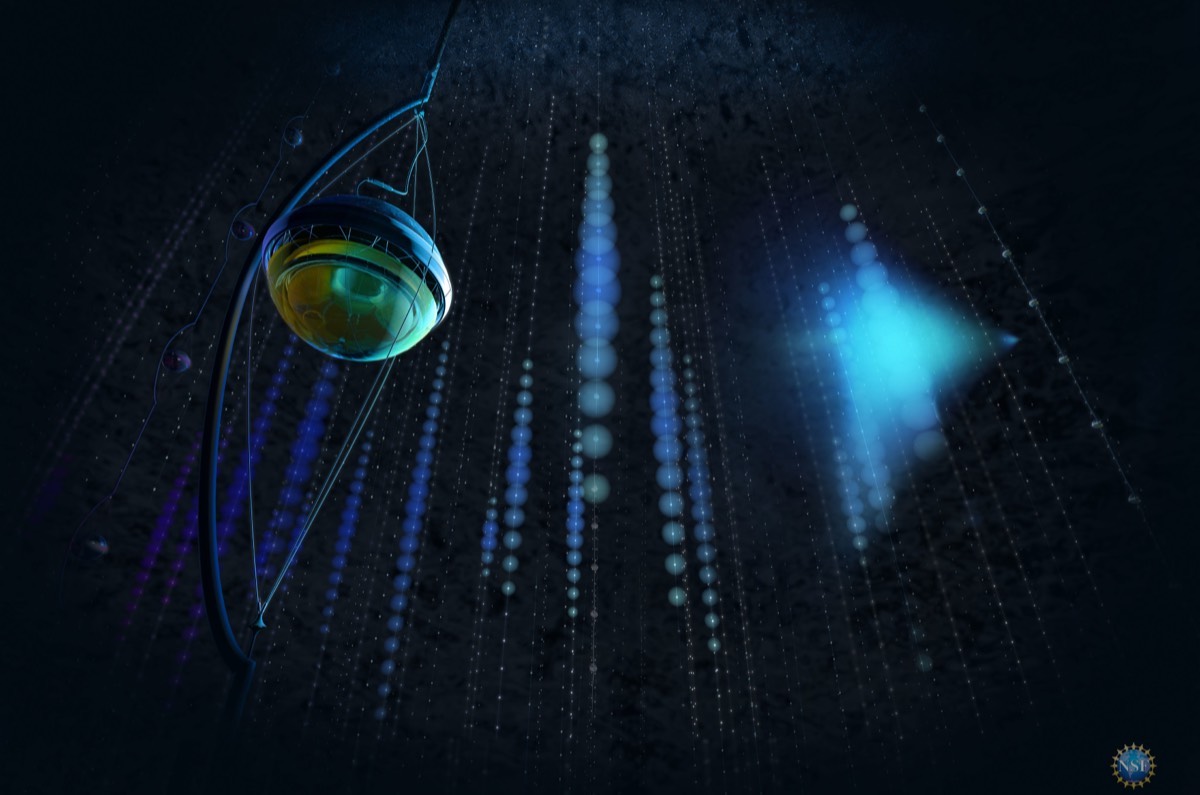
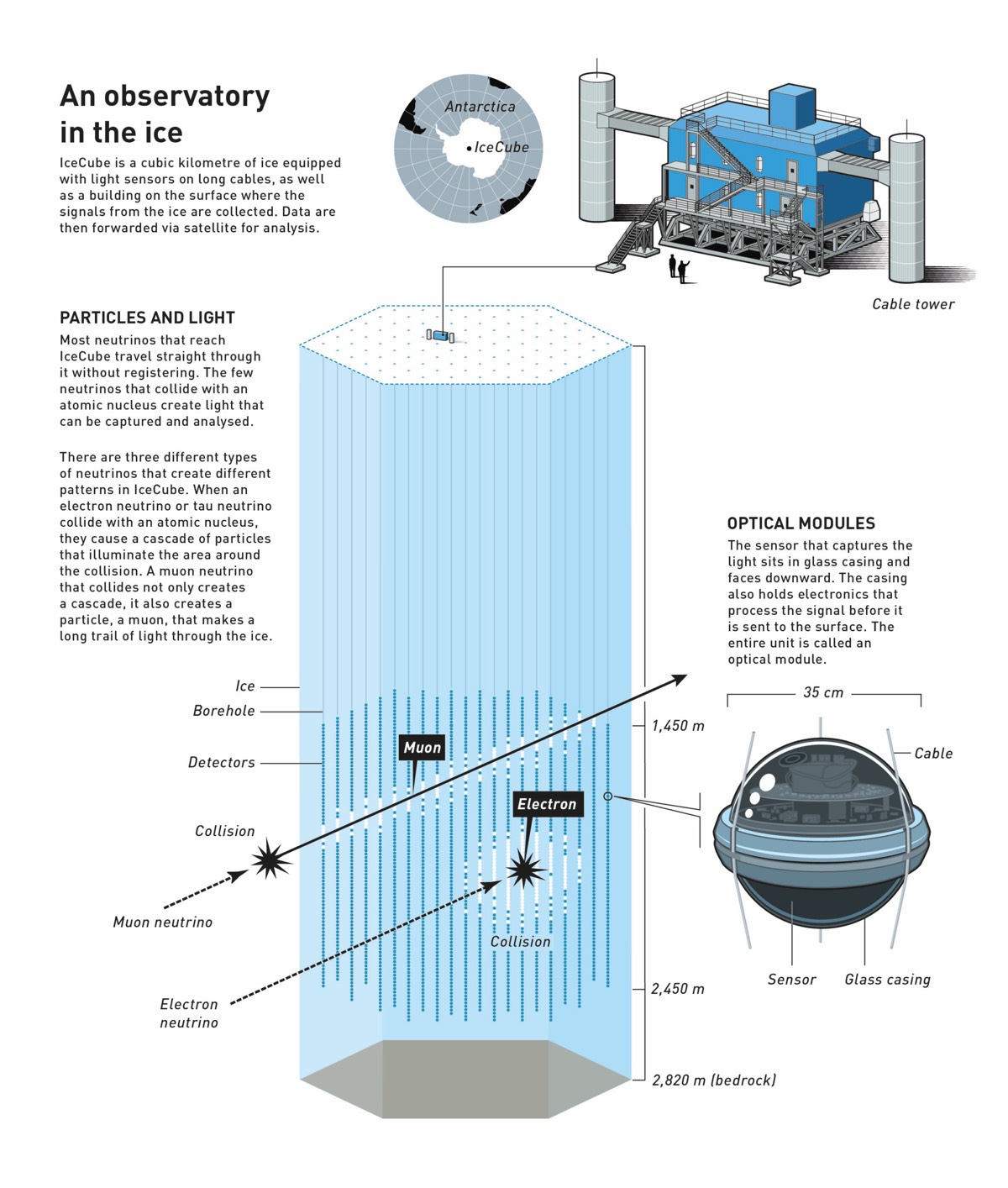
IceCube features arrays of hundreds of basketball-sized optical sensors buried deep within the Antarctic ice: a full cubic kilometer of ice, with 5,160 light sensors spread among 86 cables. On those rare occasions when a passing neutrino interacts with the nucleus of an atom in the ice, the collision produces charged particles that emit UV and blue photons. The sensors pick them up.
In some cases, IceCube sees a spray of particles and photons when something slams into one of the atoms in the ice. In other cases, particles simply nudge the atoms, liberating a few photons. There is no neutrino source pointed at IceCube, though. Instead, it relies on natural neutrino sources. Some of these are produced far away in space and travel great distances to Earth. Others are produced as cosmic rays slam into the atmosphere.
If IceCube relied only on the neutrinos that interacted with matter within the detector, however, it would take years to build up enough collisions to test things. So instead, the IceCube team used the entire Earth. IceCube can detect the path particles take as they pass through the detector by entering on the side. These would be neutrinos that intercepted the Earth tangentially at the South Pole itself and so interacted with very little matter.
IceCube came online in 2011 and surpassed expectations. “The biggest risk we took is that nobody knew if the kilometer cube detector was actually large enough to detect neutrinos beyond our atmosphere from the Universe and that was our biggest one. But it only took two years to detect that,” Halzen said during the Nobel press conference. “We found evidence for neutrinos coming from supermassive black holes in other galaxies, and they shine so strongly that when you look at a neutrino sky, you don’t see the Milky Way.”
Cosmic signals
In 2014, IceCube discovered three neutrinos with unprecedented high energies, nicknamed Bert, Ernie, and Big Bird. In 2017, physicists traced a high-energy neutrino back to a specific source—a distant galaxy, called TXS 0506+056, often referred to as “the Texas event.” That same year, IceCube scientists tested a Standard Model prediction: that neutrinos are more likely to interact with matter at higher energies. As predicted, the number of neutrinos arriving through the Earth dropped compared to the ones coming in tangentially, and their frequency dropped further as a product of energy.
And in 2022, IceCube scientists backtracked the paths that high-energy cosmic neutrinos traveled on their way to Earth. After poring over ten years of data, they found evidence—in the form of a tantalizing excess of 79 neutrinos—that an active galaxy called Messier 77 (aka the Squid Galaxy) is a strong candidate for a high-energy neutrino emitter. This result brought astrophysicists one step closer to resolving the mystery of the origin of high-energy cosmic rays.
“Cosmic rays, wherever they are born, make neutrinos, but at the time, we had no idea where or how,” said Halzen. “Now, by seeing neutrinos, we start to see the first cosmic accelerators, and that’s really exciting.”
IceCube isn’t done making new discoveries. “We have these neutrinos of enormous energies, but all the physics that we are doing seems to be consistent with the Standard Model neutrino physics that we know and love, and we want to break that,” Halzen said.
The project just completed a major upgrade in February, adding five more strings of light sensors to the bottom center of the existing arrays, along with an additional 600 new light sensors and calibration instruments. Last month, the National Science Foundation committed $53 million over the next five years to maintain operations.
As for Halzen’s future research plans, “I am working on a proposal, and I hope that this prize will help getting it approved,” he joked during the news conference.