The design requires less energy to capture CO2 than current systems.
Equipment to capture carbon dioxide from ambient air or smokestacks generally works through a sort of reversible filter. Air is passed through granules or a liquid that absorbs the CO2, then that CO2-loaded substance undergoes a process (usually heating) that causes it to let go of all that CO2. The resulting gas can be collected in a separated stream.
It’s also possible to do a similar sort of operation on a smaller scale—like inside a battery. A new study from a team led by James Buchen of the University of Delaware demonstrates an example of a battery-based electrochemical carbon-capture technique that they say is more viable than previous attempts. It has the potential to require less energy—and therefore be cheaper—than the reversible-filter designs that currently dominate.
Carbon chemistry
The basic idea behind a device of this type is that hydroxide produced at the battery cathode reacts with CO2, converting it to carbonate or bicarbonate that passes through the separator membrane to the anode. There, the lower pH causes the reaction to reverse, with carbonate turning back into CO2 gas. The role of the cathode is to produce hydroxide ions; the role of the anode is to consume them.
In this case, both the cathode and anode are nickel hydroxide. That’s the same as the cathode in the old-school rechargeable AA and AAA nickel-metal hydride batteries. But instead of a battery you can charge full of energy to power some mobile device, this works more like a chemical seesaw. Apply a voltage in one direction and you drive the cathode to make hydroxide that moves to the anode. Switch the applied voltage around, and the old anode becomes the new cathode, driving the exact same chemistry in reverse. And the whole time this device is grabbing CO2 and transporting it across the cell.
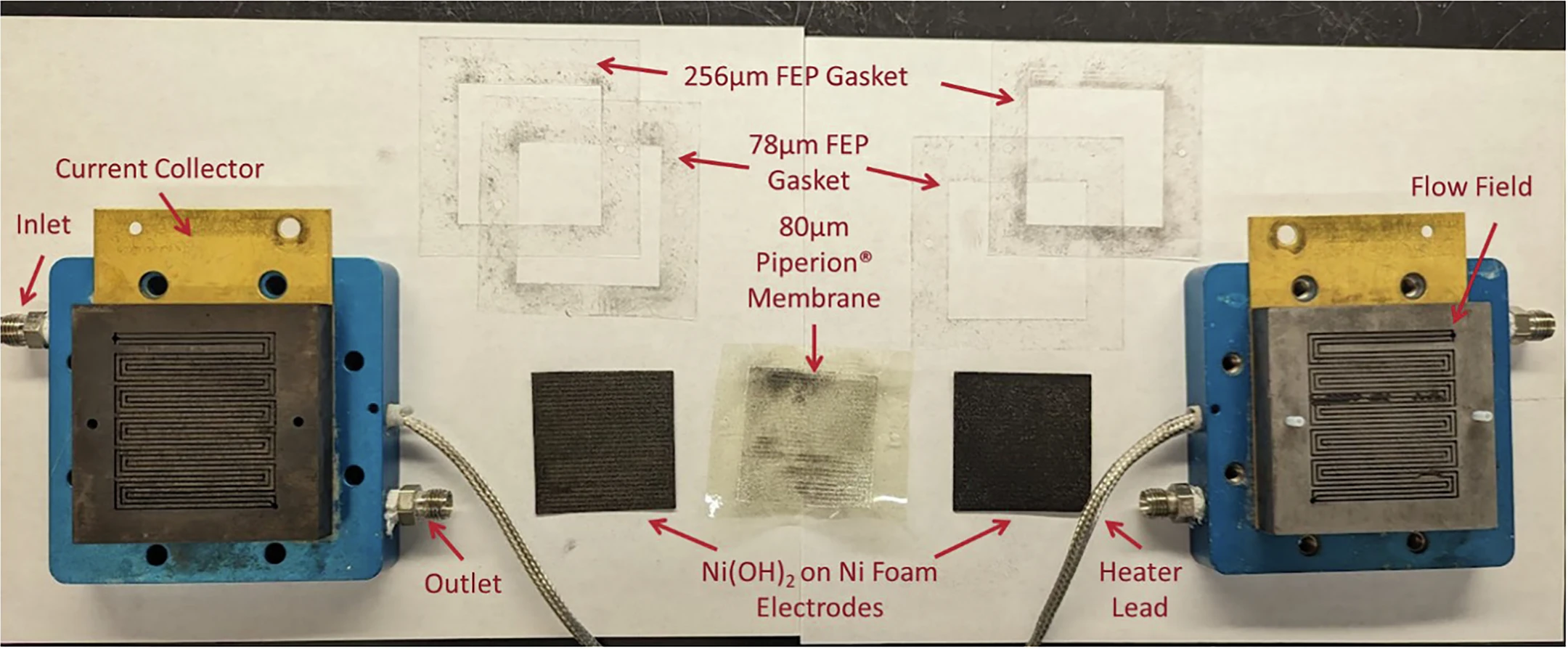
The researchers tested a lab-scale device made of nine cells stacked together, each with an area of about half a letter-sized sheet of paper. A blower pushed air through sinuous air channels in the plates sandwiching each cell together (using components borrowed from fuel cells).
This small device used electricity at a rate of about 0.8 megawatt-hours per ton of captured CO2. Current facilities capturing carbon from ambient air are in the neighborhood of 1.5 to 3 megawatt-hours per ton of CO2.
Piloting the process
Several of the researchers on the team are part of a startup called RepAir Carbon that is based on this technology, and part of the paper is spent on sketching out financial feasibility at scale.
Estimating the cost for an initial small pilot plant (about $566 per ton of captured CO2), they use the learning rate from the lithium-ion battery industry and some common cost scaling for bigger plants to project forward a couple of pilot generations. For a plant with a thousand times the capacity of their pilot, they estimate they could get to $92 per ton of captured CO2.
That would be much cheaper than has so far been achieved by companies like Climeworks, which is aiming to get down to $250–$350 per ton by 2030—and has demonstrated how difficult it can be to meet optimistic scaling projections.
Targeting $100 per ton has long been the goal in the carbon-capture world, as costs that low could spur much wider adoption. Adding to the number of technologies being pursued may improve the odds that one of them reaches that goal.
Nature Energy, 2026. DOI: 10.1038/s41560-026-02129-z (About DOIs).