The fossilised skull of a new species of mysterious meat-eating dinosaur from the Isle of Wight has been rediscovered in the collections of the Natural History Museum after over 100 years in storage.
Over its nearly 150-year history, this London museum has become home to over 30 million specimens, making it fairly easy to forget about the odd fossil or rock here and there. This is almost definitely what happened to the only known fossil of the UK’s newest dinosaur, a two-legged meat-eating theropod (the dinosaur family including birds) which we have named Invictibellatrix amberina in a new study.
In 2020, Paul Barrett, one of the museum’s palaeontologists, looked through the fossil collections and came across a small chunk of bone which he recognised as an important part of the skull of a dinosaur: the braincase. After going through museum records, he realised the braincase was found on a beach near Sudmoor Point of on the Isle of Wight, an island off the south coast of England known for its world-famous dinosaur fossils. Knowing that it came from the Isle of Wight, Barrett enlisted one of us (Cassius Morrison), a PhD student specialising in dinosaur braincases at the time, to study the fossil in detail and try to figure out which dinosaur it belonged to.
This work showed that the roughly 120 million year old fossil was unlike anything found from the island before and belonged to new species of a mysterious family of carnivores called the Megaraptora.
Megaraptorans are known for their slender skulls, lightly-built skeletons and gigantic hand claws, with some of the larger species having claws over 1 foot long. These ferocious predators are known from across the globe, with most species known from South America, particularly Argentina. Our new British species, Invictibellatrix amberina, was on the smaller side for megaraptorans, about 5 metres from head-to-tail and weighed as much a large tiger, making it the smallest known megaraptoran.
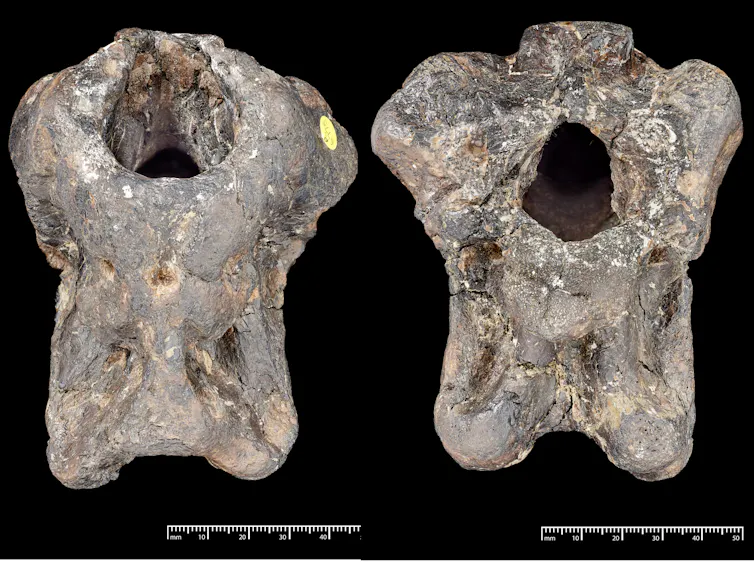
To study the new species, we compared it directly with the skulls of other carnivores. This involved playing a scientific version of spot-the-difference, looking at the subtle differences between species to work out what we were dealing with. We also used computed tomography (CT) scanning, which combines X-rays and computer processing to create detailed images, to look inside the braincase of and study what we could of its brain. Putting all of these findings into a computer algorithm to determine where our species sits in the family tree helped us to avoid bias in our interpretations.
Our work suggests that the new species was probably part of the early days of megaraptoran evolution, representing what these animals looked like before they grew to gigantic sizes, similar to their relatives the tyrannosaurs.
and its place in the theropod family tree are particularly important, as we now have a better understanding of when and how megaraptorans spread across the world. Before the discovery of , megaraptorans were only known from species of the early Cretaceous period (130-120 million years ago) of Thailand and Japan, plus multiple larger species from the late Cretaceous period (85–66 million years ago) of Australia and Argentina.
Warrior of the amber
The great distances between these discoveries means that megaraptorans must have been even more common than their fossils suggest, since there is no way for large animals like these to swim across the oceans that separated these continents during the Cretaceous period.
As the first European megaraptoran, provides us with strong evidence that the group probably travelled to the southern continents from Asia, via Europe and Africa. Afterwards they probably spread out across South America and Australia sometime during, or perhaps even before, the early Cretaceous period. The fossil also implies that other megaraptorans may be waiting to be discovered in Africa and even Antarctica.
probably lived alongside other carnivores such as (a relative of ), (a relative of ) and , which as the name implies, was an early relative to the Tyrannosaurus rex. These four dinosaurs were probably eating different animals to each other to survive. The spinosaur specialised in eating fish, with the others eating more land-based prey. probably fed on small dinosaurs, mammals, lizards and even crocodiles.
The story of megaraptorans seems to follow the pattern of most of nature’s successes. A small opportunist living in the shadows of much larger animals around the globe only to become the dominant force in a few select ecosystems up to the end of the age of dinosaurs.
It’s this story which gave Invictibellatrix amberina its name, honouring the role of megaraptorans as the apex predators in the late Cretaceous of South America. It translates to “unconquered [female] warrior of the amber”.
does not tell us everything. Scientists are still not sure when megaraptorans first evolved, but the fossil does give us some much-needed clues. There is so much left to be discovered about dinosaurs. Sometimes their secrets can be found simply hiding away in museum collections waiting for someone to come and take a closer look.