Amid a cycle of divided parties, political fragmentation and the UK going through a record number of prime ministers in recent years, young people could be forgiven for tuning out of politics altogether. Our experts have recommended nine books to strike teenagers and young adults’ interest in thinking politically.
1. Noughts and Crosses by Malorie Blackman (2001)
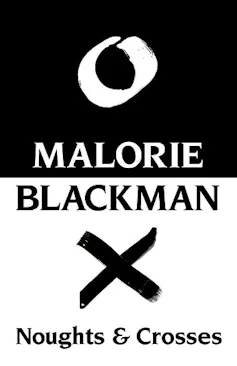
Noughts and Crosses makes the consequences of racial injustice, segregation and unequal political power impossible to ignore, showing how politics can affect people’s friendships, families, relationships, safety, opportunities and futures.
The book follows Sephy and Callum, two young people whose friendship and love are shaped by a deeply unequal society. The Crosses are the dominant political and social class, while the Noughts face segregation, discrimination and violence. Yet, the book does not simply tell readers that discrimination, segregation and prejudice are wrong. It makes them feel the damage these forces do to individuals, families and communities.
Blackman shows how political systems and social attitudes can protect privilege. They limit opportunity and make injustice seem normal, as education, policing, public opinion and everyday interactions all reflect and enforce the built-in inequality between Crosses and Noughts.
For young readers (and older ones), this is a gripping introduction to questions about power and responsibility. It is particularly valuable for those who may not often have to think about inequality in their own lives. The book reminds us that politics is about real people’s safety, dignity, futures and wellbeing.
Zoe Stephenson is an associate professor in forensic psychology
2. Can You Run the Economy? by Joe Mayes (2025)
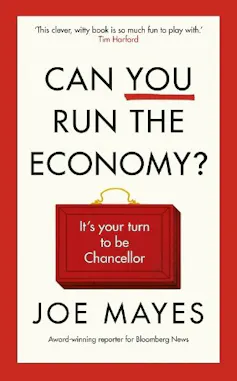
People often think politics is all about speeches and debates, but economics is where many of the biggest political decisions are made. That’s why I’d recommend Can You Run the Economy?; this interactive book lets you actively participate and “become” the chancellor. Readers make decisions on taxation, public spending and the wider economy while balancing advice from political advisers, responding to pressure from the prime minister and dealing with unexpected events that threaten to derail your plans.
Some decisions readers face in the book sound popular, but your fictional advisers question whether the public finances can actually support them. That’s what makes the book so engaging: every choice has consequences, and you’ll often find your advisers disagreeing on the best course of action. I even managed to get myself sacked as chancellor. As frustrating as this situation was, it perfectly demonstrated the point the book is trying to make: sensible economic decisions don’t always lead to political success. Sometimes the right economic choice can be the wrong political one.
By experiencing difficult trade-offs for themselves, young readers will quickly realise that politics isn’t about finding perfect solutions. It’s about balancing competing priorities and understanding the consequences of decisions.
Matthew Allen is a lecturer in economics
3. Freedom is a Constant Struggle by Angela Davis (2015)
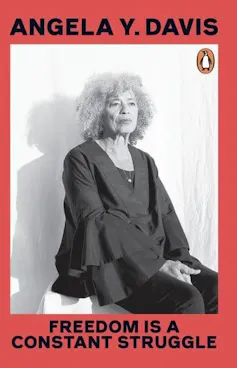
This is an excellent introduction to politics for young people. In the book’s foreword, American philosopher Cornel West calls Davis an “intellectual freedom fighter” and notes that she was once at the top of the FBI’s most-wanted list. Her determination and fighting spirit are palpable on every single page.
Freedom Is a Constant Struggle is a collection of speeches and interviews given throughout the early 2010s, which connects movements that centre and inspire young people such as Black Lives Matter, Occupy, prison abolition and Palestine solidarity. Davis’ analysis is rooted in walking the talk, and the book is especially engaging for younger readers because it links ideas to political action in a clear and accessible narrative.
The book draws on personal and political history to show that struggles for justice are interconnected rather than isolated, evolving rather than static. It inspires critical thinking, solidarity, and the courage to imagine otherwise.
Alison Phipps is a professor of political sociology
4. Brit(ish) by Afua Hirsh (2018)
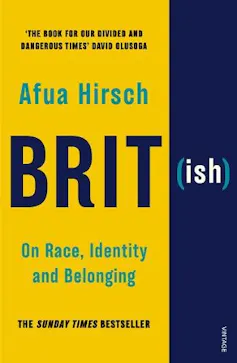
Brit(ish) explores what it means to live in Britain as a dual-heritage person who is always asked, “Where are you really from?”
Blending memoir, history and cultural analysis, Hirsch moves from her childhood in affluent, majority white Wimbledon to Oxford and later to Senegal and Ghana. The novel traces how everyday racism, microaggressions and “colour-blind” attitudes shape a fragile sense of belonging. These places matter because they chart Hirsch’s struggle to belong. English settings expose the racism and class privilege in Britain, while West Africa reveals that returning to her roots does not give her an easy sense of home.
Her stories of being followed in shops, misread by both white and Black communities, and repeatedly interrogated about her origins expose the mental toll of feeling like an outsider at home. Throughout, she links her personal dislocation to Britain’s unacknowledged histories of slavery, empire, immigration and the policing of the “good” immigrants. Young people would enjoy reading the book for its clarity and Hirsh’s harsh truths about her own lived reality that reflects the importance of identity in Britain today.
Najma Yusufi is a fellow specialising in transnational and postcolonial literature
5. Brave New World by Aldous Huxley (1932)
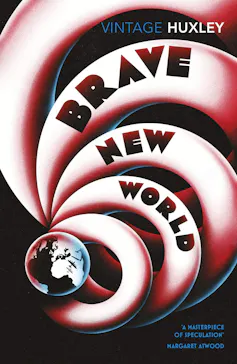
What would happen if a society prioritised stability above everything else, including personal freedom? This is one of the central questions explored in Brave New World, set in a future society built on genetic engineering and social conditioning. The novel presents a world in which people are designed for particular roles and taught from birth not to question them.
Citizens are kept satisfied through both constant entertainment and use of drugs, allowing those in power to maintain social order without the use of force. While this system appears to eliminate conflict and suffering, Huxley invites readers to consider what has been sacrificed in return – people now doubt their ability to influence the society around them. This reflects political disillusionment among some young people today, who question whether traditional institutions can genuinely represent them or bring about change.
Huxley suggests that power is not exercised only through governments and laws, but also through education, science, technology and culture. These are areas that strongly influence young people’s lives, and the way they understand the world around them. By exploring the tension between individuality and conformity, the novel challenges the assumption that a comfortable and carefully manageable life is preferable to one that includes certainty and genuine freedom. Brave New World continues to encourage young people to reflect critically on the world we live in today, considering how comfort and entertainment can sometimes discourage people from challenging society around them.
Ana Nunes is a senior lecturer in social and political sciences
6. Imagination: A Manifesto by Ruha Benjamin (2024)
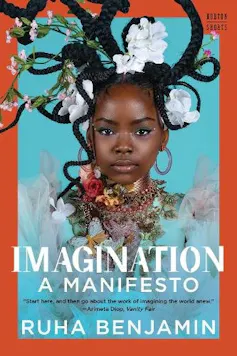
Imagination: A Manifesto asks whose futures we currently are asked to pay attention to, and what other futures we might collectively imagine instead.
Novelist Toni Morrison once urged “… when you enter those places of trust, or power, dream a little before you think”. Benjamin takes this seriously, arguing that imagination is too often thought of as childish or reserved for artists, rather than being understood as a site of struggle, a place of possibilities. As every system we live under was first imagined by someone, Benjamin argues it thus can be reimagined.
Benjamin unpacks how our collective imagination of the future is currently built around entertaining the fantasies of the rich, who envision privatised space travel instead of free public transport, colonising Mars instead of decolonising Earth, mass incarceration instead of a world that holds everyone safely. Instead of accepting the world as it is, Benjamin offers a plea is for collective, critical, and creative imagining of different futures altogether.
For young readers, it’s a great way of understanding that the future they are being taught isn’t inevitable but shaped by political choices. The book treats imagination as a skill, built through everyday practice. This can be seen in classrooms, friendships and through creative work, which all make political thinking feel accessible and vibrant. The challenge, Benjamin argues, is to pursue collective acts of imagination, such as building disruptive art installations, or developing community data projects that wrest control of information away from surveillance systems and back into neighbourhood hands. In doing so, we can begin to take imagination seriously as the starting point for political change.
Harry Dyer is a digital sociologist and associate professor in education
7. But What Can I Do? by Alastair Campbell (2023)
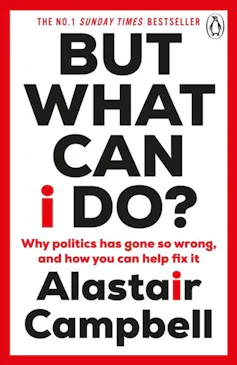
But What Can I Do? asks a timely question. Can individual citizens still make a meaningful difference in public life? The book shows that political engagement doesn’t only mean standing for office or joining a party. It can begin with supporting local campaigns, voting, volunteering or simply having better dinner conversations.
Campbell’s top ten reasons to consider going into politics are so persuasive that, for a fleeting moment, I wondered whether I had missed my true calling. Tip number ten: “If you make it to the top … you’re talked about and written about forever.” It’s certainly tempting, if not exactly modest. Yet at a moment when public debate is increasingly focused on safety in political life, and the UK is “trying out” yet another new prime minister, the reader may understandably pause before submitting any nomination papers.
By drawing on his considerable and heavily critiqued political experience, Campbell argues that democracy depends not only on elected representatives and institutions, but also on active, informed and persistent participation by citizens. The book is a useful reminder that politics should be the responsibility of all of us.
Francine Morris is an associate dean of business
8. Homage to Catalonia by George Orwell (1938)
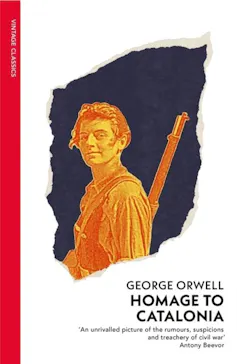
In this account of his time fighting against the fascist Francoists in the Spanish civil war, Orwell writes with immediacy and passion.
He vividly conveys the physical experiences of fighting and suffering injury on the frontlines, as well as the frustrations of the destructive internal struggles that undermined the Republican cause. Ultimately, Orwell fought on the losing side. The arms, soldiers and advisors provided by fascist Italy, Nazi Germany, and the Soviet Union proved one of the decisive factors in Franco’s victory.
This is particularly pertinent at a time when we have seen a decades-long reemergence of radical right-wing politics in Europe. Had more democracies come to the Spanish Republic’s defence, the war’s outcome might have been different.
Homage to Catalonia can remind young people of the importance of politics and fighting for what is right. Its immediacy demonstrates why we should get involved in politics to advocate for and defend what we believe in (though hopefully without the need to take up arms). It’s also a poignant illustration of what it is like to be on the losing side, even when your cause is just. Politics sometimes involves painful defeat. We have to be ready to regroup and find ways to carry on campaigning for what we believe in.
Joe Greenwood-Hau is a lecturer in political and international studies
9. A Christmas Carol by Charles Dickens (1843)
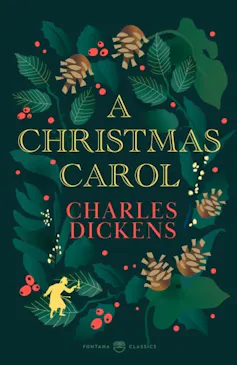
This is a timeless classic associated with festive goodwill and generosity. Yet it began as a political pamphlet: “An Appeal to the People of England, on behalf of the Poor Man’s Child.” Driven by anger at widespread poverty, child labour and the appalling treatment of the poor, Dickens reshaped that appeal into a supernatural, heartwarming tale to reach a far wider Victorian audience.
Scrooge, the “odious, stingy, hard, unfeeling man”, is isolated by greed. The Cratchits are poor yet full of joy and gratitude. Ignorance and Want, two impoverished children with “no refuge or resource”, represent the societal and moral consequences of poverty, forcing readers to confront social injustice directly. Dickens presses that addressing the gap between the rich and poor is a collective responsibility. A society rife with poverty and inequality harms all in the end, including the wealthy.
A Christmas Carol feels as timely now as in 1843. Though written as political provocation, it still contains hope, which can inspire young readers to pursue change in themselves and society. Any young person confronting our own highly unequal society, in which extreme wealth exists alongside extreme poverty, should read it and consider what can be done to change Britain for the better.
Anna Thew is a research fellow in public policy
This article contains references to books that have been included for editorial reasons, and may contain links to bookshop.org. If you click on one of the links and go on to buy something from bookshop.org The Conversation UK may earn a commission.