Nvidia doesn't seem to care whether open or closed models win out as long as its hardware is powering the infrastructure.
"We love closed models," CEO Jensen Huang said. "There's a solid place in the world for closed frontier models. But the world has so many good ideas … The idea that all of us would be based on general intelligence is not logical."
Speaking with Lin Qiao, CEO and founder of Fireworks.ai, at the company's Forge event in San Francisco on Tuesday, Huang wasn't ready to throw Nvidia's cloud customers, which help deliver the proprietary AI of Anthropic and OpenAI, under the onrushing open model bus.
But having come to the defense of open weight models in July to push back against protectionist pressure from the leadership of Anthropic and OpenAI, Huang recognizes the economic and strategic appeal of AI services that are more affordable and less locked-in.
Most of the value in the world, he said, is captured in specialized intelligence, which is to say AI models trained on specific domains of knowledge.
"The opportunity for artificial superintelligence is already here," he said. "By taking an open frontier model, adapting it, and providing it with your domain knowledge, your access to your specialized tools, and the proper evaluation, you should be able to create essentially a superintelligence."
That aligns with Fireworks' business – offering a platform for companies to train and run models tuned to their specific needs. Coincidentally, that platform just received an infusion of 25,000 Nvidia GPUs to support its expansion in Europe.
Huang's endorsement of open models also fits with Qiao's introductory remarks about the need for the AI frontier to be open. But he largely avoided echoing Qiao's focus on the cost savings allowed by working with open models.
In her introductory remarks, Qiao stood on stage backlit by a slide composed of ten headlines highlighting the extraordinary cost of unchecked token spending.
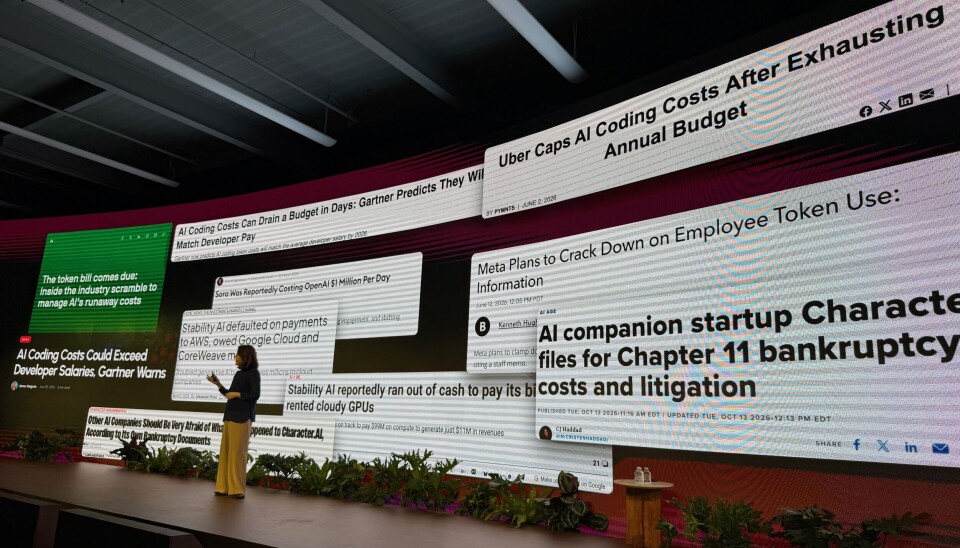
"Cost is out of control," she said. "Business cannot scale without borrowing a lot of money."
That theme was echoed in a subsequent session helmed by Kay Zhu, co-founder and CTO of AI workspace Genspark, titled Gen-1 Slides: Frontier Quality Without Frontier Costs. Gen-1 Slides, Genspark's model for generating slide decks, was built atop MiniMax M3 and tuned to deliver results comparable to Anthropic's Opus 5 at 1/17th the cost – $0.30/M tokens compared to $5/M.
Asked what might become commonplace next year but seems unlikely today, Huang said this year's breakthrough has been agent harnesses that turn AI models into agents. He added, "I would say the big breakthrough we'll talk about next year, maybe this is a little self-serving, is how Open Shell has enabled every company in the world to deploy agents safely, confidently."
Given the nod to make a second prediction, Huang added, "I would say that the second big breakthrough for industry would be hardware in the loop. And hardware in the loop basically is robotic systems."