Full-stack safety solution for physical AI is being used by robotics companies.
Investors bullish on AI data centers may be fueling Nvidia’s multi-trillion-dollar market capitalization, but the AI chipmaker has also bet billions of dollars on physical AI technologies such as robotics and self-driving cars. Part of that gambit has involved Nvidia developing a full-stack safety system that companies can build upon to reduce the risk of their machines harming nearby people.
Nvidia’s Halos system launched in 2025 with hardware and software tools to help developers implement guardrails in self-driving cars and other autonomous vehicles. Then the company expanded its safety architecture to more physical AI technologies by announcing Nvidia Halos for Robotics in June 2026—with the goal of enabling safe deployments of autonomous mobile robots in warehouses, humanoid robots walking around inside a factory, or even surgical robots.
“Now the AI models are getting capable, the robot hardware is getting capable, and a thing we thought is going to be the next bottleneck is safety,” Amit Goel, head of robotics ecosystem and edge computing at Nvidia, told Ars. “So that’s why we launched our Halos for Robotics to unlock the capability of these systems.”
The expanded safety offering for robotics comes as Nvidia CEO Jensen Huang described the physical AI business as already driving nearly $10 billion in annual revenue for the company during an appearance on the All-In Podcast in March 2026. Huang previously began highlighting physical AI as Nvidia’s second-most important growth category in 2025.
Expanding safety from AVs to robots
So what does Nvidia’s full-stack safety system involve? It starts with hardware, such as the Nvidia IGX Thor computing module for robotics and industrial applications that has an independent processor dedicated to safety-related workloads. “In the context of physical AI, you need to have your functional system and your safety system all running on the same silicon,” Goel said.
On the software side, the Halos operating system was designed to enable constant monitoring of “every hardware block” and “every software library” to swiftly spot any failures, Goel explained. The system also isolates safety-critical computing workloads to avoid any potential interference.
The system also includes the Nvidia Holoscan Sensor Bridge that connects sensor data with safety-related computer processing in a way that can easily identify corrupted data. This can be embedded in individual hardware components such as a microcontroller or Field Programmable Gate Array.
Last but not least, the Halos package also includes Nvidia’s simulations for testing robots in virtual environments, and an inspection lab program that allows robotics companies and other partners to get quick feedback on any safety “artifacts” that arise during robotic development.
However, adapting Nvidia Halos from autonomous vehicles to robotics required accommodating many different definitions of safety. The definition of functional safety for autonomous driving generally remains the same across different automotive companies and countries, Goel explained. But a robotic vacuum cleaning a hallway will have very different safety considerations compared to a robotic forklift handling heavy payloads in a warehouse loading docks.
“We had to reimagine and do a lot of foundational work to build a platform that is programmable, that gives all the hooks to the developers to actually define custom safety functions, but at the same time not break the underlying infrastructure that we built,” Goel told Ars. “Because giving flexibility can come at the cost of losing some control over the stack.”
Custom safety functions are also necessary because robots may operate in complex, diverse environments.
“If you are a robot coming down an aisle at six miles per hour, your senses do not see what are the blind spots and what is coming around the corner,” Gold said. “What the robots do is almost come to a halt before the turn, because they really don’t know what’s happening in all these factories, warehouses and hospitals—they’re unstructured environments and things can come from anywhere.”
Real-world robot deployments
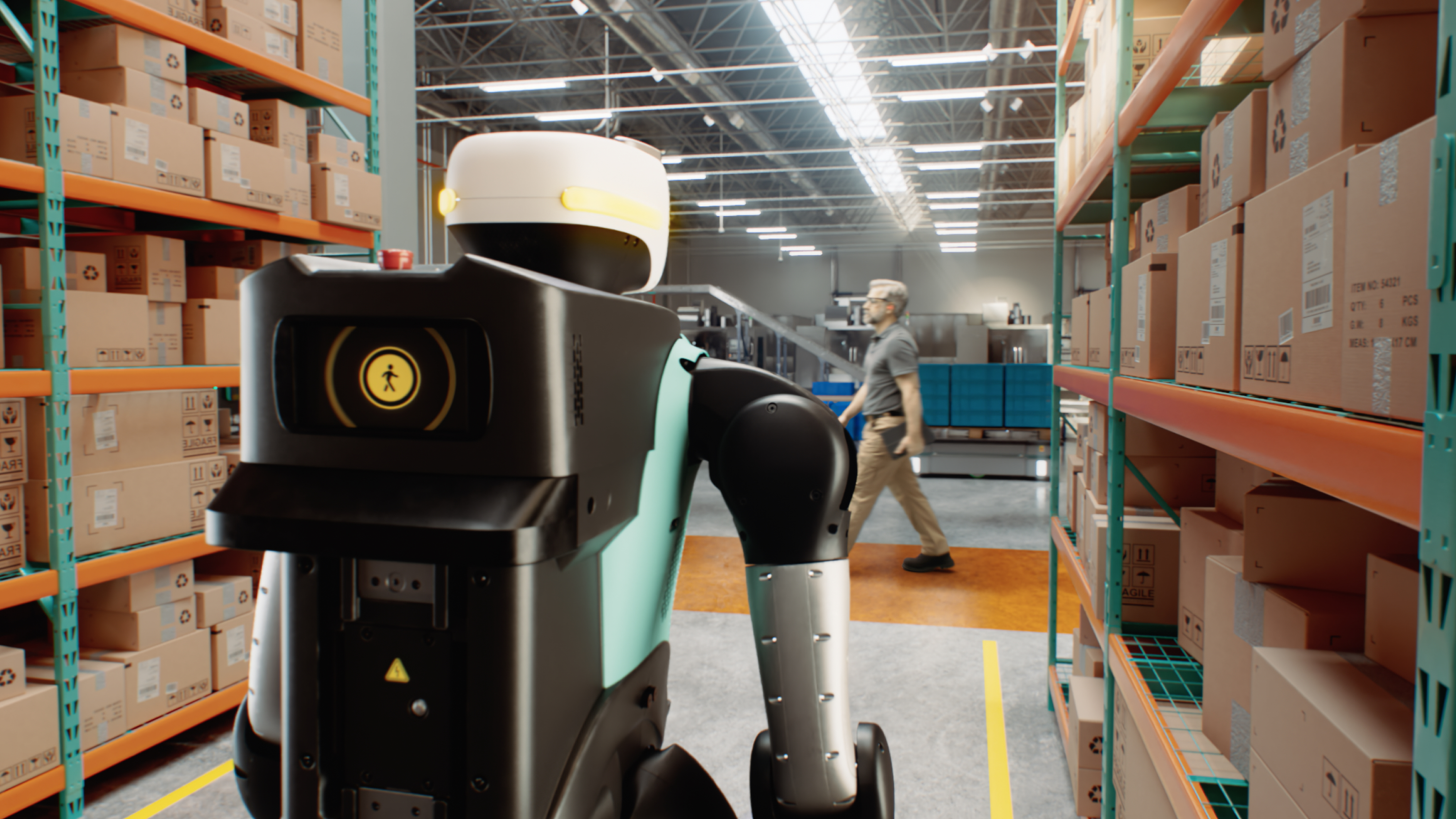
The US startup Agility Robotics was first to incorporate Nvidia Halos into its latest Digit 5 humanoid robot that is designed to work safely near people without requiring isolated workstations or physical barriers. The Nvidia system helped Agility bring all the relevant safety sensors and hardware inside the robot, whereas previous Digit robot operations have also relied on external sensors placed around the robot’s work cell to ensure safety.
“Now the robot is literally unchained—the safety goes with the robot wherever it goes,” Goel told Ars. “Now they can operate everywhere in a factory or a warehouse without having to set up a brand new infrastructure every time they want to do a new task.”
The Massachusetts-based robotics company Boston Dynamics has also been an early partner in the Nvidia Halos safety accreditation program, with a focus on building a safety platform that encompasses their Spot robot dogs, wheeled Stretch robots with a large robotic arm, and Atlas humanoid robots that could start deploying in the automotive factories of parent company Hyundai by 2028.
Other companies working to incorporate Nvidia Halos include the German company KION Group that deploys self-driving forklifts and other autonomous mobile robots, along with the South Korean company LG that is developing its own humanoid robot based on Nvidia’s IAI foundation model for humanoid robots called Isaac GROOT.
It remains to be seen if humanoid robots can become autonomous, general-purpose robot workers capable of handling practically any human task. But the latest push by the United States, China and Europe to deploy more robots extends well beyond humanoids—and is putting robots to the test in many new environments.
“Earlier robots were mostly confined in one station doing one thing,” Goel said. “But in the new age of robotics with a generalized body as well as generalized skills, it is essential that the robots can do multiple tasks in multiple environments—and the only way you can do that in production is if you improve safety.”