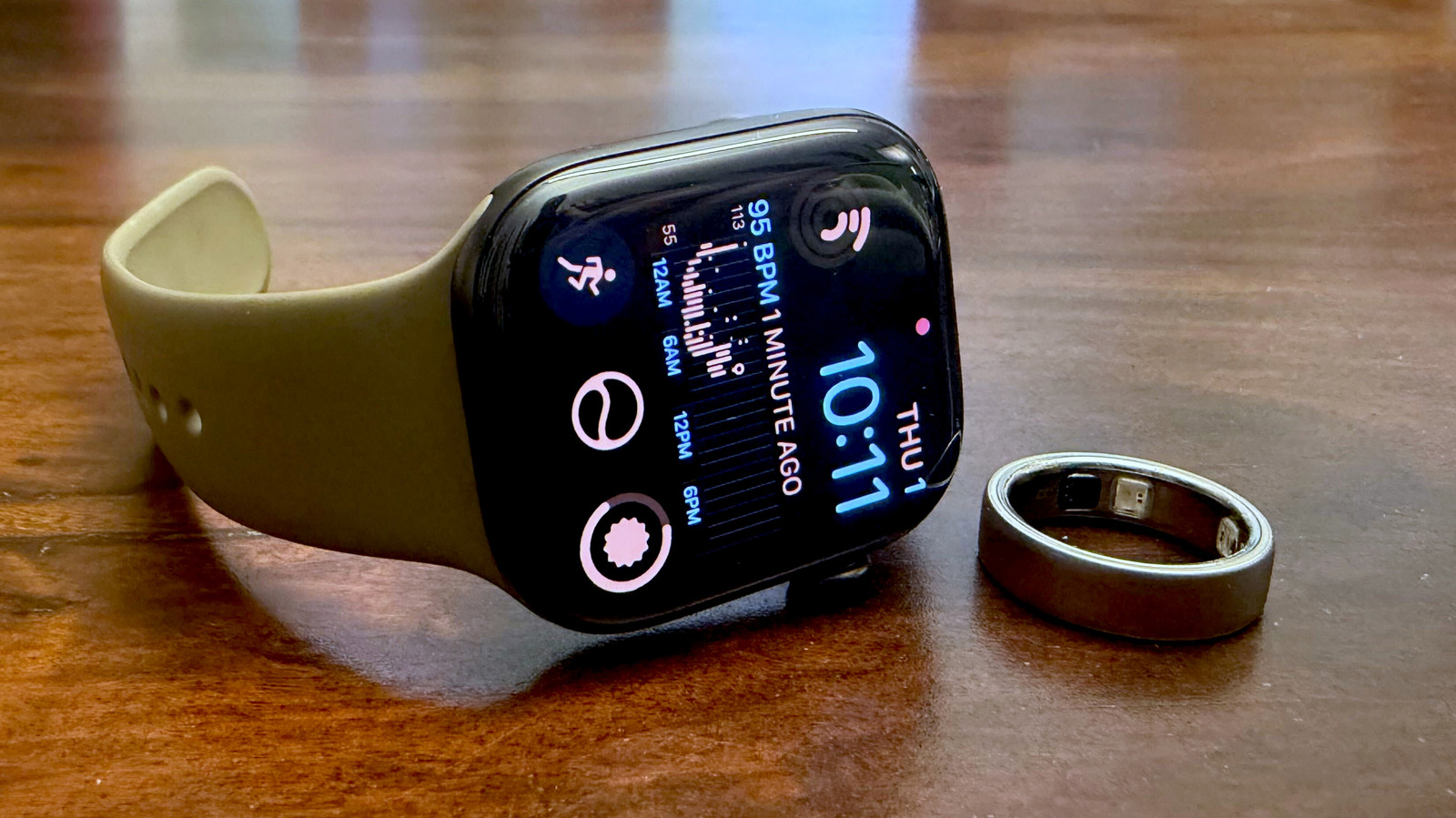
The Oura and the Series 12 gather much of the same health data, including metrics like sleep, steps, estimated calorie burn and heart rate (including variability). They also provide tracking related to menstrual cycles, though Oura claims to go a step further in women's health, providing insights related to pregnancy and menopause. They further share Readiness scores, which synthesize various factors to gauge whether you should push for that new squat PR or take it easy.
From there, though, the devices actually diverge pretty sharply. Naturally, the biggest difference is that the Series 12 has a touchscreen, available in 42 and 46mm sizes (the latter costing $50 extra). It's about more than checking the time or health data — in tandem with 64GB of storage and Apple's S11 processor, the Series 12 can handle many tasks without needing to pull out your iPhone, from Apple Pay and notifications to navigating off-road trails. Cellular models (starting at $500) can handle some online functions without Wi-Fi, whereas an Oura has no choice but to talk to your phone. You'll have to pull out your phone to see any of your Oura's data or control its settings — the company is even discontinuing its web interface.
Speaking of which, it's time to talk about platforms. While both devices sync with Apple Health, only the Oura supports Android's equivalent, Health Connect, for one very obvious reason: The Series 12 requires at least an iPhone 11 running iOS 27 or later. If you own an Android phone from the likes of Google, Samsung, Motorola or others, your time is going to be better spent pitting the Oura against Google's Pixel Watch 5 or Garmin's many alternatives.
It's also worth noting that the Series 12 is miles ahead when it comes to workouts. The Oura mostly detects activities automatically and stores your data in its app, and it may not always register them accurately or at all. Manually launching one is more reliable, but either way you'll have to grab your phone to see any real-time data. Conversely, while you have to launch many Series 12 workouts yourself, that gets you real-time stats on both your phone and your wrist. Often, it's tracking data that the Oura simply can't, such as running cadence or your precise GPS location. The Oura can only link GPS data from your phone. Incidentally, any smart ring is a bad choice for weightlifters, since you're liable to grind down its shine with the knurling on barbells and dumbbells.
One area where the Oura triumphs is battery life. Realistically, any non-Ultra Apple Watch should be charged every day, possibly even twice per day if you want to do sleep tracking. The Oura can potentially last six to nine days straight. That's far more convenient, and it reduces the gaps in your data as well.