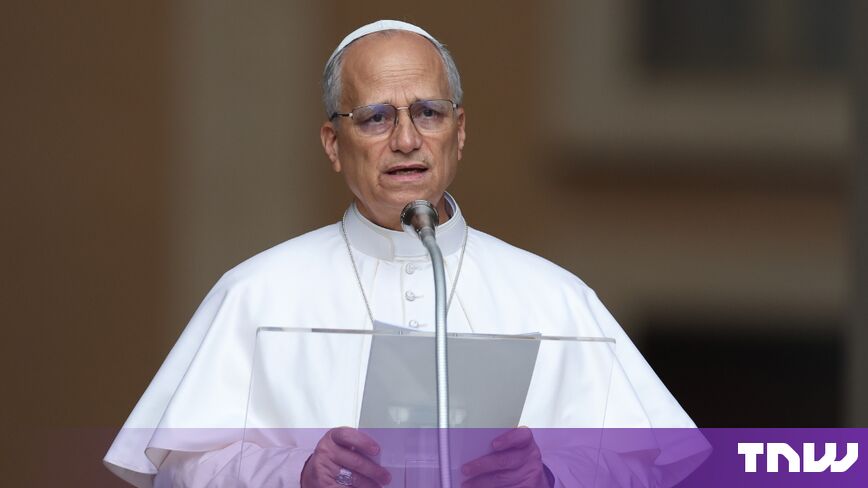
Pope Leo XIV arrived at UNESCO’s Paris headquarters on Friday with a question he said no culture can take for granted, not even in the 21st century: what does it mean to be human?
The address was the centrepiece of a day UNESCO had dedicated to artificial intelligence, information integrity, education, and artistic creation.
A few hours earlier, at the Élysée Palace, Pope Leo had warned President Emmanuel Macron against a “paradise of machines” invading daily life.
At UNESCO, he said new tech must serve people.
“Our efforts in this domain must ensure that new technologies remain at the service of the human person rather than becoming yet another instrument of domination and injustice.”
He said machines have taken over many human tasks over the years, and now, he added, some of them are even called intelligent, a word for how people think.
“While intelligence is attributed to computational systems, we struggle to recognise the inalienable dignity of human persons whose lives are judged according to the criterion of efficiency.”
People who are no longer seen as productive are then “rejected and discarded,” he added. He also said a person’s worth does not depend on what they can do.
Then, Pope Leo also spoke about how people share news and facts. He said we talk faster than ever, but not more truthfully. Having more facts, he said, does not make us wiser.
“Artificial intelligence amplifies this problem. Although such systems can correlate data, they cannot answer questions that concern the meaning of human life, which is rooted in lived experience,” he said.
“Meaning is the oxygen of the mind,” he added.
He called the search for truth a matter of justice. He also praised a UNESCO programme that teaches people to use media and digital tools with care.
The Pope then asked the international community to pay particular attention to children and young people.
“In the digital age, their vulnerability must never become an opportunity for exploitation,” he said.
He said tech should help young people grow, learn, and build friendships, and should protect their freedom to think for themselves.
Then, Pope Leo used the biblical story of the Tower of Babel to describe “a unity imposed through domination.”
He said the same urge shows up today in new forms of colonialism, and it also appears wherever life is treated as a thing to buy and sell.
“Science itself, when reduced to a technique of power, no longer serves to elevate the human person,” he said.
Ahead of the speech, France 24 reported that Leo was expected to call for AI regulation. A day earlier, Leo told the Pontifical Academy of Sciences that AI had brought “new dangers to security and international peace.”
AI has been a key theme for Leo since he became pope. In May, he published his first encyclical, a formal letter to the Church, called .
UNESCO said the Paris visit would also include a framework agreement with the Holy See on AI cooperation. Earlier this week, the Vatican also backed a new AI4Peace International Association.
His argument was narrower and harder to wave away: a technology built to answer nearly anything is being asked the one thing it cannot, while the people who can are increasingly judged by whether they are productive. For an industry that measures its models in tokens per second, “meaning” is an unfamiliar benchmark.
His Holiness Pope Leo will continue the trip until Sunday, when he is due to speak in Metz.