
People are being told to prepare for "the unthinkable" as flood response teams warn of a heightened risk over the autumn.
Natural Resources Wales (NRW) said it was concerned by long-range forecasts which indicated an increased likelihood of wetter, windier weather than usual over the coming months.
Those living in flood-hit areas told BBC Wales they were worried, and had started preparing.
One in seven properties in Wales is classed as being at risk of flooding, but NRW said just 27% of those eligible to receive flood warnings to their phone or email were currently signed up.

After a summer marked by drought and wildfires, the organisation has urged people "not to become complacent" and said conditions could change quickly.
Wales has seen a series of major floods in recent years, often in the wake of powerful storms such as Dennis in 2020, Bert and Darragh in 2024 and Claudia in 2025.
The threat comes from both rivers and the sea, while surface water flooding - where local drainage systems become overwhelmed during heavy downpours - is seen as an increasing danger.
NRW argues that the country's geography makes it particularly vulnerable - with a vast coastline and several so-called "fast-responding" rivers which can fill at speed as rain runs off steep terrain in places like the south Wales valleys.
More than 274,500 homes and businesses are currently classed at risk of flooding, with this figure set to increase significantly by the end of the century.

'People could have died'
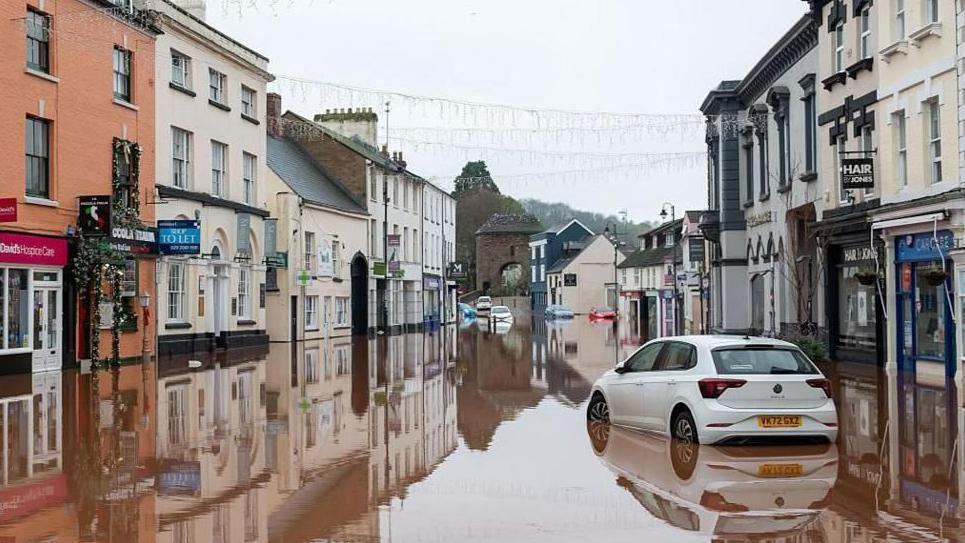
On the high street in Monmouth, people told BBC Wales of "harrowing" and "dreadful" scenes when major flooding hit in November 2025.
Friends Malcolm Butcher, 82, Jim Tyler, 81, Brian Churches, 82 and Dave Blake, 82, said they had lived in the town all their lives "and never seen anything like it".
"At 2:30 in the morning when it hit it was unbelievable... absolutely raging," Malcolm said.
If it had happened in the daytime "people would have died", he added.
Eighteen cars on his road were lost to the flood waters - including his own, while the houses in the street behind were all flooded out.
"It is a worry, we have three rivers running into Monmouth... and the winters are changing," he said.
People could help prepare for floods by moving "the good stuff upstairs" and making sure they had sandbags to hand ahead of bad weather, he said.
"It's not back to normal yet but we're getting there," added Imogen Elliot, 82.
"Waitrose was four feet in water and it went right up the street - we've had flooding before but not like that."

Jane Roche, who runs a café and fishmongers on the banks of the River Teifi in Cardigan, Ceredigion, has helped coordinate a community flood plan for the area.
"Flooding is something we've learned to live alongside for many years - we've seen first-hand the disruption it can cause for businesses, residents and visitors," she said.
"Developing a community flood plan has brought local people together, helped us understand what actions we need to taken when warnings are issued and given us confidence to support one another when severe weather is forecast."
More frequent and intense weather extremes are expected as a result of climate change, with Wales facing the prospect of wetter, wilder winters more often.
Meanwhile, this year scientists are monitoring the El Niño event over the Pacific Ocean - which set to be "strongest in living memory".
The powerful natural climate phenomenon pushes up global temperatures and can increase the risks of extreme weather.
While this does not automatically translate into bad weather in the UK it is "part of the picture" that is leading to concerns for the coming months, according to Jeremy Parr of NRW.
"We do invest in flood defences... but you can't stop all of the flooding all of the time," he said.
"So that means that people need to think the unthinkable really - or the unpleasant - and [consider] if it were to flood around where I live, what would I do?"
"Time and time again" the organisation was told by people who had experienced devastating flooding that "they'd never flooded before, and didn't think it would happen to them", he added.
NRW advises people to check their flood risk by postcode online, sign up for flood warnings and access advice about what to do if flooding is forecast in their area.
The organisation's flood warning service is available to 181,158 properties in Wales, but new figures show just 48,844 were currently signed up to receive the alerts via phone or email.
"It is low - 27%," Parr admitted, suggesting that people may be being put off by myths that signing up could affect their insurance premiums.

Cardigan's mayor Olwen Davies has bought a flood door for her own house, and also uses a flood gate for extra protection.
She said: "The river comes up once or twice a year... if there's a high tide, with a strong south-westerly wind that's what creates the most havoc.
"We work together and we know who to call on," she said.

Sarah Davies from the Met Office said long-range forecasts for October, November and December suggested "a greater chance of weather-related disruption".
"Weather patterns can change quickly at this time of year, and long-range forecasts describe broad seasonal trends rather than the timing, location and severity of individual weather events," she added.
"Whatever the season, understanding your flood risk and knowing what action to take if warnings are issued are sensible steps that can help you prepare should severe weather occur."
Additional reporting by Sara Dafydd