A combination of Chinese competition and US tariffs is causing problems in Germany.
The future is looking increasingly bleak for Germany’s automotive industry. Since the turn of the century, car makers have been among the crown jewels of the German economy, punching above their weight in terms of investment and innovation. But those companies are now facing multiple problems at once, from declining demand at home and stronger competition from abroad to the cost of punitive and arbitrary new tariffs, on top of preexisting structural challenges like an aging workforce and a slow recovery from COVID.
Total automotive sales in Europe have fallen from a peak of almost 18 million in 2019 to around 13 million in 2025, and some share of that smaller market is increasingly going to new entrants from China, which has its own spare automotive production capacity problem to worry about. And while the US market has always been the most profitable for German car exports, that was before the imposition of new import tariffs, which currently stand at 25 percent but could be subject to change at any time.
Factory closures now seem not just possible but likely, something that would have been unthinkable just a few years ago. Earlier this summer, news emerged that Volkswagen Group is considering closing four of its German factories to prepare for the future. Things have not gotten much better for VW Group in the months since that news broke.
Part of its problem is Porsche. VW Group has owned the Suttgart-based sports car maker since 2008, after turning upside-down a failed bid by Porsche to take over VW Group. And for a long time, Porsche generated significant profits for its owner. But sales in China have slowed, and like many other OEMs, it bet too heavily too soon on the electric vehicle transition; Porsche’s EVs are very competent, but it builds too many and sells too few. As a result, its profit margin fell below that of Skoda.
That’s partly why VW Group had to write down $11.5 billion (€10 billion) on Friday, $6.9 billion (€6 billion) of which was as a result of its 75 percent stake in Porsche.
Faced with the likelihood of a terrible 2026, VW may speed up its plan to shrink its workforce. “I had hoped that the measures agreed in 2024 would already be sufficient. Unfortunately, that has not been the case. We have absolutely no time to lose and will therefore significantly step up our performance program,” VW brand head Thomas Schaefer told a staff meeting.
And VW Group isn’t the only one. Today, Mercedes-Benz became the latest OEM to warn workers that it might have to close “one German assembly plant and one German powertrain plant” unless it can save costs.
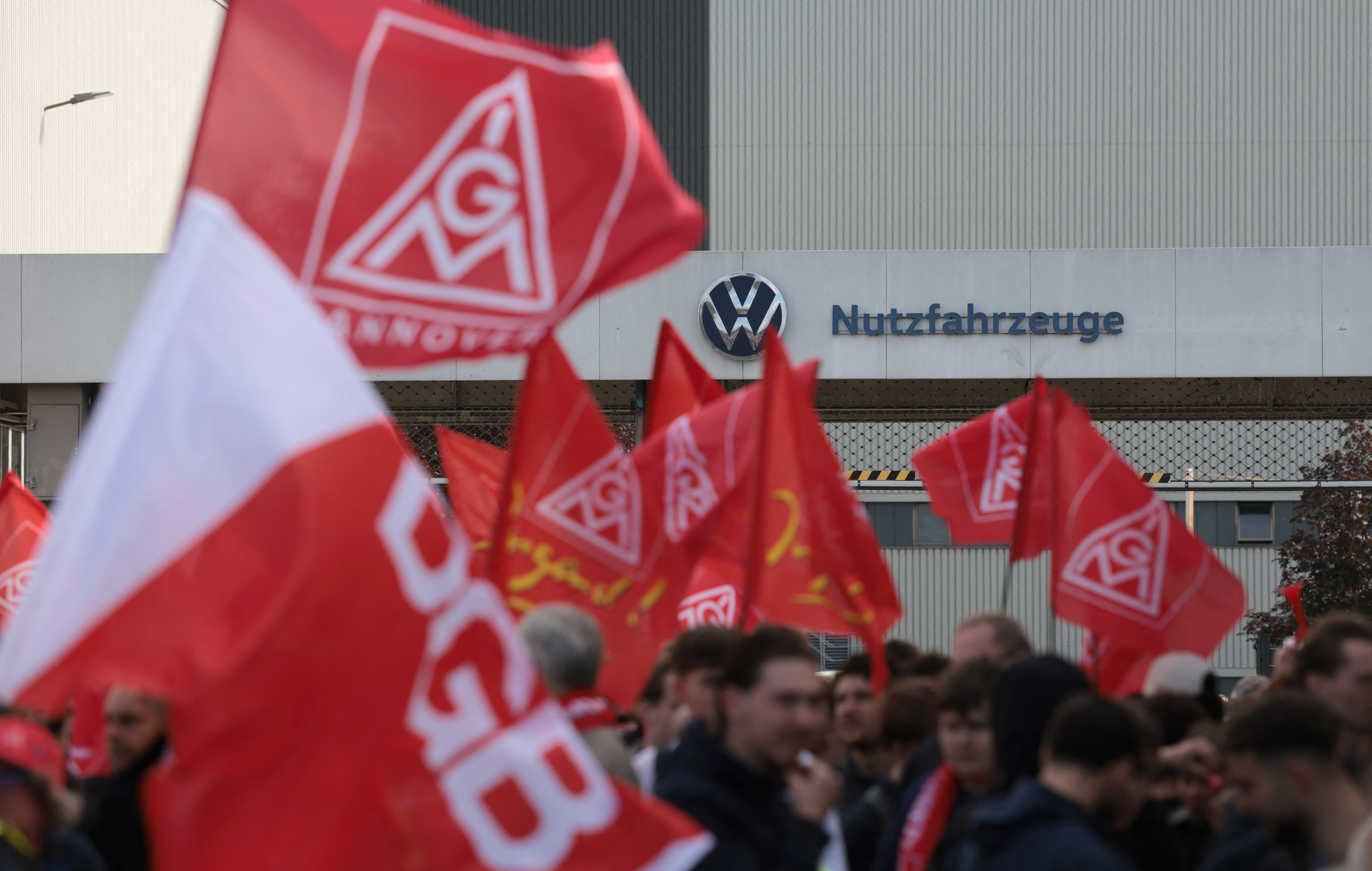
Workers were out in protest yesterday at Audi, BMW, Mercedes-Benz, Porsche, VW, and their suppliers. “We expect corporate leaders and management teams to take responsibility for Germany as an automotive nation, for employees and for jobs,” said Christiane Benner, head of the IG Metall union, which was leading the protests.