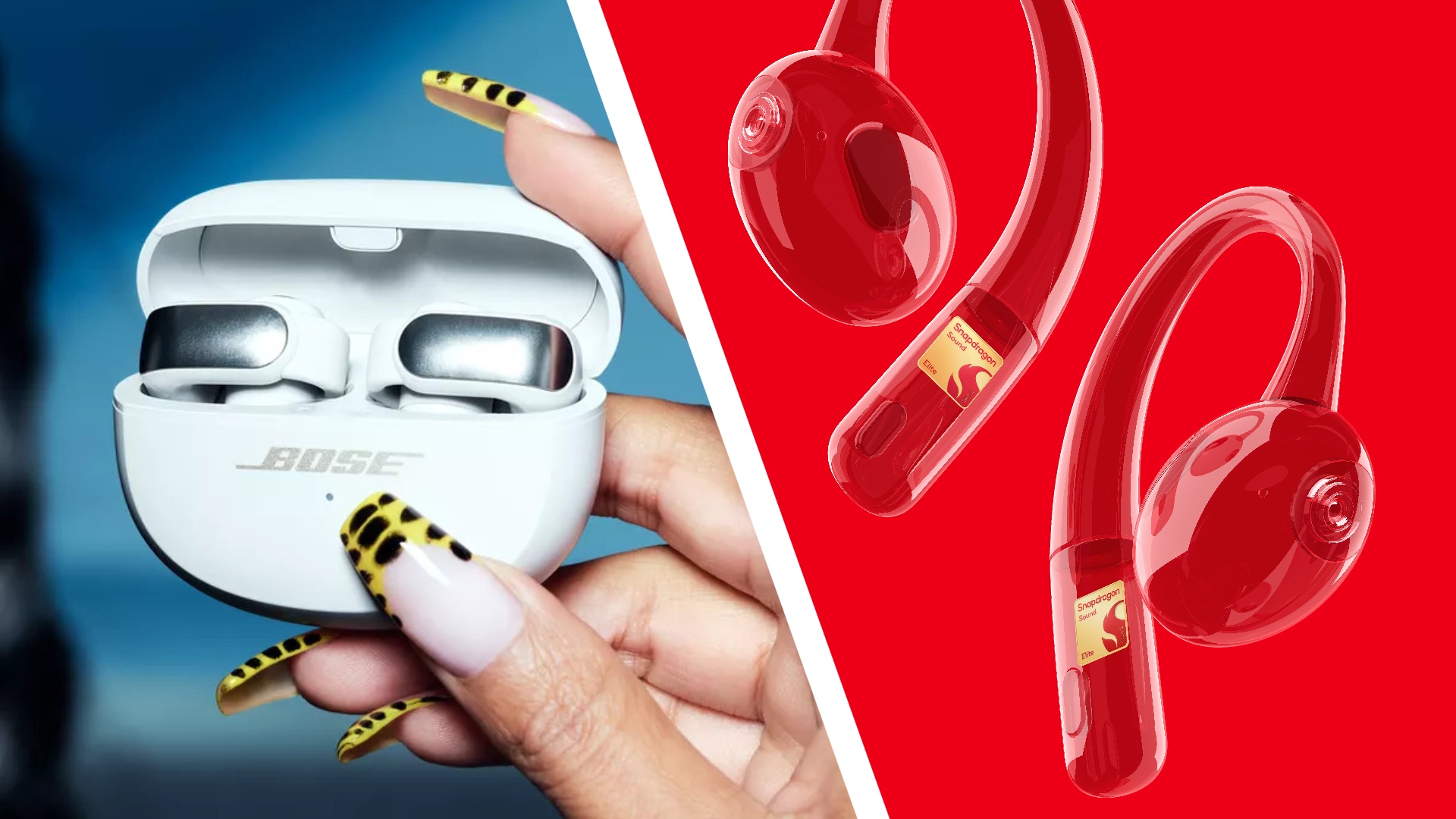
You may have heard the rumors: camera-equipped earbuds are the next frontier for audio technology brands (including, we think, Apple), and Qualcomm’s new Snapdragon Sound Elite Gen 2 platform could be the catalyst that brings them to fruition.
As Qualcomm’s “first premium audio platform purpose-built for personal AI,” the Sound Elite Gen 2 aims to transform headphones and earbuds into “intelligent companions that can understand, assist, and adapt throughout the day” — and the American silicon giant considers camera-equipped earbuds to be among those “companions.”
Qualcomm flew TechRadar out to Snapdragon Summit in Hawaii to hear more (no pun intended) about its vision for the AI-assisted future of audio, and the company was bullish about the positive effect AI will have on both sound quality and virtual assistance.
“This isn’t about putting a chatbot in your ear; it’s about creating devices that understand what’s happening around you,” Sarah McMurray, Staff Manager for Product Marketing at Qualcomm, explained in a briefing attended by TechRadar, noting that the Sound Elite Gen 2 will use AI to make earbuds more responsive to environmental changes.

“At the core of the platform is an advanced AI-adaptive ANC system designed for consistent, real-world performance, not just ideal conditions,” added Grace Bramwell, Qualcomm PR. “The system continuously responds to changes in fit, movement, and environmental noise, maintaining reliable noise cancellation without the need for manual adjustment.
“Powered by flexible, programmable processing and up to 2x greater AI capability than the previous generation, Snapdragon Sound Elite Gen 2 can intelligently steer ANC filters in real time, optimizing noise reduction across different acoustic conditions and device types. This enables stronger performance in challenging scenarios, including low-frequency noise, dynamic environments, and open-ear designs, while giving OEMs greater flexibility across a wide range of form factors.”
In other words, the Sound Elite Gen 2 could make your next earbuds or headphones better at automatically switching between ANC and transparency modes, and deliver improved audio quality in both states (“stronger performance with low-frequency noise,” for instance, might mean upcoming earbuds can more effectively drown out the mechanical hum of your fridge or the drone of a passing truck).
It’s worth noting that Qualcomm itself is not a consumer product manufacturer. It licenses its audio technologies to OEMs (Original Equipment Manufacturers) such as Bose and Bowers & Wilkins, so it will be up to those brands to take up and implement the Snapdragon Sound Elite Gen 2 platform in a way that fulfills the potential Qualcomm is describing here.
Welcome to the age of in-ear assistance

Of course, Qualcomm’s plans for the future of audio are bigger than improved ANC. AI-powered audible assistance is the hottest topic in town right now, and apparently, consumers are as keen on the thought of AI-powered assistance as Silicon Valley investors:
“Our research tells us that up to 70% of users want advanced AI capabilities in their wearable devices,” says Ziad Asghar, Qualcomm’s Senior Vice President and General Manager of XR, Wearables, and Personal AI. “As AI becomes a core capability, users will increasingly expect more natural ways to interact with it.
“Those interactions won't always happen through a screen. They will happen through natural conversations, where users can simply speak to an AI assistant and receive help in real time. With Snapdragon Sound Elite Gen 2, we're heralding intelligent audio wearables that enable experiences such as real-time translation, contextual assistance, personalized hearing, and multimodal interactions that combine audio, vision, and AI."
No current wearables effectively combine those three elements (except perhaps smart glasses, but have you ever tried listening to your favorite album on a pair of Meta Ray-Bans? Don’t. Ever). That’s why OEMs are developing camera-equipped earbuds — they’re truly hands-free and, crucially, more socially acceptable (visually speaking) than Austin Powers-style specs.
But if, as a society, we haven’t yet cracked the social code on smart glasses (and as our deep-dive on the so-called great privacy revolt reveals, we most definitely haven’t), are camera-equipped earbuds something we’re ready for? Qualcomm is cautiously optimistic.
“The privacy concern is not new,” Asghar explained to TechRadar in a roundtable at Snapdragon Summit. “We at Qualcomm and Snapdragon have been managing it for a long time in multiple different areas. And our concept is very clear: we want to be able to give the consumer the ability to choose how much information they want to share.
“For instance, we can obfuscate faces. We have the capability on our chipsets to detect a face very easily — not a face, but detect a face. To do multi-modality, I don’t need to send a face for AI processing; I need to be able to send the context [of my environment]. For that, I can detect the face and cover it up. That technology is something we have integrated into our products and that we’re sharing with our partners.
“Another thing we’ve been driving is on-device AI. As you do more processing on the device, you basically take away the concern of that image leaving the device [...] We are targeting this problem at every different level. Of course, we enable our customers and partners [to use these tools], and with the pressure and concern that’s coming through, we will of course work with them.
“I also want to say something,” Asghar added. “Today, you carry a device with multiple cameras on it: it’s called a phone. I was talking to a group of students in San Diego, and this [privacy] issue is not top of their mind. Different age groups are thinking about it in different ways. Younger people are so used to blogging and vlogging. I think some of the concern, in my opinion, is just because this is a new form factor. But we want to provide all the tools [to manufacturers] such that consumers feel comfortable.”
Again, it will be up to brands such as Bose and Bowers & Wilkins to implement the Snapdragon Sound Elite Gen 2 platform in an effective and ethical way, but it's clear that Qualcomm is aware of the increasingly negative public sentiment around camera-equipped wearables.
If, however, these OEMs can convince consumers that on-device processing really is as private as Qualcomm claims, perhaps the age of Minority Report-style glasses and earbuds will arrive sooner than we thought.

And of course you can also for news, reviews, unboxings in video form, and get regular updates from us on too.
Axel is TechRadar's Phones Editor, reporting on everything from the latest Apple developments to newest AI breakthroughs as part of the site's Mobile Computing vertical. Having previously written for publications including Esquire and FourFourTwo, Axel is well-versed in the applications of technology beyond the desktop, and his coverage extends from general reporting and analysis to in-depth interviews and opinion.
Axel studied for a degree in English Literature at the University of Warwick before joining TechRadar in 2020, where he earned an NCTJ qualification as part of the company’s inaugural digital training scheme.