A meteorite found in the Sahara is a rare piece of Mars’ ancient crust.
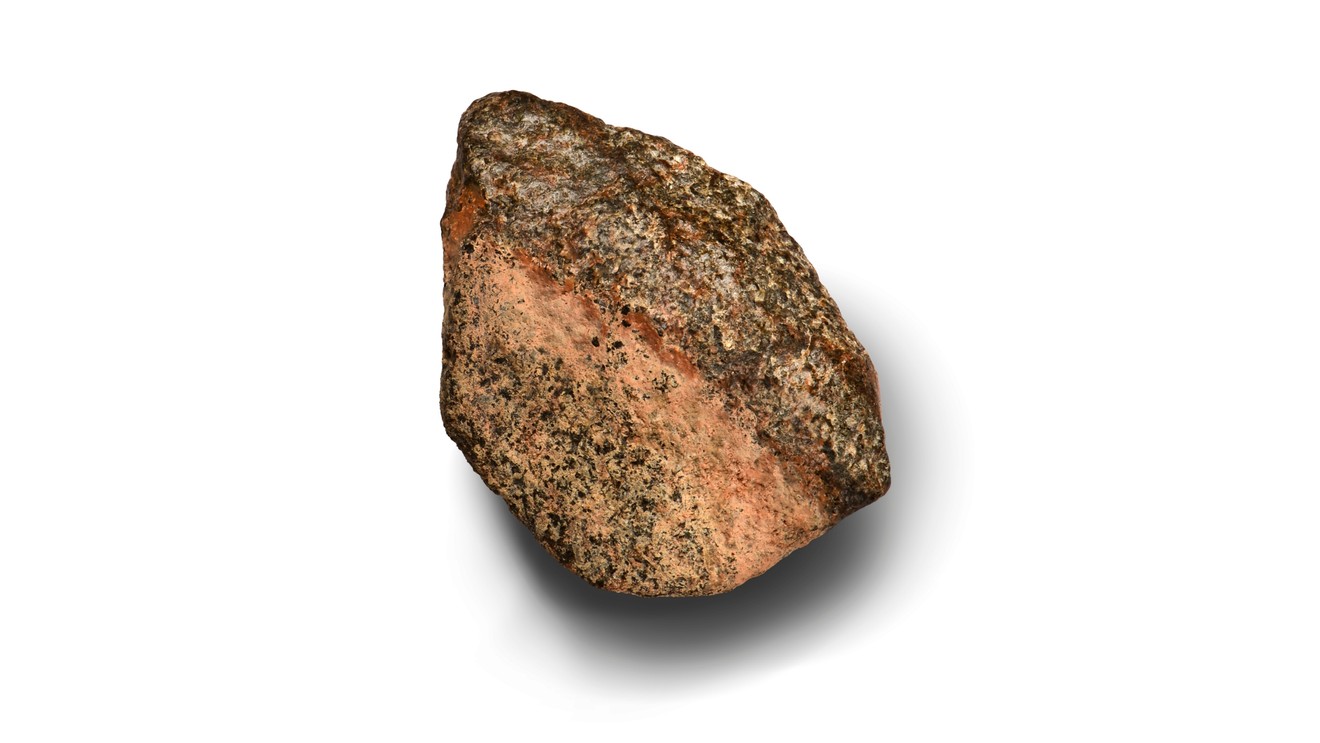
Crater counts tell us that most of the Martian surface is more than 3 billion years old, but pieces of Mars we have on Earth tell a different story. The three main classes of Martian meteorites—shergottites, nakhlites, and chassignites—are all 2.4 billion years old or younger. Until now, only two genuinely ancient Martian meteorites were known: Allan Hills 84001, found in Antarctica, and a jumbled rock from northwest Africa nicknamed Black Beauty. Now we have a third one.
A team led by Yang Liu, a planetary scientist at NASA’s Jet Propulsion Laboratory, has shown that a Martian meteorite called Teghaza 001, found in the Sahara Desert in Mali in 2022, formed at least 4.1 billion years ago. “It’s very old and similar to some of the oldest rocks on Earth,” Liu says.
A filtered collection
“We don’t fully understand why old Martian rocks are so rare on Earth,” Liu said. Part of the answer may lie in how a piece of Mars gets here. It takes a large impact to launch a rock off the planet, and not every rock can survive that. “If the impact hits into loose powder, it may not get cemented to become a rock and fly off Mars’ gravity,” Liu said. “So the natural impact already acts as a filter. Weak rocks do not make it off Mars.”
That left scientists with a biased collection.
“Even to date, none of our collected Martian meteorites are similar to what we found on the surface,” Liu said. The partial exception is Black Beauty, which has a bulk chemistry that matches orbital measurements. But Black Beauty is a mix of soil and many small rock fragments. Teghaza 001 is a single, intact igneous rock.
Teghaza 001 was acquired through the desert meteorite trade, where hunters comb the Sahara for dark stones that stand out against the sand. Its eight stones, weighing just under 800 grams in total, were bought by a private collector, who sent a piece to the University of New Mexico for classification. There, planetary scientists Carl Agee and Karen Ziegler measured its oxygen isotopes. “Each planetary body has a very characteristic oxygen isotope value,” Liu says. Teghaza 001’s values matched those of other Martian meteorites.
At first, the rock was classified as a shergottite, the most common (and young) type of Martian meteorite. But Agee noticed some oddities and reached out to Liu. One of Teghaza’s minerals had been altered on the inside while its outer part stayed pristine, the reverse of how weathering on Earth works. The oxygen isotopes looked a bit strange, and there was some manganese-rich material similar to what Liu had studied in Black Beauty.
“When I got to the sample, I looked around, I said, ‘That’s boring,’” Liu said. “The high-manganese material is actually terrestrial, but I quickly realized the sample is very different, very special.”
Teghaza 001 is made mostly of feldspar, a pale mineral common in the crusts of rocky planets. It has darker pyroxene crystals mixed in; according to Liu, those resemble some rocks exposed in the lunar highlands. Its crystals are rather big, up to a millimeter across, which scientists interpret as an indication it cooled down slowly. “For slow-cooled rock, they tend to have time to grow bigger,” Liu said.
By comparing the crystals with lab experiments and terrestrial rocks, the team estimated Teghaza 001 cooled by roughly 0.01° Celsius per year, indicating it formed from magma that never erupted but instead solidified inside the crust.
Clocks reset by water
The team dated the rock in several independent ways. Zircon grains gave about 4.11 billion years. Phosphate minerals and rubidium-strontium dating gave similar ages. “Doesn’t matter what type of zircon we are analyzing or what mineral we are analyzing, we get this very consistent age. And we didn’t expect that,” Liu said.
It is notoriously hard to reset the age of zircons, and the impact that launched the rock, while strong enough to forge high-pressure minerals, wasn’t hot enough to do it. “To change it, you really require some kind of hydrothermal fluid,” Liu said.
Sodium-rich rims on feldspar grains and sodium trapped in the zircons support the idea that hot water percolated through the rock shortly after it formed. So 4.1 billion years marks its last soaking, the youngest of what were probably several alteration events. “The crystallization age would be older than 4.1 billion years,” Liu said.
Teghaza 001 is also unusually rich in oxygen-18, a heavier form of oxygen, with about two parts per thousand more than other Martian meteorites. Neither crystallization nor gas escaping from magma can produce a difference that big. Because water that reacts with rock at low temperatures near the planet’s surface forms minerals rich in heavy oxygen, the team thinks the magma either swallowed bits of crust that had already interacted with surface water or reacted directly with fluids that had picked up the same heavy signature.
This implies that “There was active circulation of water through Martian crust,” Liu said. “When this rock was forming, we do have a hydrosphere on Mars, and that hydrosphere is reacting with Martian crust intensely.” The water must have been circulating through the crust and reacting with magma before it had even finished cooling. “It’s actually more dynamic and more active than we thought,” Liu said. She argues that this finding fits the picture of a wet early Mars and points to potentially habitable environments in its crust.
Teghaza 001 also reveals details about Mars’ interior. The rock crystallized near the surface, but the magma it formed from came from much deeper. Ratios of trace elements that resist alteration, like the zirconium to titanium ratio, differ from those in every other Martian meteorite. The team’s melting models matched the rock’s chemistry best when its mantle source contained garnet, a mineral that is stable in the Martian mantle only at depths of more than 160 kilometers.
Studies of other Martian meteorites suggest that as an early ocean of magma solidified on Mars roughly 4.5 billion years ago, the mantle separated into three to five reservoirs. Teghaza 001’s source does not match any of them. “In the first few hundred million years, the Martian mantle was evolving in a way that’s more complicated than we thought,” Liu said.
The orbital view
Comparing the rock’s chemistry with orbital maps, the team suggests it most likely came from the southern highlands, northwest of the giant Hellas impact basin. “No matter how many meteorite samples we have, we will always have this question: Where are they coming from on Mars?” Liu said.
Orbital data can narrow a source down to a patch of roughly 100 by 100 meters at best, which often amounts to one pixel in our remote sensing data. When Teghaza 001 left Mars is also an open question. “We only did the minimum required to make the world know this sample is special,” Liu said, adding that two or three groups are already studying it to get further insights.
The real game-changer, Liu said, would be samples collected with careful geological context, like those Perseverance has gathered in and around Jezero Crater. Liu would like to see some from terrains as old as Teghaza 001 or older. “If these samples come back, there are so many discoveries that can be made,” Liu said. “This could revolutionize our understanding of Mars and the early solar system.”
Liu’s study on Teghaza 001 is published in Science: https://doi.org/10.1126/science.adz5646