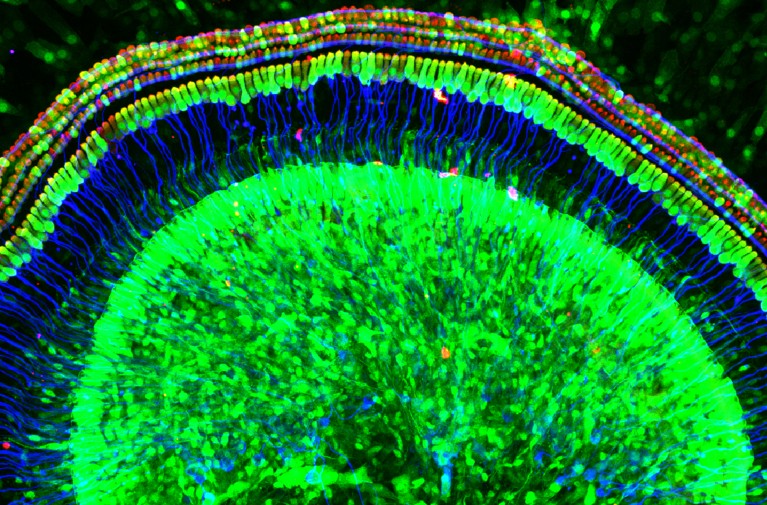
This form of deafness is caused by a mutation in the otoferlin gene (OTOF), which encodes a protein that is crucial for transmitting sound signals in the inner ear to the auditory nerve for processing. One in 500 babies is born with congenital hearing loss and, of those, between 1% and 8% have OTOF-associated hearing impairment. (Nature acknowledges that many Deaf people do not consider the condition to be a disability that requires a cure, and that individuals often identify as being a part of Deaf culture.)

Earlier in 2025, the boy was one of 24 participants, all aged between 10 months and 16 years, in the CHORD clinical trial1. The ongoing study seeks to test the effectiveness and safety of Otarmeni, a gene therapy designed to deliver a functional copy of the OTOF gene to hair cells in the inner ear.
During the trial, half of the participants received a single infusion of Otarmeni, delivered through surgery into one ear, and the other half received a one-time dose in both ears. Around 80% experienced improved hearing within 24 weeks of receiving the gene therapy. Forty-two per cent have since regained their hearing.
In April this year, Otarmeni became the first gene therapy for hearing loss to be approved by the US Food and Drug Administration (FDA). Before this, the last major breakthrough for people with the condition was the cochlear implant, a microchip that can restore hearing, which was approved by the FDA for children aged 12 months and over in 2000.
Otarmeni, made by US-based Regeneron Pharmaceuticals, is one of several gene therapies for OTOF-associated hearing impairment — although some are still in development. Akouos, a US precision-medicine company owned by the drug maker Eli Lilly, has started an early-phase clinical trial to test an OTOF gene therapy, as have both the French drug maker Sensorion and Shanghai Refreshgene Therapeutics in China, the latter with the aid of government funding.
Why has this form of congenital deafness attracted so much attention? OTOF is one of more than 150 genes tied to non-syndromic genetic hearing loss — deafness that occurs independently of a broader syndrome. According to Dylan Chan, a paediatric otolaryngologist at the University of California, San Francisco, OTOF is a relatively low-hanging fruit for treatment.
“This is a unique situation in hearing loss, where everything in the ear is formed normally, everything functions normally, except there’s one missing protein that makes the synaptic transmission not function,” says Chan. “It’s a huge breakthrough because we’ve never been able to treat the inner ear before.”
Is exposomics the key to making personalized medicine a reality?
The process of creating a gene therapy for people with hearing loss, which laid the groundwork for altering the OTOF mutation, has taken some unexpected twists and turns since it started in the 1990s. Here, Nature looks at key milestones in the development of a gene therapy for OTOF-associated hearing impairment.
The 1990s
The condition is diagnosed through a hearing test that measures how the inner ear, auditory nerve and brainstem respond to sound. This is followed by genetic testing to confirm the OTOF mutation is present.
In the United States in the 1990s, however, genetic testing wasn’t covered by health insurance, says Daniel Lee, a neurotologist at Harvard Medical School in Boston, Massachusetts, who specializes in complex ear disorders. Instead, many US families paid for such testing themselves, he explains, even knowing that the results were unlikely to help their child, but could aid researchers in identifying the genetic causes of different forms of hearing loss. This would provide the foundation for the future development of gene therapies.
Genetic testing is now more mainstream and is often covered by insurance or forms part of clinical-trial protocols, allowing more families to be included in research. In 1999, the OTOF gene was identified by a team at the Pasteur Institute in Paris2. ”Without those efforts early on, we would not be here,” Lee says.
2006
When genes are functioning as they should, their expression ultimately results in proteins that help the body to work. To develop a therapy for the mutated OTOF gene, researchers first needed to understand what wasn’t working in people with the mutation.
In a landmark study published in Cell in 2006, researchers compared the inner hair cells of mice that had Otof-associated alterations with those of healthy mice3. The authors established that otoferlin was essential to the transfer of sound from the inner hair cells to the auditory nerve, with the protein enabling the release of the neurotransmitter glutamate at synapses. Mice with the Otof gene knockout displayed typical physiology of the inner ear.
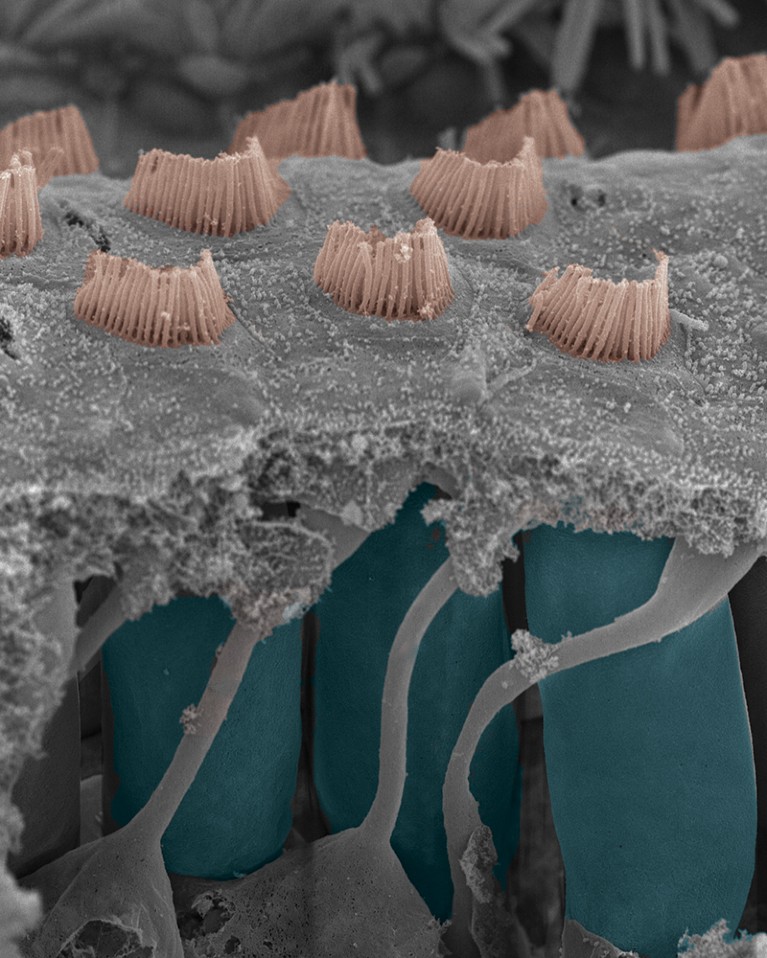
Auditory neuroscientist Tobias Moser, who is a co-author of the Cell study, says that the work highlighted the OTOF gene as a potential target for gene therapy in humans. “By understanding the role of otoferlin, dissecting the disease mechanism and by demonstrating a relatively intact morphology of the cochlea, this made otoferlin a good target,” says Moser, who is based at the University of Göttingen in Germany.
2006 to 2012
Although Moser and his colleagues’ findings advanced the field’s understanding of the mechanism of OTOF-associated deafness, there had yet to be any successful attempts to restore hearing in laboratory mice with the mutation.
The gene-therapy method used to treat OTOF-related deafness involves transporting a working copy of the gene into specific cells, along with a switch that tells the cells to activate the gene to produce the otoferlin protein. To do this, scientists use viruses as a transportation vehicle (or vector) because viruses are naturally adept at getting into cells to infect them. Before the viruses are used in gene therapy, however, their disease-causing genes are removed. This technology has been used in trials of gene therapies for dozens of diseases, including disorders affecting the blood, muscles and eyes.
Gene therapy to restore hearing was first tested in other models of deafness. In 2010, Lawrence Lustig, who at the time was a neurotologist at the University of California, San Francisco, and Omar Akil, then a researcher in Lustig’s lab, were among the first to successfully use gene therapy to restore hearing in mice missing Vglut3, another gene linked to congenital hearing loss.
“We had never tried hearing restoration up to that point. We had been studying the mechanisms of hearing loss in various mouse models of deafness,” says Lustig, a site principal investigator at New York-Presbyterian and Columbia University Medical Center in New York City for the CHORD clinical trial.
To deliver the working copy of the Vglut3 gene to the inner hair cells of mice, Akil used a viral vector called adeno-associated virus type 1 (AAV1). Within two weeks of the treatment, all of the mice had had their hearing restored, as confirmed by auditory brainstem response testing4.
“I almost couldn’t wrap my head around it,” Lustig recalls. “I was like, ‘This just does not happen.’”

Gene therapy marks a turning point for rare skin diseases
Many of his peers had similar reactions. “I don’t think anybody believed the results,” says Lustig. Ultimately, the paper was published in the journal Neuron in 20124.
This success resulted in Lustig’s lab and others focusing on the OTOF gene. But they were stymied by its large size — it is almost twice the length of VGLUT3. The viral vectors commonly used in gene therapy were too small to transport it. In collaboration with the Pasteur Institute, Lustig says, “We tried using smaller portions of the gene to no avail.”
2014
The size problem of OTOF would be dealt with later. Another challenge for researchers was testing to see which viral vectors could efficiently reach hair cells in the inner ear.
Inspired by Akil and Lustig’s work, Lukas Landegger, a clinician-scientist in otology and neurotology at Stanford University in Palo Alto, California, wanted to test a synthetic adeno-associated virus as a possible transporter in gene therapy. The vector Anc80L65, developed by a team at Massachusetts Eye and Ear in Boston had already been used to introduce therapeutic genes into the eye and muscle, he explains. “And because the eye also has sensory cells, like the ear’s hair cells, the idea was we should try this novel vector and see what it does in the ear,” says Landegger.
In early 2014, Landegger compared the ability of Anc80L65 to penetrate inner and outer hair cells with that of several other vectors. He applied equal amounts of the viruses to cochleas harvested from the ears of two mouse strains. The viruses were tagged with a fluorescent marker, which glowed green under blue light.
Forty-eight hours later, he checked the samples. “I looked at the specimens in the middle of the night under the confocal microscope and initially I couldn’t believe how much green I saw.”
Anc80L65 had outperformed the other viruses in efficiently penetrating both inner and outer hair cells, and was able to target other cells in the cochlea that play a part in hearing, providing a safe route to transfer genes into the mammalian inner ear5. This raised the hope that researchers had opened the door to treating a wider array of hearing-loss disorders.
Enjoying our latest content?
Log in or create an account to continue
- Access the most recent journalism from Nature's award-winning team
- Explore the latest features & opinion covering groundbreaking research