Seabirds, native plants, and healthy reefs can help atolls build as seas rise.
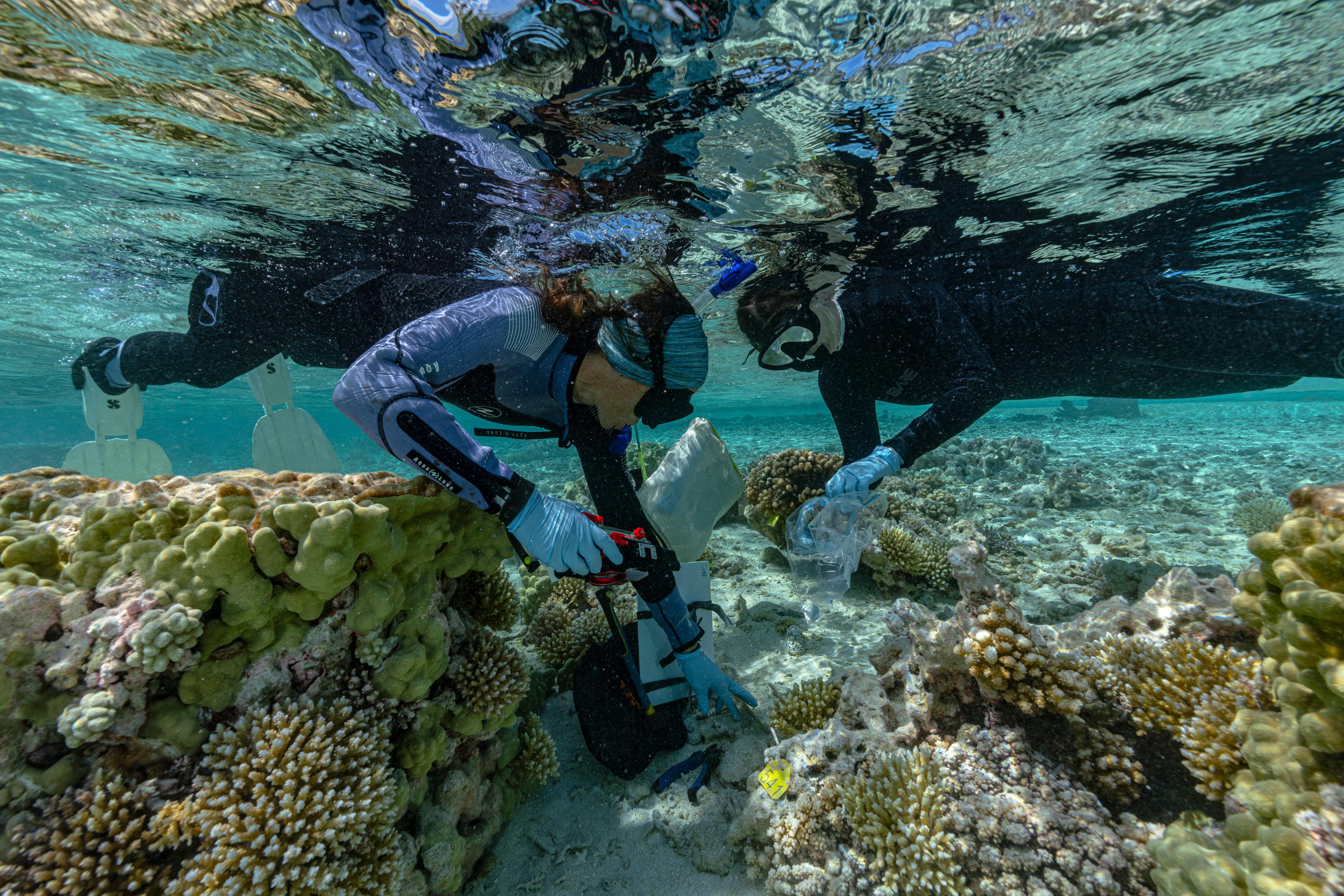
Coral-fringed tropical atolls are among the landforms most threatened by global warming, but many have a potential superpower: Healthy ecosystems may help them keep pace with rising seas.
Atoll islands with native vegetation and thriving seabird populations are “naturally active systems that can change and adapt to their environmental conditions if they are allowed to do so,” said Nick Graham, a marine ecologist at Lancaster University in the United Kingdom, who led an international team of scientists that studied island resilience across 28 atoll islands in the Pacific and Indian oceans.
Their paper, published Wednesday in Science Advances, shows that restoring atoll ecosystems reinforces their growth. Seabirds ferry nutrients from the open ocean and deposit them on the atolls as guano that nurtures land plants, marine life and coral growth. This provides more material for reef building, as parrotfish and other reef feeders turn dead coral into sand to maintain beaches, while native plants with extensive root networks stabilize sediments.
Eradicating rats and replacing coconut plantations with native forests and brush could give some atolls a “fighting chance” to persist at the rate of sea-level rise expected toward the end of the century with about 2° Celsius (3.6° Fahrenheit) of warming, Graham said.
The findings provide more evidence that nature restoration can buffer the impacts of global warming. For example, restoring wetlands and forests dampens swings between wet and dry spells, reducing flood and fire hazards. Restoration efforts can also slow global warming by supporting natural carbon storage.
On the 28 atoll islands Graham’s team studied, strengthening the dynamic system of seabirds, native vegetation, and reef systems starts a virtuous cycle, as ecosystems become better able to sustain themselves and build resilience to growing impacts.
The research included data from islands in the Seychelles and Chagos archipelagos in the Indian Ocean, and Tetiaroa, an atoll in French Polynesia in the Pacific Ocean. Graham said terrestrial ecologists, marine ecologists and geomorphologists combined measurements of seabird populations, native vegetation, and coral and reef organisms to trace how energy moves through the ecosystems.
The scientific approach, called ecosystem energetics, uses energy flow as a common currency to connect organisms typically studied in isolation.
Seabirds link the open ocean, where they feed, to the land, where they nest. Thousands of birds swarm out across vast seas, and the food they digest is concentrated into a nutrient-rich guano. Islands with greater seabird nutrient input tended to have more productive coral communities and a higher energy flow.
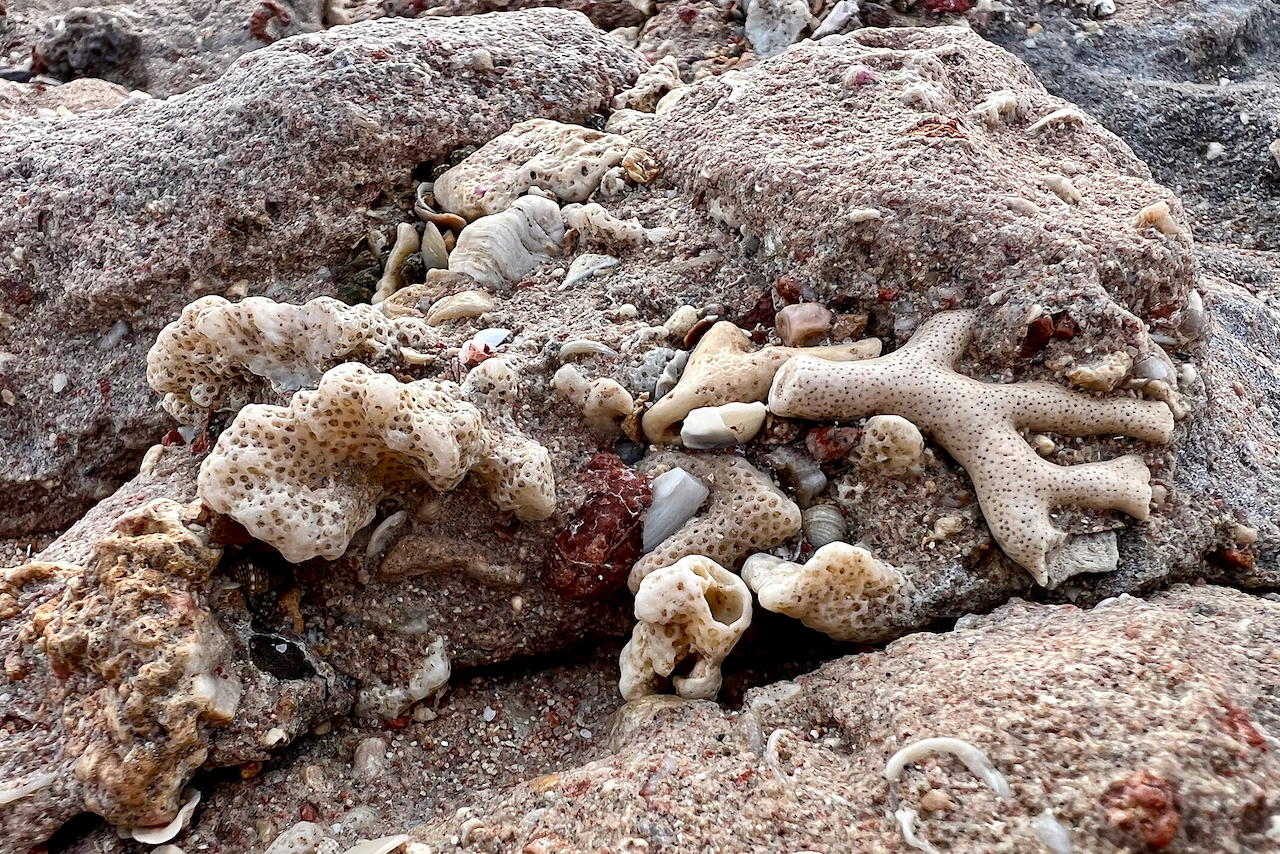
Parrotfish and other reef nibblers also contribute to energy flow by scraping the coral to feed on dead organisms and excreting sand-sized particles. Calcifying algae, other reef organisms, and shellfish help build the reef framework upward, helping reefs continue to buffer islands from waves.
In the terrestrial part of the cycle, restoring native vegetation that coconut plantations replace is crucial. Coconut palms have small, unstable rootballs that leave the surrounding soil vulnerable to erosion. Native plants, by contrast, have huge networks of finely meshed roots that bind and stabilize the shallow, porous soil and also provide better habitat for seabirds.
Restoring the nutrient cycle also means eliminating invasive rats brought by colonizers that have devastated seabird colonies for centuries. This cycle has been sustaining atoll ecosystems at least since the end of the last ice age. A 2026 study of 288 reef core growth records found that most kept pace with rising seas, although that capacity varied by location and is not guaranteed at the current rate of warming.
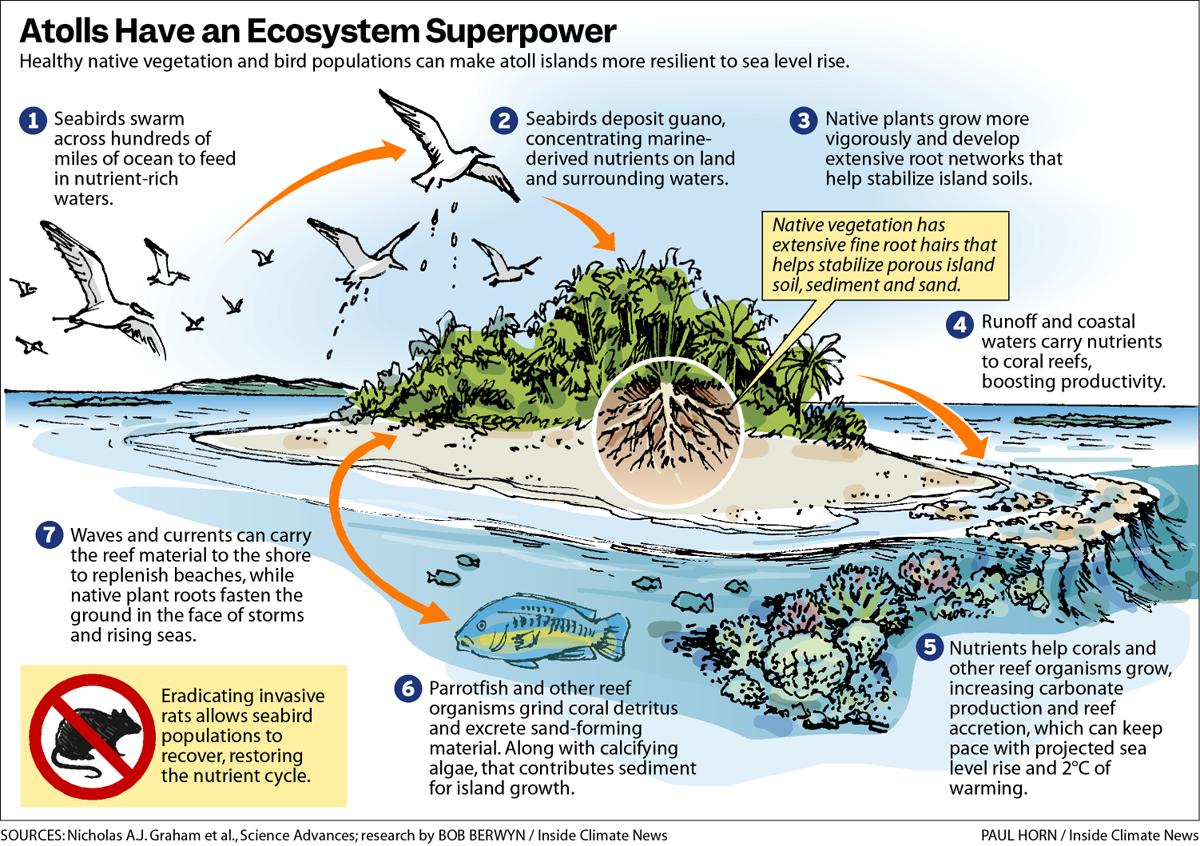
The new study measures the “reef accretion potential” for the islands, showing it to be twice as high on lagoonal and ocean-facing reefs around rat-free islands with abundant seabirds as around rat-infested islands. That would be “sufficient to closely keep up with predicted sea-level rises to the end of the century under a 2° Celsius warming scenario,” said co-author Casey Benkwitt, a California-based restoration scientist with The Nature Conservancy.
Reef growth rates without seabird populations are less likely to keep pace with projected sea-level rise, she added.
Graham cautioned that the study doesn’t imply a miracle solution for global warming impacts to low-lying islands. It didn’t make direct before-and-after restoration comparisons, and the data came from islands with different levels of seabird abundance and rat infestations, differences the research team tried to smooth out with an ecosystem energetics framework.
And reef accretion doesn’t always mean an atoll is growing vertically, because global warming is also changing waves, winds, and currents that affect where the material ends up. The study also focused on mostly uninhabited or sparsely populated islands with room for native ecosystems. On developed atolls, he said, restoration efforts can help but won’t replace the need for engineering solutions.
The study helps show a nearly complete loop, “from ocean-foraging seabirds, through native forests and coral reefs, back to the construction and stabilization of the islands on which the birds breed,” ecologist Hillary Young wrote in a Science Advances Focus commentary. Quantifying the loop provides “much-needed evidence that the fate of an atoll cannot be understood or managed by treating its land and sea separately,” she wrote.
Local conservation can influence physical resilience to rising seas, but, she wrote, “rapid reductions in greenhouse-gas emissions remain essential to long-term viability of these systems.”
Bob Berwyn is an Austria-based reporter who has covered climate science and international climate policy for more than a decade. Previously, he reported on the environment, endangered species, and public lands for several Colorado newspapers, and also worked as editor and assistant editor at community newspapers in the Colorado Rockies.
This story originally appeared on Inside Climate News.