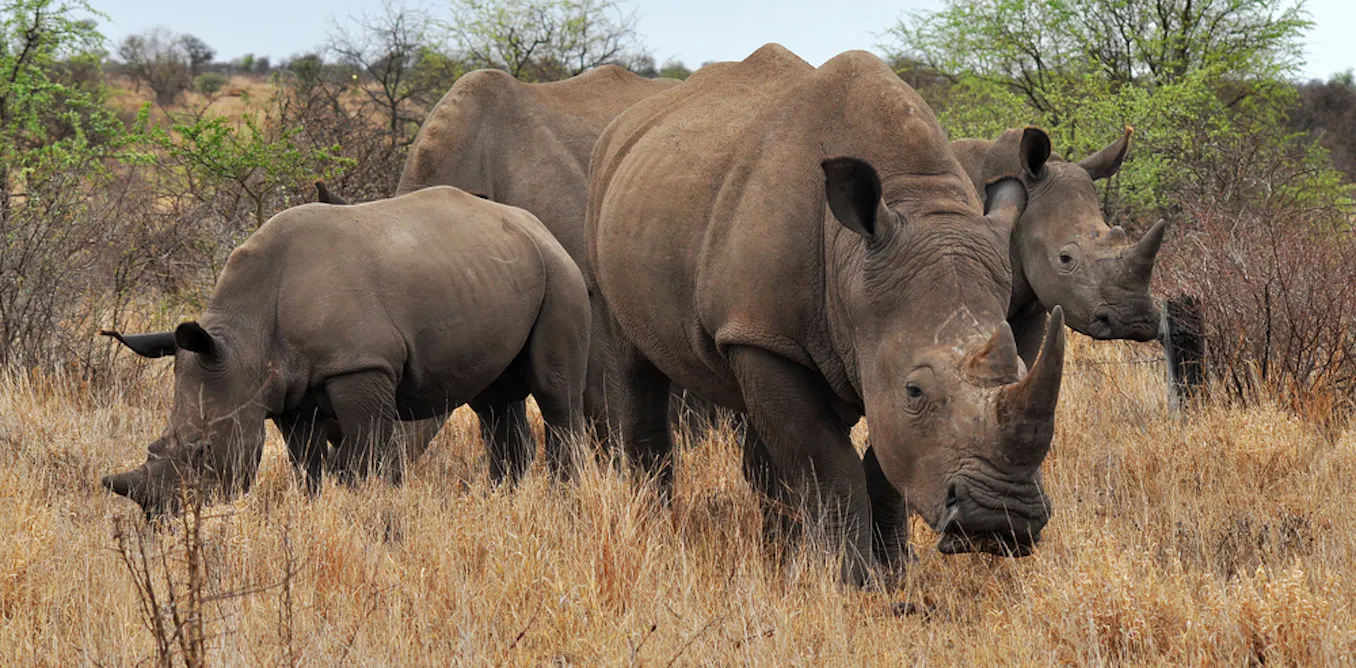
Moving large animals around is a seductive idea in conservation. If there are plenty of animals in one place and too few in another, moving some between the two seems an obvious solution. Sometimes it is. But with animals as large, mobile and socially complicated as elephants and rhinos, the move itself can turn out to be the straightforward part.
This autumn, 12 rhinos are due to be moved from a well-established reserve in North West Province in South Africa to another protected area, in the Waterberg region, as part of efforts to establish and strengthen secure rhino populations. I am involved with the conservation work around the move, including research that will follow what happens after the rhinos arrive.
But there are lessons from past projects that we have to bear in mind. In 2022, 263 elephants were moved around 350km from Liwonde National Park in Malawi to another park in Malawi, Kasungu National Park. Decades of poaching had severely depleted Kasungu’s elephants, while successful protection in Liwonde had allowed its population to grow. With Malawi’s protected areas increasingly isolated from one another, moving elephants from a relatively dense population to a much larger park with relatively few elephants made good sense.
What happened after release was much messier. Elephants moved beyond the areas intended for them and conflict with people living around Kasungu intensified. Crops and property were damaged and people were killed, although not all the deaths initially associated with the translocation involved relocated elephants.
In 2025, lawyers representing people living around Kasungu in Malawi and neighbouring Zambia began preparing legal action against the International Fund for Animal Welfare (IFAW), one of the organisations involved in the translocation. They allege that elephants have killed and injured people, damaged crops and property, and that local communities were not adequately protected or consulted. IFAW strongly disputes the allegations.
Whatever the legal outcome, it is clear that getting the elephants through the journey and established in Kasungu is only one measure of success. Whether that can happen without imposing unacceptable costs on the people already living around the park is another.
There has since been considerable further investment around Kasungu, including GPS monitoring, rapid-response teams and a 133km electric fence. IFAW reports that recorded human-elephant conflict incidents fell from 690 in 2022 to 94 in 2025. Kasungu illustrates how quickly something that makes good ecological sense can become a much more complex social and political problem once large animals are actually on the ground.
Elephants bring additional biological complexity. They are intelligent, highly social and capable of travelling long distances, while disrupting their social organisation can have behavioural effects lasting many years. Deciding how many elephants an area can support is only part of the problem. Which animals are moved, and with whom, can matter too.
In 2023, African Parks acquired the Platinum Rhino breeding operation established by South African businessman John Hume, along with around 2,000 southern white rhinos. More than 600 had been moved into protected areas across Africa by the end of 2025, sometimes in operations involving well over 100 animals. Moving rhinos on this scale makes getting translocation right increasingly important.
The spectacular bit is easy to see: rhinos darted from helicopters were transported in specially designed crates or even carried slung beneath helicopters, a seemingly alarming method that research suggests is physiologically safer than it looks.
Behind all of this is a much less visible process of preparation. A release site needs enough suitable habitat, food and water, and some idea of how many rhinos it can support. For black rhinos, that includes making sure there is enough suitable browse – the leaves, shoots and woody plants they feed on. Security is a huge consideration. Protecting animals under intense pressure from poaching can require anti-poaching teams, canine units, armed personnel and reliable communications.
There also needs to be a plan for what happens after the translocation. Filling a reserve to its apparent capacity leaves little room when the animals start breeding. Future population growth and further removals therefore need thinking about before the first rhino arrives. The rhinos themselves still have to cope with the move. For instance, a study of 682 black rhinos involved in 191 translocations found substantially more deaths in the first year after a move when animals were added to existing rhino populations than when new populations were established.
A review of 550 conservation translocations found that the social dimensions of moving wildlife were considered much less consistently than biological ones. Human conflict with wildlife sounds rather abstract, but losing a crop to elephants can be devastating for a family relying on it for food or income, and large animals can also injure and kill people.
Putting back a species that once lived somewhere can be a beautiful conservation idea. But the fact that a species occurred there historically does not mean that the landscape, or the lives of the people occupying it, have stood still. A beautiful idea is not enough if the people living there now are expected to carry substantial costs or accept risks to their livelihoods and lives.
The answer is not to stop moving wildlife. Translocation has restored species to places where they had disappeared and, as wildlife populations become increasingly fragmented, conservationists may need to do more of it. But we need to realise that the elephant walking out of a crate or the rhino getting back to its feet is the part that makes for great photographs. Much of the real work has happened before that moment, and a great deal more may have to happen afterwards.