Anyone who has ever worked at a large enterprise knows the drill. You submit an IT ticket for a complex software issue, and then you wait.
First-generation AI chatbots have successfully managed to automate the low-hanging fruit of Tier-1 support, like password resets and basic software approvals. But they historically hit a brick wall the second a request requires actual problem-solving.
Now an AI-native helpdesk startup, Risotto, is trying to solve that headache. Today the company announced the launch of its ‘Autonomous IT Engineer’. It is a new AI co-pilot designed specifically to tackle complicated, ambiguous Tier-2 requests.
The fundamental flaw of traditional IT automation is that it doesn’t scale with complexity. When an unseen edge case pops up, human engineers have to step in. They investigate logs, diagnose the problem, and manually deploy a fix.
The real pain point isn’t just the labor, it’s the lost institutional knowledge. Those hard-won resolutions usually disappear into closed ticket histories. That means teams will need the exact same manual effort the next time the issue arises.
An agent that writes its own runbooks
Risotto is attacking this lifecycle flaw head-on. The company says its new Autonomous IT Engineer doesn’t just act as a conversational bot. It operates as a digital employee capable of investigating entirely new problems. By analyzing real-time user context and system logs, the agent diagnoses the issue and proposes a step-by-step fix. It then executes it via human-in-the-loop approval.
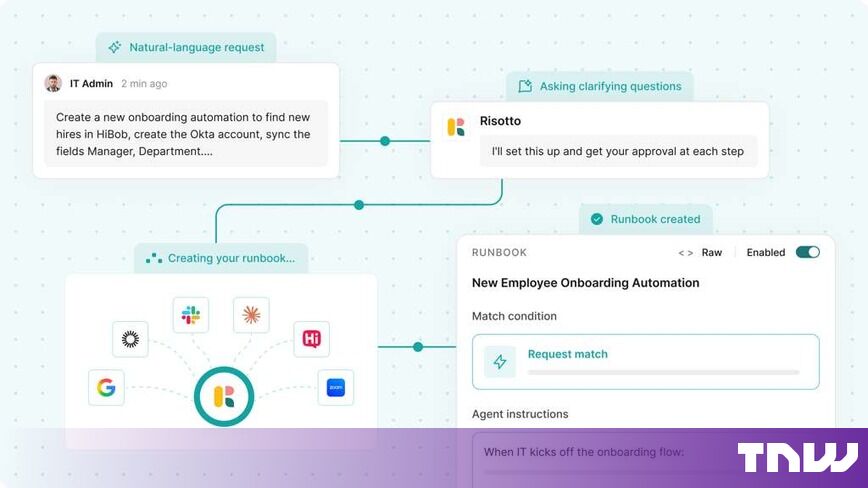
Crucially, Risotto designed the system to learn. Once it solves a novel problem, Risotto automatically converts that successful fix into a reusable, self-improving runbook.
“Every AI helpdesk can deflect password resets, but the real bottleneck in IT lies mapping out and automating complex operational workflows that haven’t been previously documented,” said Aron Solberg, CEO and Co-Founder of Risotto. “Our Autonomous IT Engineer doesn’t just resolve these complex issues; they convert each resolution into a reusable automation. The agents don’t just use tools, they build the tools they need.”
Mining past tickets
To ensure the platform doesn’t start from zero, Risotto says it comes equipped with a ‘Past Ticket Mining’ feature. It analyzes 90 days of a company’s ticket history to automatically surface and generate new automation workflows. Users can also describe the automations they want in natural language. Risotto then builds and tests them, connecting to existing corporate tools via API or MCP endpoints.
The platform is also pushing beyond reactive support. Risotto can generate custom, live-data dashboards and reports in minutes. That bypasses the need to file separate tickets with a BI or engineering team. It also allows IT teams to set up proactive triggers for scheduled or event-driven workflows. Examples include system health checks or employee onboarding sequences. That shifts the IT department’s role from reactive firefighting to proactive operations.
Customers and results
This agentic approach to IT service management (ITSM) is already gaining traction, and Risotto claims current customers include Gusto, Instacart, Docker, Retool, ThoughtSpot, Patreon, and Ironclad.
The efficiency gains reported by these early adopters are steep. Risotto says customers are seeing average first-response times drop to under four seconds, with auto-solve rates between 40-90%. Most impressively, in a case study with Ironclad, the company claims to have achieved a 91% autosolve rate. Vidyard claimed an 80% automation rate of tier-1 requests within 30 days. At Gusto, the platform achieved a 53% resolution rate on day one, with an estimated 114,000 hours of support wait time saved.
“Risotto’s AI-powered support system had a massive impact straight out of the box and with very little setup,” noted Mike Smith, IT Operations Manager at Jobber, another Risotto customer. “Employees now get fast, efficient answers with the same precision as one of our professionals.”
Earlier this year, the company announced a $10M seed round led by Bonfire Ventures, along with 645 Ventures, Y Combinator, Ritual Capital, Surgepoint Capital, and former executives from Dropbox and HelloSign. The company appears to still be well capitalized.
Risotto’s bet is that as the corporate tech stacks grow increasingly fragmented and complex, companies will happily pay to automate away the friction of internal support. By turning one-off human fixes into permanent, automated workflows, Risotto is saying that the future of IT isn’t just about answering questions faster, it’s about ensuring the same question never has to be answered twice.