Warning: this article contains spoilers for Rivals season two part one.
There was something masterful about the episode six cliffhanger of Rivals’ season two, based on Jilly Cooper’s much-loved novel. It was certainly ambitious in scope.
There was the exposure of the affair between Tony Baddingham (David Tennant) and Maud O'Hara (Victoria Smurfit), wife of his nemesis Declan O'Hara (Aidan Turner). Then there was Maud and Declan’s teenage daughter Caitlin (Catriona Chandler) losing her virginity to Tony’s teenage son, Archie (Louis Landau). And Cameron Cook (Nafessa Williams) finally realising that her lover Rupert Campbell-Black (Alex Hassell) is in love with eldest O'Hara daughter Taggie (Bella Mclean), and Lizzie Vereker (Katherine Parkinson) resuming her affair with tech millionaire Freddie Jones (Danny Dyer). All against a backdrop of a dramatic storm.
I admit I groaned inwardly at the use of the storm as a device, believing it would surely descend into terrible cliche. Instead, Rivals’ mid-season finale did something extraordinary.
In 60 minutes of high-drama television, the storm became both metaphor and agent, felling Tony’s beleaguered wife Monica (Claire Rushbrook) by its end, and weaving the threads of the narrative into the next – and what promises to be very different – act in the final six episodes of the season starting on November 11.

Early in the episode, the teenage Caitlin and Archie finally get together after Archie has been developing photos of wild birds, captured on his dad Tony’s camera. It seems their parents have not been careful with their own relationship. The teenagers find a photo of Maud – Caitlin’s mother – posing naked, with Tony’s voyeuristic reflection caught in a mirror. At this moment, Monica returns home.
Thankfully, the episode does not spend the rest of the hour teasing us over whether Monica will discover the photo. She sees it quickly, burns it in the fireplace, confronts Tony (who has now returned home) and walks out into the storm. And this is where things get interesting.
Rivals as a domestic tragedy
Monica’s walk through the storm is a King Lear-like moment. Exposure to the elements and a descent into frenzied madness bring reason into focus. She arrives on Lizzie’s doorstop and the two sit down to a cup of tea. Then brandy.
With this scene, the show examines the symmetry of their lives. And the two frumpiest and most downtrodden women in Jilly Cooper’s Rutshire become the beating heart of the episode – perhaps the whole series.
With this move, the TV show deviates dramatically from Cooper’s source material.
Suddenly liberated from the polite social conventions she has found smothering, Monica asks Lizzie about her affair with Freddie. Reeling from the revelation of Tony’s most calculated piece of adultery to date, Monica doesn’t ask Lizzie this to judge, but rather to encourage her to pursue love and happiness regardless of the damage it may cause to others.
The women’s conversation at the kitchen table lays bare the devastation wrought on their lives through their unswerving sense of duty. And to the demands of placing the needs of their husbands, and everyone else, first. It’s a crystallising moment where they see themselves properly for the first time, speaking honestly with each other.
Monica and Lizzie now agree they wouldn’t want their own daughters to live similar lives, and with this dawning realisation the viewer knows that the real moment of women’s liberation has just happened within the series.
Honesty and women’s writing
This call for honesty in human relationships feels like a connecting thread across so much writing by women. It can be found even in the work of the first professional woman writer, Aphra Behn (1640-1689). Behn’s popular novels, plays and poems explored many of the same social settings and concerns that we find in Cooper’s Rutshire: desire, marriage, money, fame, politics, love, power.
The world of Behn’s writing is that of Restoration England’s “merry monarch” Charles II, notorious for its sex, scandal and celebrity. Behn is fascinated by this social orbit – just as readers and viewers today are captivated by Cooper’s Rutshire. And yet her aim, as with the current TV adaptation, is ultimately to challenge the validity of that glossy world.
Because, in the very process of enjoying its sheer escapism, there is a sadness in both Cooper’s Rutshire and Behn’s Restoration London. This is not a world in which women can honestly be themselves, or pursue their own desires. With the second half of season two, Rivals now seems poised to offer us a perspective of a woman – Lizzie – who might achieve this rare feat.
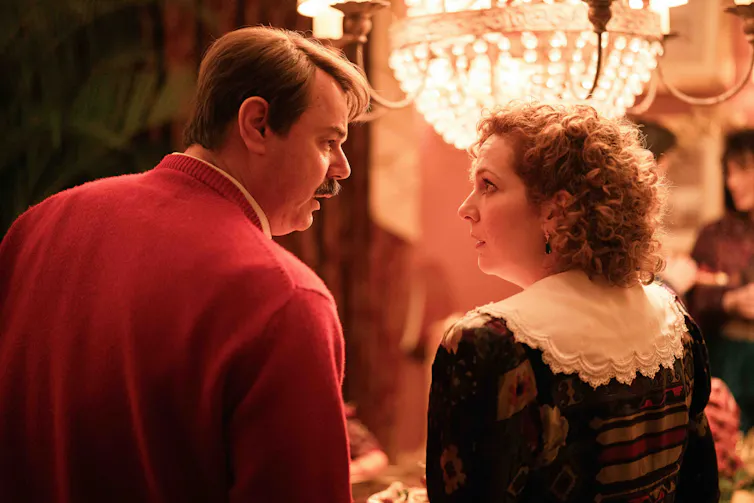
The women of Rutshire
It’s not the talented, couture-clad Cameron, a television producer poached from the US, who is the true trailblazer of the show. Rather, it’s Lizzie and Monica, in this quiet chat among the chintz and domesticity of the kitchen, who are about to turn the world of Rutshire on its head.
Monica is the catalyst for this moment of self-examination, but it is Lizzie who will reap the rewards. For by the end of the night, Monica is dead, killed when her car is crushed by a falling tree in the wild tempestuous weather.
Again, this is a notable deviation from Cooper’s novel. Cooper gives Monica her eventual rewards for bearing with Tony for so long. In her 2007 novel, Appassionata, we discover that she has divorced Tony and is now living happily in an open relationship with childhood friend Dame Enid Spink.
Women are at the heart of Rivals. The novel and TV show are set in the beautiful honey-coloured mansions of the Cotswolds, inhabited by svelte, beautiful, talented people who spend their lives flitting between the TV studio, the polo club and dinner parties. A triumvirate of imposing men run things – Tony Baddingham, Declan O'Hara and Rupert Campbell-Black – oozing sex appeal, power and machismo.
Yet with the cliffhanger episode, the TV series made clear its commitment to a much wider society beyond the screen. For it makes two quiet housewives its heroines. Where the tragic stage of the immediate moment belongs to Monica, the future belongs to Lizzie. And storm clouds, it seems, are gathering once more.