Every bottle sitting unsold on a liquor store shelf ties up cash. Deciding when to discount it, which customers might buy it and whether to order another case requires information and time. An independent retailer may struggle to pull that together.
Santé sees a business opportunity in those everyday decisions.
This week, the company announced $15 million in Series A funding led by FINTOP. Returning investors Bonfire Ventures, Operator Collective, Y Combinator and Veridical Ventures participated. Its pitch is that artificial intelligence, connected to the software merchants already use to run their stores, can help them make better decisions about inventory, marketing and staffing.
Santé says it serves nearly 1,000 retailers representing $2 billion in annual gross merchandise volume. That measures merchandise sales across its retail footprint, rather than Santé’s revenue. Still, it gives the company a substantial base of commercial activity around which to build its next generation of products.
The funding follows a $7.6 million seed round announced earlier this year. It signals an increasingly ambitious agenda for CEO Darren Fike: moving from software that reduces administrative work to software that helps generate business.
“When we started Santé, our mission was to eliminate the operational headaches that plague independent wine and liquor retailers,” Fike said in the announcement.
Now, he said, the company wants to “build a growth engine that proactively drives sales, re-engages lapsed customers, and actively boosts the bottom line of our customers.”
That is a compelling proposition in a market where growth has become harder to find.
The spirits market
U.S. spirits supplier revenue declined 2.2% to $36.4 billion in 2025, according to the Distilled Spirits Council of the United States. That was even as sales volume increased 1.9%. Premixed cocktails, including spirits-based ready-to-drink products, were a bright spot, while other major categories declined. Those are supplier figures, rather than store-level results. But they illustrate an industry in which moving more product does not automatically produce more revenue.
For retailers, that puts greater weight on the assortment they carry, the prices they charge and the customers they can persuade to return.
One system for the store
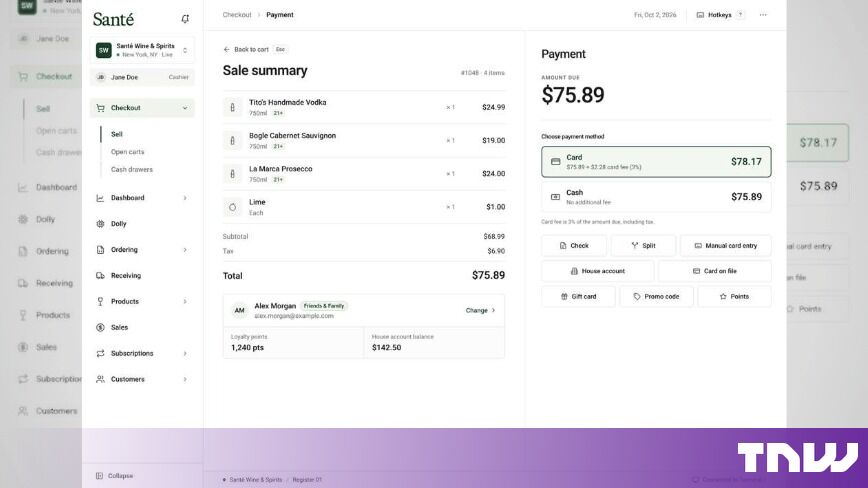
Santé’s strategy starts with bringing those parts of the business into one system. Its platform spans checkout, inventory, e-commerce, delivery orders, marketing and subscriptions. It also incorporates details specific to alcohol retail. These include wine vintages, bottle and keg tracking, and mix-and-match case discounts.
Those features may sound mundane alongside the promise of autonomous AI. But they help explain the company’s investment thesis: useful automation depends on understanding how the merchant’s business actually works.
A system recommending a promotion needs accurate costs and stock levels. A campaign advertising a particular wine needs to distinguish the right vintage. An ordering recommendation needs to account for products sold by both the bottle and the case.
If that information is fragmented or outdated, an AI-generated recommendation may simply help a retailer make the wrong decision faster.
Invoices, pricing and promotions
Santé says its invoice tools scan distributor invoices and automatically update inventory quantities and unit costs within minutes. That removes a repetitive task, while also supplying information that could improve decisions elsewhere in the business. A price recommendation, for example, becomes more useful when it reflects what the store most recently paid for the product.
The company’s merchandising agent builds on that foundation. It analyzes item-level sales data and suggests pricing and promotional strategies for slow-moving goods.
The opportunity is to help merchants put their cash to better use. Clearing a product that has been sitting on the shelf can make room for something customers are more likely to buy. But the economics require care: a discount can accelerate sales while reducing the profit earned on each bottle.
That makes the quality of the recommendation more consequential than the speed at which it is delivered.
Customers and staffing
Customer marketing offers another route to growth. Santé says its marketing agent groups shoppers according to purchase history and launches email and text-message campaigns promoting products, events and discounts.
The attraction is the connection between inventory and customer behavior. A store might have both an oversupply of a particular wine and a group of customers who regularly buy similar bottles. Bringing those facts together could give the owner a more focused way to move the stock.
That example illustrates the intended value of the platform. The announcement does not establish how completely the process runs without merchant involvement. But it explains why owning the operational software could matter. The system already sits close to the information needed to decide what to promote and to whom.
Santé is applying a similar approach to staffing. Its scheduling agent uses store-level sales patterns to help match employees across roles with expected demand. The platform also brings delivery orders from DoorDash, Uber Eats, GrubHub and Instacart into the point-of-sale system. It generates descriptions and images for online product catalogs, according to the company.
Individually, these tools address familiar retail chores. Together, they support a broader ambition: making Santé a central part of how an owner manages the business throughout the day.
The lead investor
For the lead investor FINTOP, specialized software and embedded financial services are central to the appeal.
“It’s rare to find a founder and team at this stage that have both proven the solution is superior and are executing at an elite velocity in a massive, complex vertical,” said Brittani Roberts, the Director at FINTOP who leads the firm’s Vertical SaaS and Embedded Fintech thesis. “The team has built intuitive and practical AI back office workflows, with embedded fintech throughout the platform, so store owners aren’t simply getting another tool to track inventory. They’re getting an intelligent platform that directly expands their profit margins and operational scale.”
The $15 million round is a bet that a specialized software provider can turn the daily records of a neighborhood business into real growth.