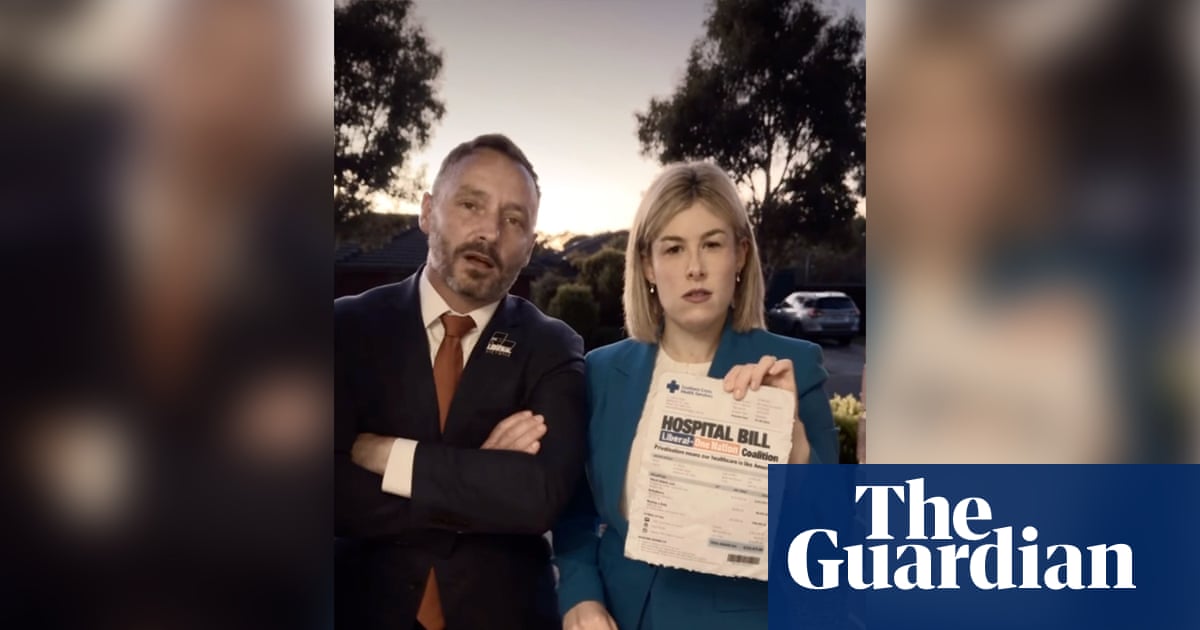
It's the night of Halloween and Jess Wilson has appeared on social media feeds with a warning about a scary prospect: "Americanised healthcare" under a future Liberal government.
"If you had a heart attack, you would have to pay $150,000 for care," the Victorian Liberal leader says, mid-trick or treat.
There's just one problem: Wilson never said this.
The election campaign video, posted to Victorian Labor's social media accounts on Saturday, is an AI-generated depiction of Wilson, complete with a voice that sounds just like her.
In it, she clutches a bill listing the supposed costs of US-style healthcare: $150,000 for a heart attack, $6,000 for an ambulance and $40,000 to have a baby. At her side is One Nation's Victorian leader, Warren Pickering, curiously sporting a Liberal party badge.
The claims made in the video stem from comments made at a press conference last month, after Wilson announced a $1.27bn plan to pay private hospitals to conduct public elective surgeries to help reduce the waitlist.
When asked if it was bad to "Americanise" the state's healthcare system, Wilson responded: "Not at all."
"This is happening in Queensland today. In fact, the Labor government has implemented it here in the past," she said at the time.
On Wednesday the premier, Ben Carroll, defended the video's content, telling ABC Radio Melbourne: "Jess Wilson herself has said there is nothing wrong with Americanising our health system. They're her words. She has said that, and every Victorian should be terrified by that."
But Wilson said it was a "desperate smear campaign" and that "in no way, shape or form are we Americanising the healthcare system here in Victoria".
The Liberal party campaign described the video as "garbage" and urged voters to treat it that way.
Yet it is also using AI on social media ahead of this month's election.
Among the Liberal party's social media posts include AI-generated videos of the premier, Ben Carroll, asleep at his desk. This followed a front-page Herald Sun story on 24 October, in which unnamed sources accused the Labor leader of taking naps on the job.
A source inside Labor's campaign headquarters, not authorised to speak publicly, said the Liberals "threw the first brick" by creating that video.
But it's not confined to the major parties throwing "bricks". Conservative lobby group Advance Australia last month released an AI-generated video that fabricates a Labor victory on election night, complete with former premiers Jacinta Allan and a North Face-clad Daniel Andrews. A video shown at One Nation's launch event conjured up inflammatory tropes of people from various ethnic backgrounds.
It has led experts and the Greens to call for the practice to be banned altogether.
"Trust is already at all-time lows," says Clancy Moore, chief executive of Transparency International Australia.
"So lies, deepfakes and AI-generated politicians in election ads only further erode Victorian's trust in politicians and our democracy."
'Little nudges' with 'drastic impacts'
Timothy Koskie, a media researcher at the University of Sydney, says misinformation in political messaging on social media "predates AI pretty significantly", but the rise of fake videos and images makes it easier to play on "some subtle mischaracterisations that are easier to represent artificially."
"It's not that we're deceiving voters into believing something that's not true. It's that we're making more convincing an argument that actually doesn't hold up," he says.
"It's very difficult to stop it from happening. The public won't reward people who refrain from using it."
But Koskie says those spreading misinformation should be held accountable for "their mischaracterisation of information".
"Trying to clean it up after is a losing proposition," he says, suggesting even small fines can be effective in reigning in bad behaviour, citing X's $650,000 fine after failing to comply with an Australian child safety notice.
"These little nudges have some pretty drastic impacts over time. So we don't necessarily have to drag these people over coals or torture them in public if they make a misstatement, but that misstatement needs to have some sort of a follow-up."
Under the SA laws, the use of AI-generated deepfakes to create electoral ads that depict acts that a person did not perform – without that person's permission – are banned, with penalties in place of up to $5,000 for people caught in breach.
Moore says at the very least, political parties in Victoria should be using an AI watermark to inform voters. Only the Advance video contains a disclaimer that "this nightmare version of election night has been imagined by AI".
The Greens will on Thursday call on whoever forms government to introduce SA-style truth in political advertising laws, with the party's state leader, Ellen Sandell, saying "Victorians deserve to know that what they're seeing and hearing from political parties is real".
Sandell has also urged parties to sign a memorandum of understanding that sets out standards of behaviour during the campaign, which includes not using "deceptive AI content."