19th century Nature account of 1841 train delayed by geomagnetic storm got year wrong—due to a typo.
The infamous Carrington Event of 1859 has long been considered the first extreme space weather event, but there have been reports of minor disturbances to telegraph equipment during geomagnetic storms since the late 1840s. In 2013, scholars discovered an anonymous report published in 1871 in Nature describing how a “very intense magnetic disturbance” disrupted rail travel in Exeter on the southern coast of England in October 1841. If accurate, this would be the earliest such account. However, according to a paper published in the journal Space Weather, that 1841 date is most likely a typo, with the real railway disruption occurring several years later.
“Space weather is often discussed as a modern challenge because of our dependence on technologies such as satellites, communications systems and electricity networks,” said co-author Jim Wild of Lancaster University. “What this study shows is that society has been experiencing the effects of space weather on technology for almost as long as electrical technologies have existed. The Exeter train delay is a fascinating story because it sits right at the point where emerging technologies first began to encounter the realities of the space environment.”
The Carrington Event remains the most powerful geomagnetic storm in the scientific record, with strong auroral displays occurring all over the world, causing sparking and even a few fires in telegraph stations. Some of the auroras were so bright that people reported being able to read the newspaper by their light. The telegraph was a relatively new technology at the time, having first emerged in the 1830s, and the geomagnetically induced current—from a likely coronal mass injection from the Sun—knocked out telegraph systems. Some operators found they were still able to transmit and receive messages even after disconnecting the power supply, relying just on the powerful auroral current.
Were a similarly intense geomagnetic storm to occur today, it would likely seriously damage the electrical power grid, causing widespread outages and blackouts, as well as disrupting satellite communications. That’s why scientists are so keen to learn more about past geomagnetic disturbances: It will help them strengthen future predictions in order to mitigate any damaging effects.
Wild and his co-authors were intrigued by the anonymous Nature report of a geomagnetic disturbance on October 18, 1841. Most emerging railway companies had incorporated electrical telegraphs to provide signals for train control systems to avoid collisions. The alleged 1841 disturbance was significant enough that it caused a 16-minute delay in the departure of a 10:05 PM express train at Exeter, because the telegraph operator couldn’t determine whether the rail line was clear or occupied by another train.
Searching the archives
However, Wild et al. questioned the accuracy of the report. Not only was the author anonymous, but the Nature paper had been published 30 years after the claimed geomagnetic disturbance took place. A search of historical archives revealed that the South Devon Railway Company built the tracks between Exeter and Plymouth in stages—and construction was not approved by Parliament until July 1844. The relevant section of track didn’t open until May 30, 1846, five years after the reported delay. So the anonymous Nature report could not be accurate.
Wild et al. were unable to locate the original source material for that 1871 Nature article, but they did find the publisher’s original copy with a handwritten annotation: “N. [J.] Holmes.” They concluded the author was most likely a prominent electrical engineer named Nathaniel John Holmes, who was involved in the deployment of undersea telegraph cables across parts of the North Sea. In 1871, Holmes was living in Hampstead, about a mile away from where Nature editor Sir Norman Lockyer lived.
Furthermore, the authors also found contemporary newspaper accounts of Holmes delivering a lecture on chemical effects of the solar spectrum in Scotland. So Holmes was clearly interested in solar activity and was familiar with Lockyer’s discovery of helium lines in solar spectra. There is also an 1877 letter from Holmes inviting Lockyer for a visit, indicating they had a business relationship of some kind.
That still did not explain the discrepancy between the reported 1841 date for the Exeter train delay and historical records. “No citation is provided that would enable an investigation into the veracity of the statement,” Wild et al. wrote. “The remarkable claim that [the operators] ‘reported next morning that someone was playing tricks with the instruments’ hints that this account may have originated from a contemporary newspaper report or suchlike, but we have been unable to find any report that included this phrase or any language to this effect.”
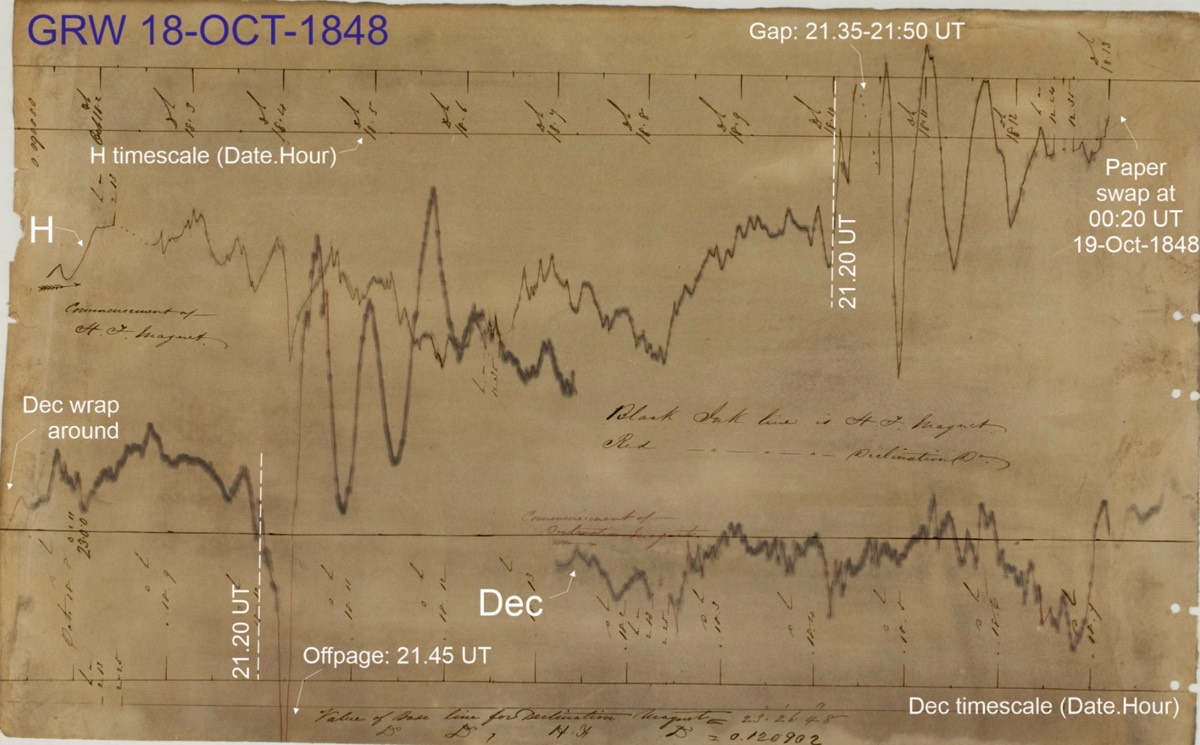
Wild and his co-authors next turned to archival scientific records, specifically the earliest magnetograms recorded at the Greenwich magnetic observatory in London. There is a record of “extraordinary” observations of a magnetic field, indicating strong geomagnetic storms, as far back as 1840, but no unusual activity, like aurora, was reported in England for October 18, 1841. However, there strong geomagnetic activity around October 18, 1848, confirmed in contemporary newspaper accounts and by sunspot observations made by British astronomer Temple Chevallier on October 19, 1848.
When Wild et al. consulted contemporary railway timetables, they found references to a 10:05 pm express train departing from Exeter between March 11, 1848, and July 26, 1849. They suggest that the original 1841 date mentioned in the Nature paper was a typographical error and that the event occurred but the year was wrong. With the 1841 account ruled out, the earliest documented example of space weather affecting technology is a March 1847 incident involving “spontaneous electrical currents” disrupting the telegraph systems on the Midland Railway, as a “brilliant aurora” glowed in the British Isles.
Space Weather, 2026. DOI: 10.1029/2026SW005239 (About DOIs).