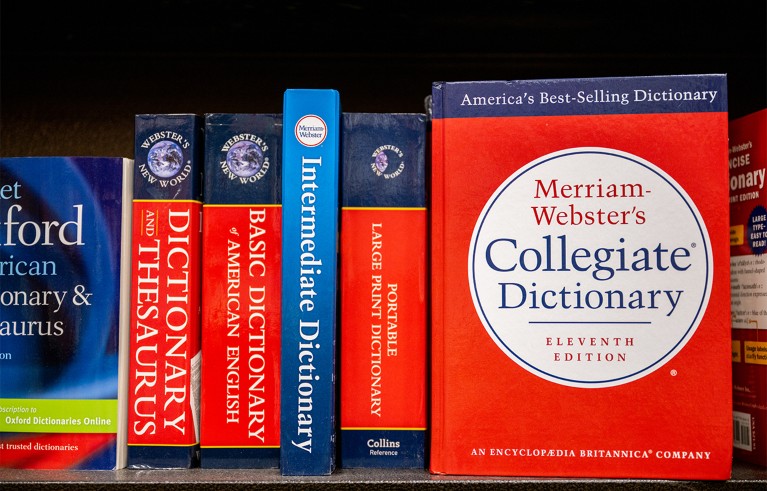
Artificial intelligence has achieved the ultimate sign of recognition: AI lingo has made it into the dictionary.
A slew of words and phrases about AI and technology has been added to the online version of the venerable Merriam-Webster dictionary, which has been a staple of US libraries and classrooms for decades and traces its roots back to a compendium of words published in 1806. Scholars say that the latest additions, which were announced in September and include terms such as ‘agentic’ and ‘natural language processing’, are notable for the advanced knowledge needed to understand them (see ‘Digital dictionary’).
“You can’t really explain ‘vibe coding’ if you don’t know what ‘programming’ is,” says Peter Sokolowski, a lexicographer at Merriam-Webster who writes and edits dictionary entries. He says that the sophistication of the newly listed words reflects non-specialists’ expanded access to highly technical terms, thanks to twenty-first-century digital communication.
“This particular batch, more than any other that I’ve seen, really does feel like it’s a meta-commentary on language,” says Sokolowski.
Sophisticated words
For a word to earn a spot in the Merriam-Webster dictionary, it must first appear repeatedly in mainstream media outlets such as newspapers and magazines, says Sokolowski. Specialist groups of physical- and biological-science ‘definers’ with expertise in these fields identify words that should be added. They then dive deeper into a word’s technical usage to understand its meaning and create a definition targeted at a general audience.
Digital dictionary
The Merriam-Webster dictionary, which traces its roots to a version published in the early nineteenth century, has added a host of technology-related terms.
Artificial-intelligence and computing terms
Natural language processing
Prompt engineering
Vibe coding
Other technical terms
Direct air capture
Uncanny valley
The surging number of complex technical words isn’t surprising, says Lera Boroditsky, a cognitive scientist at the University of California, San Diego, who studies language and cognition. Technological and scientific innovations often drive language change, she says, adding that today’s rate of technological advancement is comparable to, if not greater than, the rate seen during the industrial revolution. That rapid-fire change drives the generation of new words. “The more complex a society becomes, the more of these tightly packed units of meaning we have to make, so we can talk about things that are complex in ways that don't take forever,” she says.
Rapid spread
Enjoying our latest content?
Log in or create an account to continue
- Access the most recent journalism from Nature's award-winning team
- Explore the latest features & opinion covering groundbreaking research