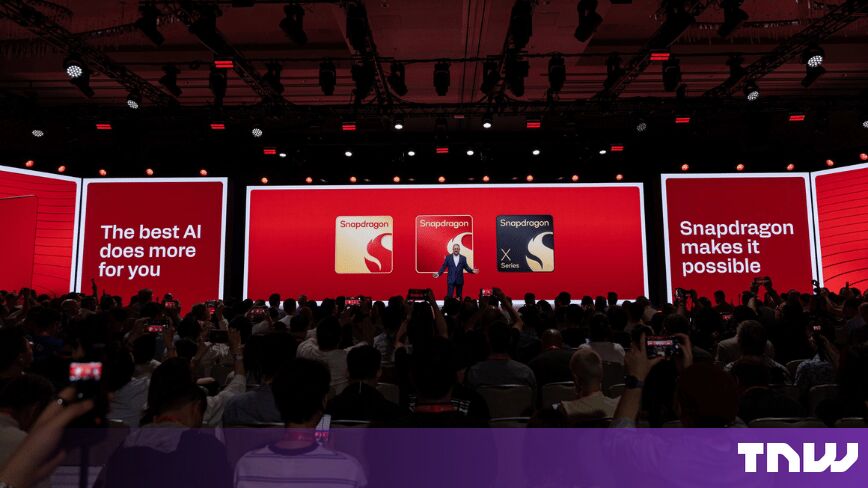
Qualcomm used its Snapdragon Summit in Maui this week to pitch its chips as the hardware for AI agents. In three days, it launched two flagship phone chips and a chip for AI earbuds and glasses. It also brought Linux to its X2 laptop processors.
Chief executive Cristiano Amon opened the summit on Tuesday, CNBC’s Kif Leswing reported. Amon also said Qualcomm will bring its High Bandwidth Compute (HBC) technology from the data centre to Snapdragon devices, according to The Elec. HBC stacks memory chips on top of an AI processor. Samsung and SK hynix will handle the memory stacking and TSMC the packaging, The Elec reported.
“We’re going into this transition from what is a very phone-centric model to now an agentic-centric model for new experiences,” Amon said, according to CNBC.
Two flagship phone chips
The Snapdragon 8 Elite Extreme Gen 6 and Snapdragon 8 Elite Gen 6 are built on a 2nm process. Taiwan Semiconductor Manufacturing Co. makes them, according to CNBC. Qualcomm calls the Extreme version’s Oryon CPU the world’s first mobile CPU to reach 5GHz.
Qualcomm says the Extreme chip’s CPU is 13% faster than the last generation, and its GPU is 44% faster. Its NPU, the part that runs AI, is 35% faster. It can record 8K video at 60 frames a second, the company says. It can also run AI models with 30 billion parameters on the phone.
On the third day, Qualcomm said the NPU handles context windows of up to 32,000 tokens. It can run mixture-of-experts models with more than 30 billion parameters. A new Sensing Hub with two small NPUs runs Personal Scribe, which builds a private knowledge graph from messages and emails.
The Spectra camera processor moves to a 20-bit architecture and is the first to support three 64MP cameras, according to Qualcomm.
For games, Qualcomm added Adreno Neural Fusion, which uses AI to upscale graphics and generate frames. More than 20 game studios and partners are working with it, Qualcomm wrote in a blog post.
“As the agentic AI age evolves, our multi-flagship strategy allows us to push the boundaries of what’s possible for mobile while bringing our latest AI innovations to a broader range of premium devices,” said Chris Patrick, Qualcomm’s general manager of mobile handsets.
Phones and partners
Phones with the chips will come from HONOR, iQOO, Motorola, OnePlus, OPPO, REDMI, RedMagic, vivo and Xiaomi. Motorola showed its Signature 27 on stage.
vivo named the iQOO 16 and iQOO Pad Ultra among the first devices with the Extreme chip, and RedMagic named its 12Pro+, in Qualcomm’s partner quote sheet. Xiaomi will use both chips.
Start-ups memories.ai, AGI Inc. and Liquid AI, maker of on-device models, showed agents on the new chips.
Gizmodo’s Kyle Barr tested Qualcomm’s reference phones at the summit. They beat Apple’s A20 Pro by 8% on multi-core Geekbench and by about 20% in 3DMark graphics tests. Apple kept a lead of about 10% on single-core scores, and the test phones ran hot, he wrote.
The launch comes as memory shortages push up phone prices. Counterpoint Research expects smartphone shipments to fall 14% in 2026.
On the PC side, the Snapdragon X Elite powers the first Googlebook laptops from Dell and HP. They went on pre-order on 21 September. Its X2 Series is also coming to Linux, as a third operating system after Windows and Googlebook.
Support starts with Debian by the end of this year. Qualcomm is working with Canonical on Ubuntu, with certification targeted for the first half of 2027. HP, ASUS and HUMAIN plan Linux devices in 2027, Qualcomm said.
Microsoft’s new Surface Pro 12-inch and Surface Laptop 13-inch run the Snapdragon X2 Plus.
On the second day, Chris Lattner presented Modular’s AI software as a single layer across Snapdragon chips. He joined Qualcomm through its Modular deal. Modular’s stack, made up of the Mojo language, the MAX serving framework and Modular Cloud, will support Qualcomm’s whole Dragonfly data centre processor family. Microsoft’s Logan Iyer joined him on stage.
Glasses, earbuds and health
For glasses, Qualcomm presented what it called the world’s first personal AI platforms to support 1-bit models. It also launched START, which pairs a chip package for glasses with phone and cloud software so companies can build such devices faster.
Meta, Snap’s Specs, Samsung and Warby Parker appeared as partners for smart glasses. INSPECS showed enterprise safety glasses with a 12MP camera.
The Snapdragon Sound Elite Gen 2 is Qualcomm’s first audio chip built for AI agents. It targets earbuds, headphones, audio glasses and earbuds with cameras. Qualcomm says it has up to twice the AI capability of the Snapdragon S7 Gen 1. It also uses up to 40% less power, a figure based on design simulation.
“Those interactions won’t always happen through a screen. They will happen through natural conversations, where users can simply speak to an AI assistant and receive help in real time,” said Ziad Asghar, who runs Qualcomm’s XR, wearables and personal AI business.
With the Connected Health Alliance, Qualcomm also launched the Personal AI Health Alliance. It has more than 30 members, including Optum, Scripps and Merck KGaA, and aims to bring data from wearables into healthcare.
Qualcomm and Mastercard also showed a shopping agent that runs on XR glasses and a phone. The user picks an offer and gives consent, and the agent completes the payment through Mastercard.