Ukrainian president, Volodymr Zelensky, recently told journalists that the Russian president, Vladimir Putin, has instructed his military commanders to abandon the rules of war that protect civilian targets. “He said there are no rules now,” Zelensky said – reporting that this information had been picked up by intelligence intercepts of Russian communications.
That Putin’s commanders took him at his word is apparent from a sharp increase in strikes on civilian targets. Over the past month there has been an intensification of Russian strikes on Kyiv and other Ukrainian cities. A UN report on October 9 reported that: “On 27 September alone, alerts lasted 19 hours. Strikes on bridges, educational institutions and energy infrastructure have intensified, causing widespread blackouts and water supply disruptions.”
On October 11, the US president, Donald Trump, announced an “energy ceasefire” which he said had been agreed to by both Russia and Ukraine. But both sides have denied this. While Zelensky has said Ukraine will halt its successful campaign of strikes against Russian oil refineries if Russia stops targeting its power plants, Russia responded the same day with a series of attacks on Ukrainian power facilities.
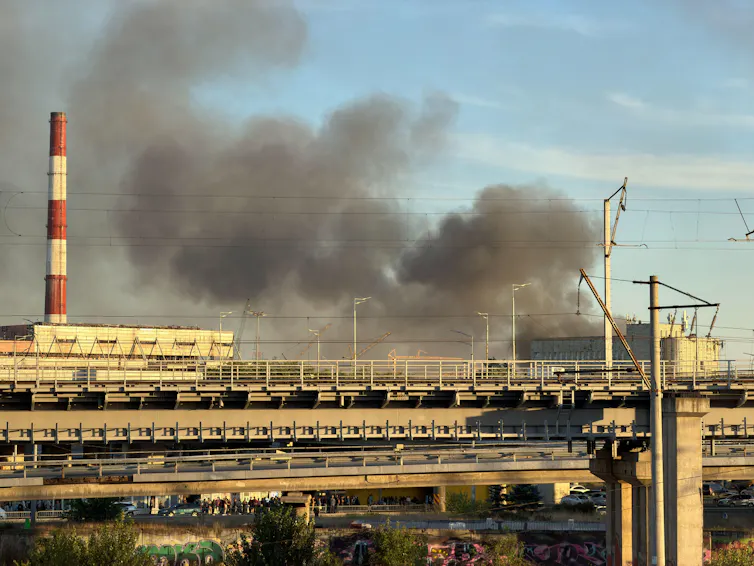
Other critical infrastructure targeted by Russian strikes has included data centres and internet providers in Kyiv and other big cities. Russia has also been targeting transport and logistics hubs, rail stations and bridges over the Dnipro river in Kyiv.
All of these are severely disruptive to civilian life. In the case of Kyiv’s bridges, their destruction has the potential to literally bring the city to a standstill.
Distinguishing between civilian targets and military objectives is a fundamental principle of international humanitarian law on the conduct of war. This expressly prohibits attacks against civilians and civilian objects.
The rule is codified in Article 48 of the Geneva Convention, to which Russia is a signatory. The article states that all parties to a conflict “shall at all times distinguish between the civilian population and combatants and between civilian objects and military objectives and […] shall direct their operations only against military objectives”.
Russian military regulations on international humanitarian law nominally endorse distinction and proportionality. Russia is also a party to the Geneva Conventions and inherited the Soviet ratification of Additional Protocol I, which defines “objects indispensable to the survival of the civilian population”.
Not a ‘new strategy’
But Russian practice has often diverged from its formal legal commitments. During military operations in Chechnya, Syria and Ukraine, the Russian armed forces engaged in patterns of behaviour that directly violated these principles. Russian forces fighting in Chechnya relied heavily on the use of massive firepower and the indiscriminate use of force.
The Russian siege of the Chechen capital Grozny, in 1999 and 2000, devastated the city, prompting the UN to label it “the most destroyed city on Earth” . Russian operations in Syria echoed this approach. Its military conducted intense bombing raids and indiscriminate airstrikes against residential areas and civilian infrastructure such as schools, hospitals and markets.
Attacking critical non-military targets has been part of the way Russia has waged war for many years. Soviet military theorist Aleksandr Svechin distinguished between two different strategies of warfare. A strategy of destruction aims to destroy enemy armed forces quickly with a knock-out blow in the field. A strategy of exhaustion, on the other hands, depends on degrading an enemy’s economic, material and moral resources over time. These ideas remain influential.
Svechin’s stategy of exhaustion is often summed up by military theorists with the acronym Sodcit. Spelled out in full, this stands for “strategic operations to destroy critical infrastructure”. It’s a key element of Russia’s way of waging war.
But Sodcit isn’t about indiscriminate attacks on civilian targets. The idea is to “inflict sufficient material and psychological ‘deterrent damage’ to reduce the adversary’s capacity and, above all, willingness to continue or escalate the war”.
It’s interesting to note, though, that when reporting Russian strikes on Ukraine, the state news agency, Tass – a Kremlin mouthpiece – aims to establish these are “dual-use targets”. In other words, they can also be used for military purposes. So a Nova Post logistic hub, where people’s parcels and other mail are sorted, was, Tass claimed, “used to store dual-use cargo designated for supplies to the Ukrainian army”.
But it’s much harder to justify bombing apartment blocks and cities’ electricity installations in military terms.
So as winter approaches, destroying Ukraine’s energy networks and leaving people without heating, power or water, aims to destroy morale. And when civilian infrastructure is targeted, civilians also die. The UN human rights monitoring mission in Ukraine (HRMMU) has reported that civilian casualties in the first eight months of 2026 were higher than the whole of 2025. This is also calculated to destroy morale.
Putin’s “new strategy” of attacking civilians and the things that enable them to go about their lives is nothing new. But it seems clear that with winter approaching, and in light of recent Ukrainian success on the front lines, Russia will redouble its attacks on Ukraine’s home front.