A photograph survives, but the life around it has been dismantled. A voice remains on an old recording, but the singer has been forbidden to stand before an audience. A face flickers across a cinema screen, while the woman it belonged to has lost her work, her home and the right to be publicly remembered.
This is the terrain of Soheila Sokhanvari’s art. She has won the 2026 David and Yuko Juda Art Foundation award for her work, which asks what remains after a life has been pushed out of history – and whether a portrait, however lovingly rendered, can resurrect a woman consigned to oblivion.
Born in Shiraz, southwestern Iran, in 1964, Sokhanvari left for Britain aged 14, shortly before the 1979 revolution transformed the country she knew. Separated from her family, she repeatedly drew them from photographs. The theme of exile in her work is not only a separation from place, but from time: from a homeland that continued to live in her memory while becoming unreachable.
That rupture shapes both the visual language and the scale of Sokhanvari’s work. Drawing on the intimate format of Persian miniature painting, she works painstakingly in egg tempera on calf vellum. These small portraits require the viewer to come close. Women once magnified on cinema screens return at a scale that concentrates rather than diminishes their presence. Their faces, drawn from old photographs, remain grey and spectral, while colour blooms around them in dense Persian-inspired patterns.
Painted worlds
The five portraits presented for the award bring her father, Ali-Mohammad Sokhanvari, into the company of Empress Farah Diba Pahlavi and actresses Zhaleh Olov, Zari Khoshkam and Farzaneh Taidi. Family memory and public history meet in the same painted world.
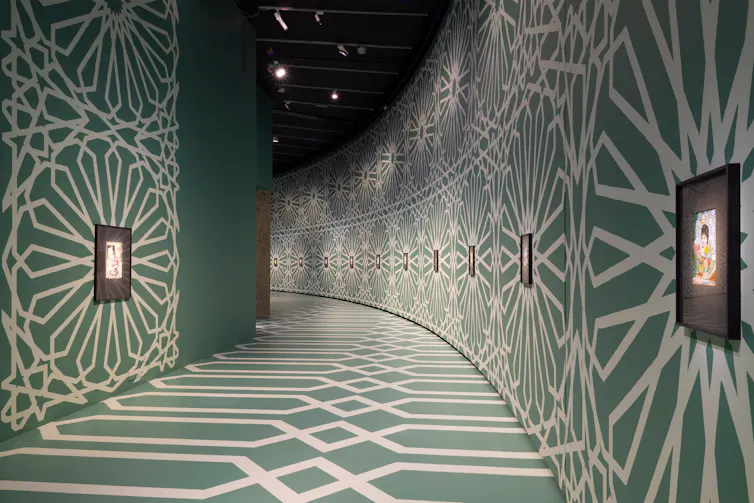
In 2022, Sokhanvari brought 28 of these miniature portraits together in her major Barbican installation, Rebel Rebel. The show placed individual lives within a longer history of Iranian women’s resistance across generations. Displayed together, the portraits resembled precious illuminations. Yet their beauty offered no refuge from violence. They linked the women who once claimed a public presence on screen and stage with those who continue to defend their right to visibility today.
Each of the women Sokhanvari paints carries her own story of visibility, courage and loss. Together, their lives reveal the many forms that erasure can take. Roohangiz Saminejad, the first female star of a Persian-language talkie, paid for her visibility long before the revolution. When her first movie, Lor Girl, appeared in 1933, many were enraged by the image of an unveiled woman dancing before the camera. She received death threats and eventually changed her name to live in anonymity.

Sokhanvari paints Saminejad in stark monochrome, without the patterned backdrop that surrounds so many of her other subjects. Nothing draws our gaze away from the unveiled face for which she was made to suffer. Saminejad’s story is a reminder that the danger of being seen did not begin with the revolution, but rather the revolution gave it the force of the state.
Parvin Kheirbakhsh, known as Forouzan, was once one of Iran’s greatest film stars. After the revolution, she was imprisoned and released only after signing a letter of repentance. Her money and property were seized, and she was left to die in relative obscurity. Sokhanvari’s Hey, Baby I’m a Star, speaks to the reversal of a woman once recognised everywhere becoming a stranger even to history.

The fate of Kobra Amin Saeedi, known as Shahrzad, is more devastating still. She had been a dancer and actor, but also a poet, journalist and pioneering filmmaker. Saeedi struggled to move from performing in other people’s films to writing and directing her own in an industry that made room for her image more readily than for her authorship. After joining the 1979 protests against compulsory hijab, she was imprisoned and later spent several years in psychiatric institutions.
Sokhanvari has recounted that Saeedi was subjected to electric shock therapy and had her assets confiscated. She later became homeless and died in 2025.
In Sokhanvari’s painting Kobra, however, Shahrzad is statuesque: cigarette poised between red nails, gaze withdrawn yet sovereign. Because so few clear photographs of Shahrzad survived, Sokhanvari could not simply reproduce an existing image. Instead, she studied a grainy headshot and a blurred three-quarter-length photograph, then posed as Shahrzad herself while her husband photographed her.
The artist used her own body to imagine the commanding posture that the damaged archive could no longer provide. She did not use it to invent a more innocent or idealised woman, nor to conceal the suffering of Shahrzad’s later life but to restore the self-possession that was stripped away from her.

A portrait of Googoosh, meanwhile, represents a different kind of disappearance. For 21 years after the revolution, Googoosh – Iran’s most famous singer – could neither perform nor record. She described spending most of those years under house arrest, with a month in prison. Her songs still travelled through homes across the diaspora on copied tapes. She was everywhere in memory but nowhere on the stage. When she finally sang again in 2000, she could do so only in exile, having left for good the country that knew her songs by heart.
In The Love Addict, a younger Googoosh sits before a framed portrait of the woman she would become. Her face and hands remain ghostly grey while an intensely coloured world blooms around her. The painting holds two times together: the star preserved in the artist’s childhood and the older woman who endured years of silence.
Sokhanvari calls portrait painting “an act of love”. She grinds pigments, mixes them with egg yolk and builds each form through repeated layers.
These paintings cannot return confiscated homes, interrupted careers or years spent in silence. They cannot rebuild the world in which these women once sang, acted and made themselves seen. But in every deliberate brushstroke, they refuse to let us forget.