
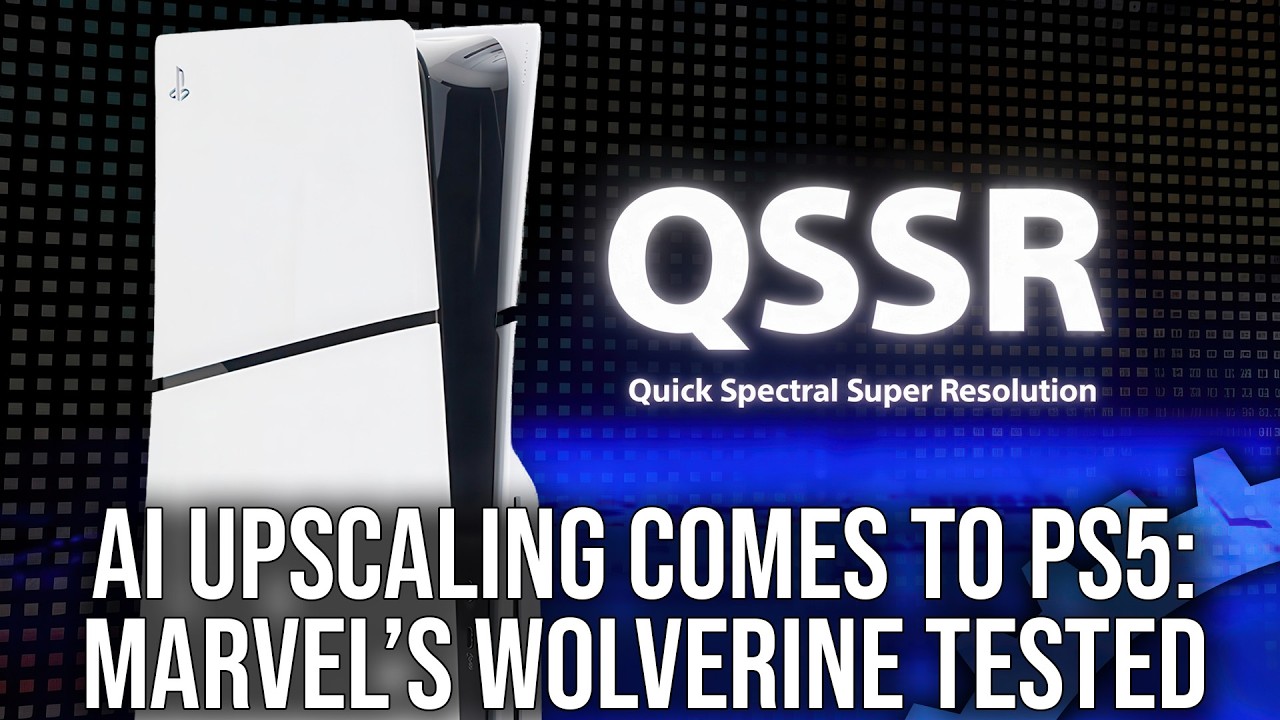
- Quick Spectral Super Resolution (QSSR) is Sony's new machine-based upscaling tech for the PS5
- Analysts at Digital Foundry say it has "remarkable" potential
- has an "exceptional" quality boost, while Ghost of Yotei "saw less dramatic improvements"
Sony has unveiled Quick Spectral Super Resolution (QSSR), its new AI upscaling technology built for the base PS5, and it can offer major image-quality improvements.
QSSR is different from PlayStation Spectral Super Resolution (PSSR), with Sony describing it as a "quick new evolution of PSSR" and "built on two key innovations," including a streamlined neural network architecture and a hand-tuned implementation that maximizes performance on PS5.
"While PSSR remains the gold standard on PS5 Pro, QSSR provides some notable improvements to both image detail and image stability on PS5," Sony said, with the first titles to use the tech being and Ghost of Yōtei.
According to tech experts at Digital Foundry(DF), who went hands-on with QSSR and tested both games, they believe "The potential here is remarkable."
"Low resolution and poor upscaling have impacted so many titles in this generation, but QSSR could make a big difference," DF wrote. "In especially, the quality boost can be exceptional.
"In terms of image quality analysis, suffice it to say that temporal stability is substantially improved, detail level increases, sub-pixel integrity is considerably superior, while artefacts from elements like moving foliage are much reduced."
However, it notes that with Ghost of Yōtei, a game that already boasts gorgeous image quality, it "saw less dramatic improvements."
In its YouTube analysis, DF founder Richard Leadbetter showed off comparisons of QSSR enabled and disabled in both games; the analysts tested a cutscene in Performance Mode uncapped, and there's a noticeable visual upgrade when the tech is on.
"The frame rate is lower," Leadbetter noted. "The headline number doesn't look great, right? A hit of about 8 to 10 frames per second [versus on/off]. But the important thing is the frame time cost of QSSR. By my calculation, it's between 1.5 to 1.8 milliseconds, and I'd say that's reasonable for an ML-based [machine-learning based] upscaler producing results like this from a low base resolution on hardware that doesn't have any form of ML acceleration.
Leadbetter deduces that the higher the output/input resolution is, the bigger the frame rate hit will be."
In 60fps graphics modes where dynamic resolution scaling is being used, he said, "basically now we're getting the best of both worlds," as "Performance is practically identical" with or without QSSR enabled.
"The QSSR 'on' side will be lower in resolution to maintain frame rate," Leadbetter said, "but the quality of the upscaler is so much better that you're getting a better experience overall."
One clip shows a 1fps drop with QSSR on, but it's hardly noticeable, and while Ghost of Yotei running in Performance Mode uncapped VRR at 120 Hz does show frame dips when QSSR is enabled, they are "slight."
"Basically imperceptible for the most part," he said, "which is very different from what we saw with , to the point where you know with the captures here, I had to recheck that QSSR was actually on because it just looks too good to be true here. There's no real performance here."
Like PSSR, QSSR is expected to be patched into more games and utilized in future PS5 titles; it's unclear right now whether Rockstar Games plans to take advantage of the tech in .

Demi is a freelance games journalist who helps cover gaming news at TechRadar. She's been a games writer for five years and has written for outlets such as GameSpot, NME, and GamesRadar, covering news, features, and reviews. Outside of writing, she plays a lot of RPGs and talks far too much about on X.