Much like the standard Surface Laptop, the Ultra variant doesn't have any of the bells and whistles from Microsoft's convertible Surfaces. It just looks like a sleek, all-metal business laptop. Pop it open and you'll notice that its 15-inch screen has a tall 3:2 aspect ratio instead of the typical widescreen configuration. And if you peer along the bottom of the case, you'll see a slightly segmented base (reminiscent of the Surface Laptop Studio), which makes a bit of room for cooling vents and downward-firing speakers.
While there's a lot to admire about Microsoft's design prowess, the biggest selling point of the Surface Laptop Ultra is NVIDIA's RTX Spark chip. It's an Arm-based system-on-a-chip that can be equipped with up to 20 CPU cores and 6,144 GPU cores. Take note: You'll need to shell out $3,700 to get the most powerful RTX Spark hardware here, but at least that ships with 32GB of RAM. The base $2,600 Surface Laptop Ultra has 18 CPU cores and 5,120 GPU cores.
Taking a cue from Apple Silicon and Qualcomm's recent Snapdragon X chips, the RTX Spark also features unified memory, which is accessible to both the CPU and GPU. That gives it even more memory bandwidth than a typical Intel or AMD-based Windows PC, which have their RAM, CPU and dedicated GPUs spread out across their motherboards. By having direct access to tons of RAM, RTX Spark hardware can also house large AI models locally, which is a major reason why both Microsoft and NVIDIA are pitching it as a major evolution for PCs.
Thanks to its NVIDIA GPU cores, the RTX Spark chip also delivers gaming performance similar to an RTX 5070 laptop GPU. That makes it ideal for 1440p gaming, and you can probably also get decent performance in 4K and other higher resolutions thanks to NVIDIA's DLSS upscaling and frame generation. The Surface Laptop Ultra starts at a much higher price than most RTX 5070 gaming notebooks, though, so it's not something you'd want to buy for pure gaming.
The RTX Spark's Arm CPU is both a blessing and a curse: It technically can perform more efficiently than Intel and AMD's x86-64 chips, but it also requires emulating older Windows software and drivers. That opens the door to unforeseen bugs and issues, especially for niche apps and minimally-supported third-party drivers. While this was a major problem when Microsoft first started dabbling with Windows on Arm (think back to the original Surface with Windows RT or the Surface Pro X), the company's emulation for x86-64 software has dramatically improved. Kernel-level anti-cheat software for multiplayer games initially didn't work on the first Snapdragon X Windows systems, but both Microsoft and NVIDIA have worked on resolving that. Now, you can easily play Arm-based Windows systems.
Microsoft initially touted the Surface Laptop Ultra's 15-inch screen as the brightest laptop display on the market, thanks to its eye-searing 2,000 nits of HDR brightness. Apple's new MacBook Pro with PROLED Display stole that thunder a bit, though: Its screen can reach the same brightness, and its OLED screen delivers deeper blacks and higher contrast. The Surface Laptop Ultra's mini-LED display is still plenty impressive though, especially while watching films in HDR with rich colors, or playing games that truly push its brightness and HDR capabilities.
The Surface Laptop Ultra also features a keyboard that's similar to the Surface Laptop's, which has always felt great to type on thanks to its deep key depth and satisfying feedback. Its large trackpad also supports newer haptic feedback in Windows — for example, you can feel a slight nudge as you move apps along the edges of the screen to lock them into place. We've seen similar haptic feedback in mice like Logitech's MX Master 4, and while it's not exactly groundbreaking, I find it to be a nifty addition to the aging Windows interface.
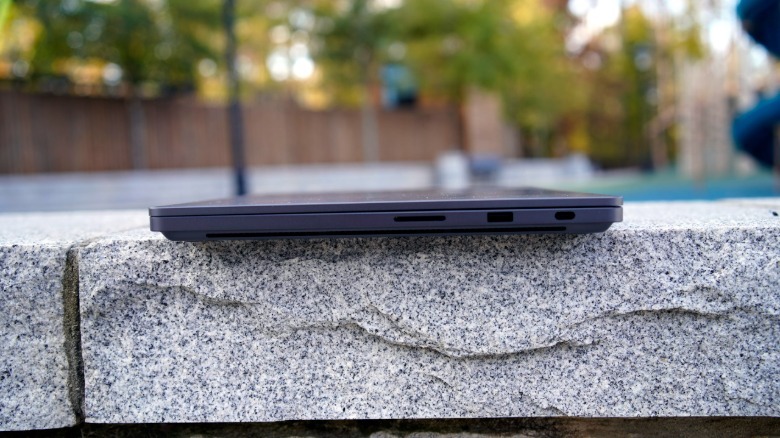
Strangely enough, one of the most interesting things about the Surface Laptop Ultra is its magnetic USB-C charging cable. It allows the notebook's charging cable to snap into place on one USB-C port, and similar to Apple's MagSafe cable, it also lets the cable easily slide out if someone trips on it. It's a useful replacement for the proprietary Surface charging connection, since it allows Microsoft to keep a standard USB-C port on the Laptop Ultra for charging, which will also work seamlessly with every other USB-C charging cable. The magnetic USB-C charging cable is Microsoft's invention, but the company says it could bring it to partner laptops if they're interested.
The Surface Laptop Pro's ports mostly match the MacBook Pro's, with three USB-C ports, HDMI, SD card slot and a headphone jack. But, crucially, there's also a USB Type-A connection for older devices. I could see that being very useful for some Windows creatives.