
Tech Digest Editor Chris Price travelled to Vilnius, Lithuania, for #Disinfo2026 to see how technology is being used to spread misinformation and disinformation worldwide, in order to undermine democracy and to advance political causes.
In the UK, we tend to take democracy for granted. OK, some politicians might have us believe otherwise, but we still have the rule of law, an independent judiciary, and, unlike many countries, we haven’t been fully invaded since 1066, as the reminds us.
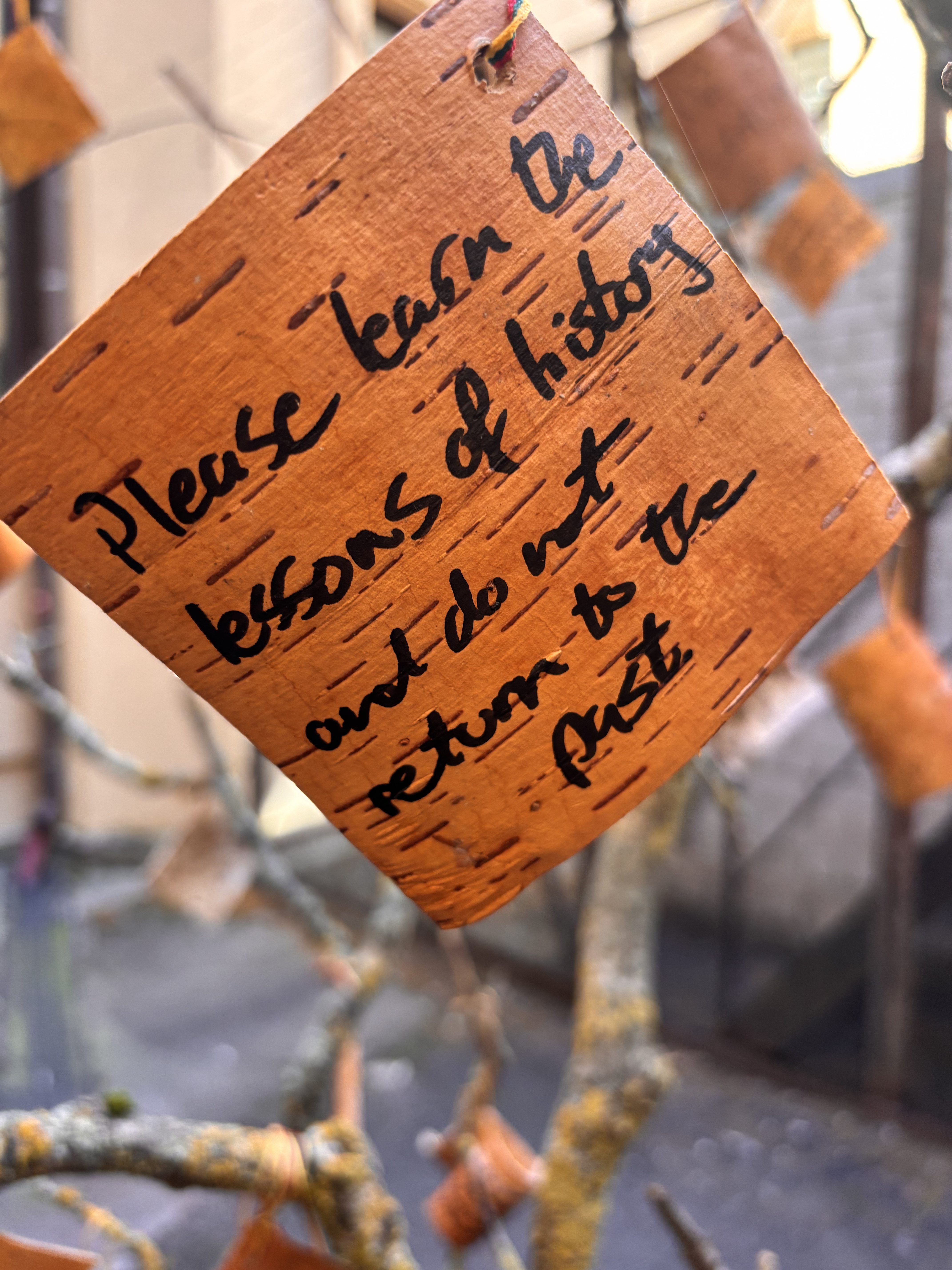
The same can’t be said for Lithuania, which I visited last week as a guest of the country’s . Walking around the Museum of Occupation in the capital Vilnius while taking a break from the disinformation conference, I was reminded that Lithuania was invaded no less than three times during World War II.
First by the Russians in a secret pact between Russia and Germany to carve up the continent according to their spheres of interest. Then by the Germans themselves, reneging on that deal (between 1941-1944) and then again by the Russians as Germany, overstretched fighting a war on multiple fronts, began to retreat. Hundreds of thousands of Lithuanians died during this period, including most of its Jewish population as well as the vast majority of the country’s resistance fighters (the partisans).
Many thousands more died after the war at the hands of Russia’s KGB (including hundreds in the execution chamber in the basement of what is now Vilnius’ Museum of Occupation) and in Stalin’s remote Soviet Gulags, where many perished of extreme cold and malnutrition.
No wonder then, when the after the fall of the Soviet Union came, Lithuania was the first of the Baltic States to declare its independence on March 11th, 1990. And no wonder that, with Vladimir Putin testing NATO’s resolve as Russia looks to expand its once-great empire yet again, Lithuania is on the front line, ringing the alarm bells.
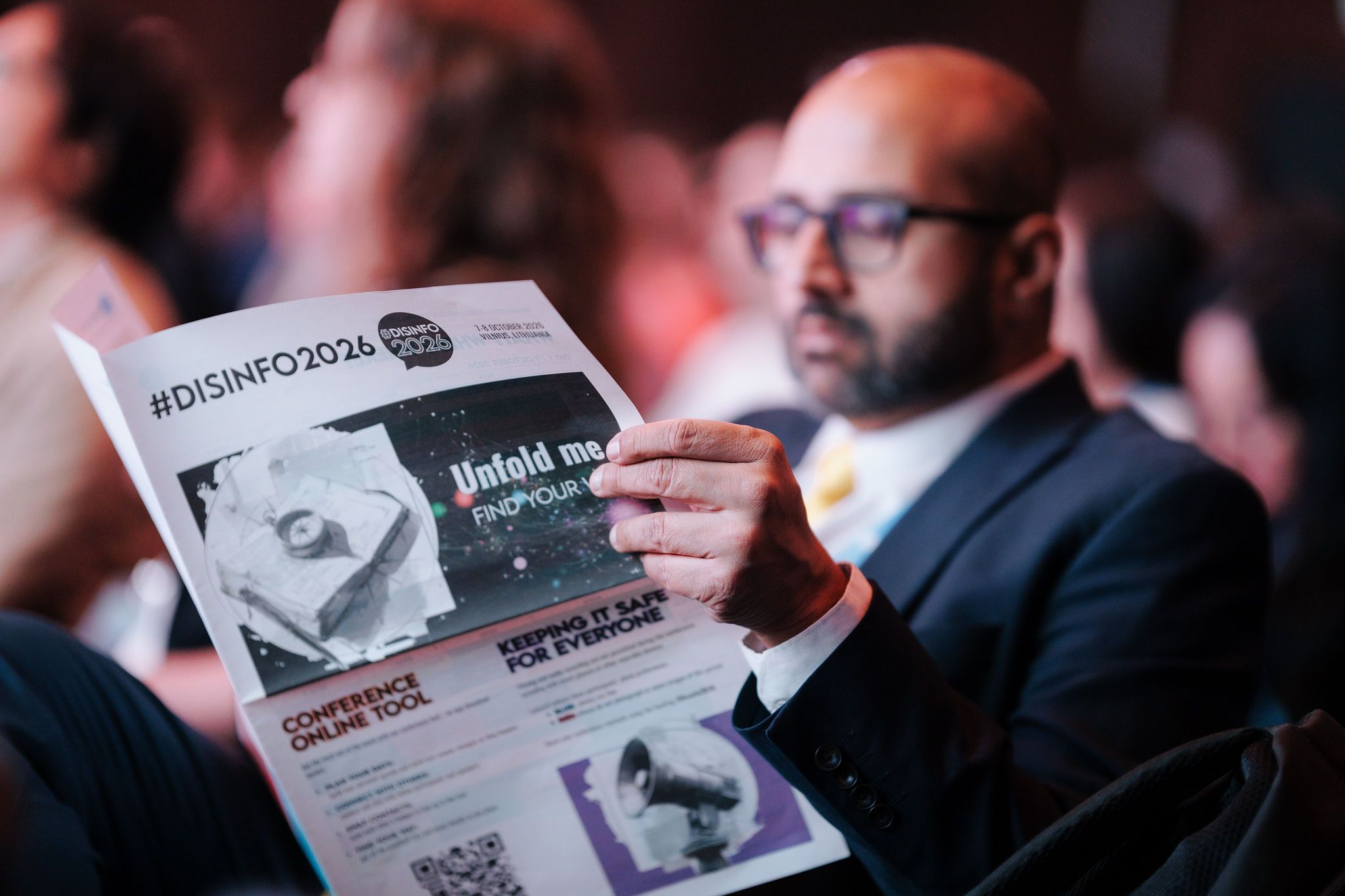
Which brings us to – a conference looking at how state-sponsored actors, often with the help of private companies, are using technology to deliberately spread mis and disinformation. Held since 2019 when it took place in Brussels, Belgium (it is organised by the Brussels-based non-profit EU DisinfoLab) this year’s conference certainly proved to be the most controversial so far.
Before the Radisson Blu hotel in Vilnius had opened its doors to delegates, including researchers, journalists and policymakers, several sponsors had been forced to pull out under pressure from the Trump administration, because of a panel that considered whether the USA ‘could be a FIMI threat’. (FIMI is the acronym used for the phrase ‘Foreign Information Manipulation and Interference’.) This included the Lithuanian Ministry of Foreign Affairs, the European External Action Service (EEAS) and, perhaps somewhat surprisingly, Canada’s foreign ministry, Global Affairs Canada.
“What this amounts to is a purported defender of free speech at the state department using the enormous power of the US government to try to pressure Americans from criticising their government,” Nina Jankowicz, a former US official and disinformation expert who briefly headed the Biden administration’s , told The Guardian.
As a result of the withdrawal, their logos were hastily wiped from the #Disinfo website and even covered over on programmes and billboards within the conference (pity the person whose job it was to cover over all the names with pieces of blank white paper days before the conference opened!)
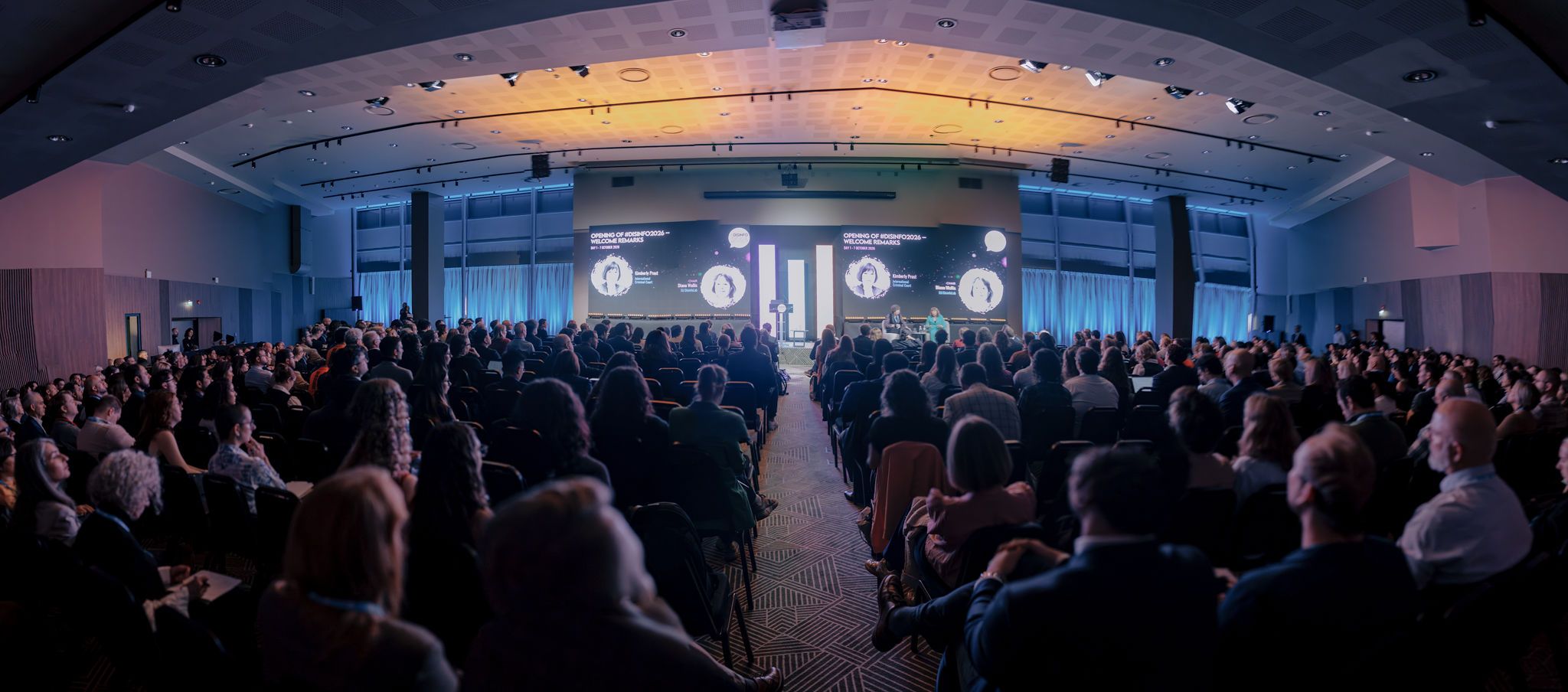
If the US wasn’t happy with being considered as a FIMI threat, then most likely it will have been even less pleased with the keynote discussion between Diana Wallis, EU Disinfo Lab’s Board President, and Judge Kimberly Prost from the International Criminal Court (ICC). Sanctioned by the US after authorising an investigation into alleged atrocity crimes in Afghanistan, including a small component concerning the activities of US officials, Prost outlined to delegates the severe economic and personal restrictions that have been placed on her life.
Indeed, the restrictions extend far beyond a mere inability to travel to the United States, deeply disrupting her daily life and routine operations. “All of your credit cards, wherever they were issued, no matter who issued them, are cancelled immediately,” she told delegates. “Your banking services are also withdrawn in their entirety.” Furthermore, access to daily services and technology provided by American companies, such as smartphones, computers, and cloud accounts from companies such as Apple and Google, can be randomly cut off.
Over-compliance by international institutions compounds the pressure. For example, a French company handling the court’s medical insurance contract refused to pay her claims. Despite these severe inconveniences, Prost emphasised that the primary target is judicial independence. “The reason for this is that they are attacking the independence of the judiciary. They want us to stop doing our jobs or to decide cases the way they want,” Judge Kimberly Prost told the packed hall of delegates. “I can assure you that none of us – and I speak for all of my colleagues – will be intimidated,” she added.
Hidden tier
Of course, while the actions of the US government towards judges in the ICC can be seen as a blatant attack on the judiciary (the US has never accepted the authority of the court), it’s fair to say that when it comes to disinformation, it is more authoritarian regimes that were mainly the subject of this year’s Disinfo conference.
Speaking to another packed audience in a session entitled , Sarah Boutboul, a lead intelligence analyst at Blackbird.AI, presented detailed research examining how official Russian messaging utilises specific social media platforms to infiltrate and shape public discourse in Africa.
According to Boutboul’s findings, disinformation campaigns are strategically orchestrated across multiple platforms, with different channels serving distinct operational functions. Platforms such as X (formerly Twitter) and Telegram are primarily leveraged for early detection, rapid volume generation, and mass amplification, where thousands of reposts and identical messaging saturate the digital environment.
However, researchers noted that initial bursts on these networks often account for only a fraction of total engagement, functioning less to drive genuine conversation and more to overwhelm the information space.
To achieve local credibility, the content is subsequently transitioned to Facebook and other African-facing channels. On these platforms, the messaging is meticulously repackaged with regional context, French-language captions, sovereignty symbols and local flags, effectively obscuring its foreign origin. As Boutboul explained, “the objective really is to reduce the visibility of Russian origin and make the content appear embedded into a domestic and regional media conversation.”
This local adaptation allows the narrative to embed itself seamlessly into domestic and regional media conversations. Boutboul detailed how this distributed ecosystem relies on a ‘hidden tier’, including entities such as the African Initiative, which bridges official state narratives with regional commentators to create the illusion of grassroots support. Ultimately, these co-ordinated networks exploit social media mechanics to while portraying Russian involvement as an effective sovereign alternative.

Nor is it just in Africa where we are seeing democratic processes coming under pressure. In a fascinating discussion on the second day of #Disinfo2026, in a session called , journalists Omer Benjakob of Israeli newspaper Haaretz and Amaëlle Guiton from France’s Libération talked about election interference across Europe. “In every country now, when an election is taking place, the question is not whether someone will try to disrupt it, but when it will happen,” said Guiton.
At the heart of many of these operations are digital avatars – entirely fictitious online personas meticulously crafted to mimic real human behaviour. Rather than relying on simple automated bot accounts, modern influence peddlers utilise software platforms, in much the same way that cyber hackers are using Ransomware-as-a-Service. These tools allow operators to generate thousands of convincing fake people complete with tailored profile histories, localised images, and social graphs designed to infiltrate online communities, evade platform detection and manufacture artificial consensus.
Operated largely by private contractors and shadowy tech firms, these influence operations are reshaping the geopolitical landscape, exploiting electoral vulnerabilities and blurring the lines between foreign meddling and domestic subversion. As Israeli investigative journalist Omer Benjakob explained: “One man’s is another man’s DIMI [Domestic Information Manipulation and Interference]”.
Yet despite the high-tech veneer often attributed to these cyber-mercenaries, investigations repeatedly reveal that these operations are frequently far from sophisticated. And while the strategic planning, such as pre-positioning websites, purchasing domain names, and co-ordinating cross-platform content, can be elaborate, the execution is often extremely sloppy. For example, in recent municipal elections in France, a covert influence campaign targeted left-wing parties and individual candidates with fabricated scandals, defamatory blogs, and targeted social media ads.
However, investigators uncovered telltale signs of rushed deployment throughout the digital trail. Attacks against candidates featured text strings accidentally left behind by generative AI tools, such as trailing prompts reading: “If you want, I can also write you a short version or a punchy version for social media”. Furthermore, the avatars and proxy profiles used to push the narratives frequently retained metadata and digital footprints from previous, entirely unrelated marketing campaigns and overseas assignments!
One company linked to international digital election interference and narrative-shaping campaigns using fake avatars is the Israeli firm BlackCore. Earlier this year, France-based disinformation detection agency Viginum claimed BlackCore had this year used proxy social media accounts to target John Swinney, the Scottish National Party, and the Scottish government during Scottish elections. It also said BlackCore had focused its operations on municipal elections in France, as well as targeting the mayoral elections in New York, won by Zohran Mamdani, and other countries such as Togo and Angola.
Nor is BlackCore the only company involved in the digital ‘dark arts’, according to investigators and journalists who have mapped out a wide array of private firms operating across the . These include Team Jorge, known for its election meddling and the AIMS avatar platform, Psy-Group (which rebranded into Percepto and was exposed for operations in Burkina Faso), Stoic, which was hired via Israel’s Diaspora Ministry and targeted US lawmakers, as well as Black Cube, whose operatives were linked to smear campaigns and visits during the Slovenian elections.

So how, with all of this disinformation, is the general public expected to separate what is false from fact online anymore? With great difficulty, it seems. Speaking in a session entitled Digital Deception: from bots to scams at #Disinfo 2026, Justas Pukys, Senior Product Manager at Surfshark, outlined the company’s recent research, which showed how artificial intelligence has drastically heightened cybersecurity threats by making online deception much easier.
To better understand public vulnerability, Surfshark partnered with master design students from Malmö University to conduct an interactive survey and experiment called “Bot or Not”. The installation allowed participants to build their own custom bots and to subsequently try to distinguish AI-generated social media communication from real human accounts.
Engaging over 1,700 participants globally across various age groups, the survey showed – rather worryingly – that more than half of the respondents failed to correctly separate AI-generated social accounts and communication from real people. Furthermore, the study demonstrated that the emotional tone of the communication heavily impacted detection rates.
While bots communicating with a negative tone had a detection rate of around 50%, bots adopting a friendly or positive stance saw their detection drop to 38%, with neutral bots landing near 40%. The research also highlighted demographic gaps, showing that younger participants under 20 were significantly sharper bot hunters than older generations over 50, while users of text-based platforms like X performed better than users of visual video-based platforms such as TikTok.
 Compounding the bot crisis is a parallel surge in online scams and digital fraud, fuelled by rapid improvements in artificial intelligence. Modern AI has stripped away traditional warning signs, enabling flawless writing, institutional mimicry, and mass personalisation through leaked personal data, claims Surfshark’s Pukys. “In the past, when you got an SMS message you could identify that there were some mistakes, some wrong addresses… but these days everything is crafted so well that it’s very complicated to tell whether it’s real or not,” he said.
To tackle the escalating tide of misinformation, disinformation, and digital scams, Pukys outlined practical defensive habits for the public. Users must slow down, verify information, and utilise specialist security tools. “If the message wants you to do something urgently and fast, or money is included, you should always pause before reacting.”
Additionally, individuals should leverage AI tools to cross-reference claims, install detection software to scan emails, SMS messages and phone calls for deepfakes, and immediately isolate devices if malware is downloaded. Summing up the approach that modern consumers should adopt when dealing with potential scams, Pukys concluded: “Emotion is often a common trigger. Key defensive strategies are to slow down before reacting and utilise defensive tools wherever possible.”
Chris Price was a guest of Surfshark at #Disinfo 2026
Discover more from Tech Digest
Subscribe to get the latest posts sent to your email.