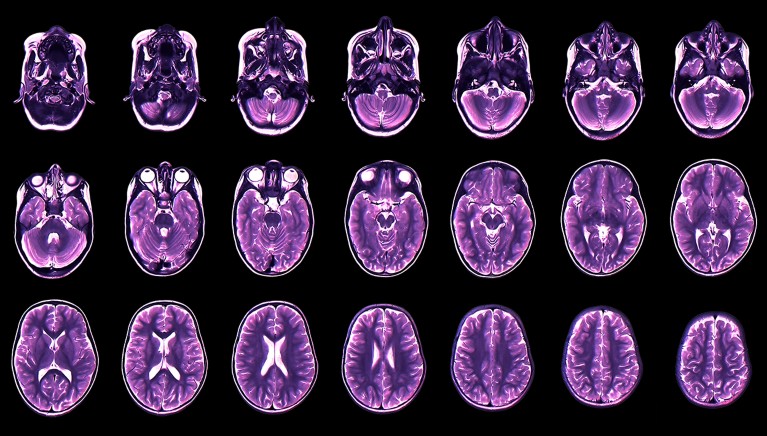
The speed at which regions of the brain mature during early adolescence can forecast the emergence of mental-health conditions up to four years before symptoms develop, according to a study of nearly 12,000 young people in the United States.
Your brain expands and shrinks over time — these charts show how
By tracking the brains of adolescents over six years in nearly 30,000 scans, researchers mapped how the brain’s outer layer, the cerebral cortex, thins as children grow into teenagers. The team observed that sensory areas of the cortex thinned, or matured, first, followed by regions responsible for complex thought.
The findings, posted on 11 October on the preprint server bioRxiv1, ahead of peer review, challenge the theory that psychiatric disorders are caused by defects in specific brain circuits. Instead, they indicate that vulnerability to mental-health symptoms could involve disruption of the brain’s developmental timeline and could be set in motion by genes that are active before birth.
The work “provides one of the clearest pictures yet of how the cortex develops from childhood into adolescence”, says Avram Holmes, a systems neuroscientist at Rutgers University in New Brunswick, New Jersey, who was not involved in the study. “It makes you think about the timing of brain development, not just the location [in the brain], when we look at psychiatric symptoms,” he says.
But he cautions that the population-level patterns found in the study — trends that become visible only when averaging data across large numbers of people — are subtle and cannot yet be used in the clinic to forecast the mental-health trajectory of an individual child.
Pruning the brain
During childhood and adolescence, the cerebral cortex thins. Neuroscientists attribute this process to the pruning of unused connections between neurons, which helps the brain to operate efficiently.
Mini models of the human brain are revealing how this complex organ takes shape
Researchers have long suspected that disruptions to cortical thinning contribute to mental illness, because psychiatric conditions such as depression are often diagnosed during late adolescence, when the thinning process is winding down. But proving that link has been difficult because brain-imaging studies have historically relied on small sample sizes or single snapshots in time.
To overcome these hurdles, study co-author Jacqueline Clauss, a child psychiatrist at the University of Iowa in Iowa City, and her colleagues turned to data from a massive project that is tracking nearly 12,000 children from around the age of nine. Participants’ brains are scanned every two years and their parents complete surveys about their children’s mental-health symptoms annually.
When analysing the data, Clauss and her colleagues found that rather than thinning at a steady rate, brain regions change following a distinct trajectory that fits an S-shaped curve. Thinning of a region of the cortex initially accelerates, then proceeds steadily before decelerating as the region nears maturity.
Enjoying our latest content?
Log in or create an account to continue
- Access the most recent journalism from Nature's award-winning team
- Explore the latest features & opinion covering groundbreaking research