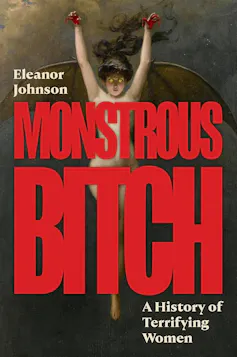
It’s news to no one that women have been consistently demonised in popular culture for a very, very long time. In her new book, Monstrous Bitch: A History of Terrifying Women, feminist academic Eleanor Johnson takes us on a detailed and delightfully macabre tour of the history of female monstrosity.
Johnson maps the 4,000-year-old tradition of framing nonconforming women as murderous, monstrous anomalies. Her central argument is that the perennial monstrous bitch, in any of its many forms, is a spectre formed in response to the patriarchy’s fear of women and belief that they’re inherently evil. These women threaten the decency and mild manners of the “good” men and women who uphold the order of the patriarchy.
In Monstrous Bitch: A History of Terrifying Women, Johnson shows us that despite differences in language, region, culture and time period, the monstrous bitch’s fundamental nature, purpose and even origin remain surprisingly consistent. This is because the patriarchy has remained consistent. This is an observation that is far less surprising, particularly in our current moment, as we witness a devastating rollback of women’s rights around the globe.
Johnson takes us through eight major historical phases of monstrous bitchery, beginning with the demonesses of ancient Mesopotamia, who were terrifying she-dogs.
From there, Johnson introduces us to the witches of ancient Greece whose horrific acts of infanticide directly echo those of their ancient forebears. For instance, Medea becomes the inheritor of the likes of Lamashtu, who was the Mesopotamian demoness of infanticide and is frequently depicted as having a hairy human body and the head of a lioness or a dog. In Medea’s case, she intentionally killed her sons as the ultimate act of revenge against her unfaithful husband, Jason. Medea, Johnson notes, is said to come from the east too.
We move through ancient Rome, where monstrous bitches prey on babies and pregnant women. Then on to the whore of Babylon and her many witchy avatars, whose power comes directly from their consort, Satan – patriarchy incarnate.
In each chapter, Johnson gives detailed portraits of these monstrous bitches, drawing primarily on historical texts of their respective times. These women come from the plays of Aeschylus and Euripides, Christian texts, Shakespearean plays, and Romantic poetry, to modern American and European cinema.
One of the book’s most engaging chapters explores vampiresses, who actually do seem like a genuine counter force to patriarchy. They achieved this through their overt sapphic eroticism and nocturnal habit of traipsing about, literally draining the lifeblood out of men and becoming all the more powerful for it.
Johnson argues that these vampiresses, like all the monstrous bitches examined in her book, also descend from an ancient Mesopotamian lineage. However, she does little to support this claim. Though she assures us that the connection stems from the “orientalising fervor” of the Enlightenment period, she supplies little evidence outside of the vague claim that vampiresses are, like the Greek and Roman bitches, said to originate in the east.
Despite the often delicious depictions of feminine monstrosity, the book’s deeper critical arguments remain somewhat underdeveloped. This is particularly true when compared with similar texts such as Barbara Creed’s work on the Monstrous-Feminine (1993) or Carol J. Clover’s many influential feminist critiques of modern horror cinema.
Johnson’s chapter on modern horror cinema, which she pinpoints as the locus of our current era of monstrous bitches, offers some of the book’s most insightful analyses of monstrous bitchery. It’s also where Johnson seems most at home, writing with particular conviction about her favourite feminist films, including Robert Eggers’ The Witch (2015) and Coralie Fargeat’s The Substance (2024).
In her discussion of The Exorcist (1973), for example, we see an intriguing reading of the film as a rare instance of a male character, a priest no less, taking responsibility for a monstrous consequence of patriarchy: a demoness imprisoned in the body of a prepubescent girl. This priest gives his life to save her, in what can be read as a striking feminist twist.
Johnson goes on to describe how at odds the story of the Exorcist is with the circumstances of its making, which involves a misogynistic director torturing the two female leads. This attention to the conditions that give rise to the production of a given film adds depth to the analysis and makes for a more compelling read. Unfortunately, many sections of the book lack this contextual richness, leaving this reader wanting more.
Ultimately, the book reads as a fascinating catalogue of predominantly western instances of monstrous bitchery, with the occasional foray into a deeper cultural or political analysis of the influences that shaped how monstrous bitches have changed over time. In her conclusion, Johnson calls on us to recognise the monstrous bitch, wherever she may appear, as a “paradigm for demonising women”, and, equally, as “an embodiment of infinite suffering”. I only wish these insights had been explored more fully throughout the book.
This article features references to books that have been included for editorial reasons, and may contain links to bookshop.org. If you click on one of the links and go on to buy something, The Conversation UK may earn a commission.