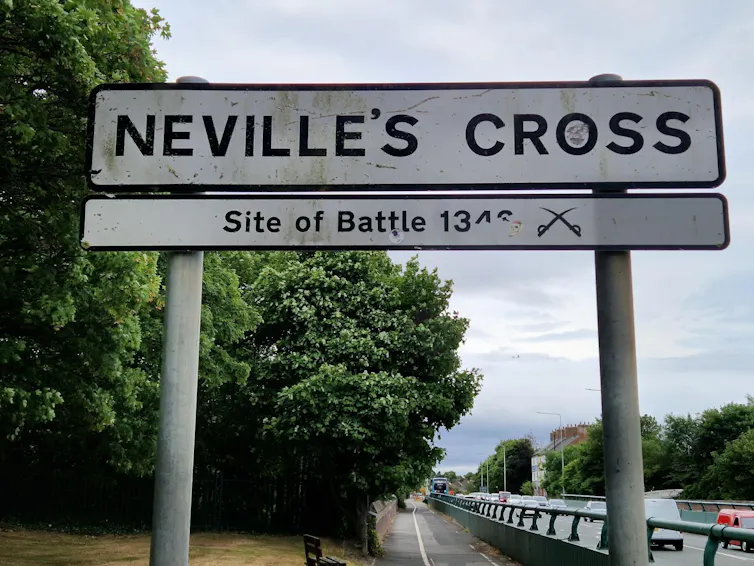
On October 17, 1346, the battle of Neville’s Cross was fought outside Durham in the north-east of England. It was a decisive moment in Anglo-Scottish history that led to the capture of King David II of Scotland. Yet few have heard of it.
Other battles are far better known. Those of Stirling Bridge (1297), Falkirk (1298) and Bannockburn (1314) are more famous because of the exploits of William Wallace and Robert the Bruce. Similarly well-known are the successes of Edward III (the Black Prince) and Henry V at Crécy (1346), Poitiers (1356) and Agincourt (1415), respectively.
Yet, less than two months after Crécy, a decisive victory was won in northern England. The battle of Neville’s Cross remains one of the least publicly known but decisive battles in English history.
As Edward III gathered a force of 15,000 men to invade France in 1346, King Philip IV of France requested Scottish aid. He wrote to King David in June and again in July: “I implore you to remember our friendship and our treaties and to strike as hard at England as you can.”
David duly invaded England with a force of around 12,000 men on October 7. They stormed the Peel of Liddell, took a ransom from Carlisle and sacked Hexham Abbey, before resting outside Durham at Bearpark on October 16.
The English were not, however, caught unawares. Contrary to Philip’s assurances, Edward had not left his northern border undefended. A force of 6,000 men was raised by the northern lords, Henry Percy, Ralph Neville and the Archbishop of York.

Seeking to catch the Scots unawares, they marched towards Bearpark before dawn on October 17. In the morning mists, the English force stumbled upon a Scottish raiding party led by William Douglas. Douglas hastily fled to inform King David that the English had successfully fielded an army against him.
The Anonimalle Chronicle, an anonymous 14th-century account written at St Mary’s Abbey, reported that David arose from his bed irritated and angrily said: “O man, that cannot be, because in England there are no men left but monks and canons, brothers and priests, swineherds and shepherds, cobblers and skinners; but all the knights are with their king overseas.”
The battle of Neville’s Cross
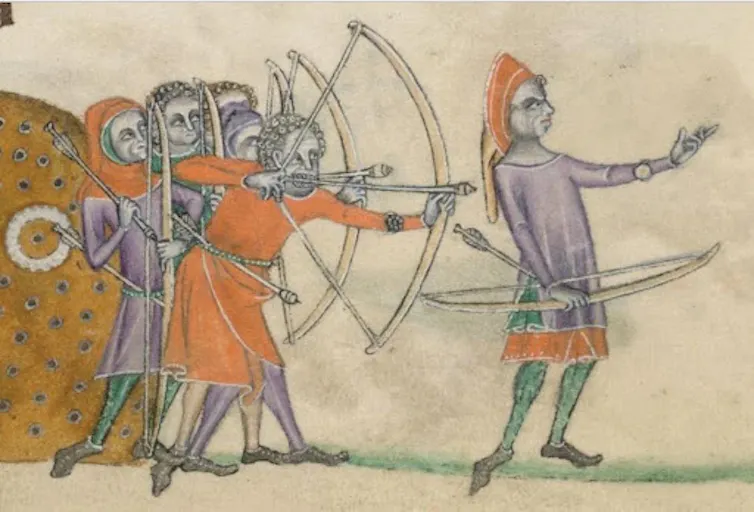
Two contemporary letters by the prior of Durham and Thomas Sampson described how the English army arrived at the battlefield outside Durham at 9am. The two armies proceeded to stare at each other across the moor for the next five hours. Then the English longbowmen opened fire on the Scots at 2pm, and the battle began in earnest. By 5pm, the Scots were routed and fled the field.
Although the ebb and flow of the battle is difficult to reconstruct, historians have suggested that “victory was achieved, not so much by archery, as by the hard work of fighting hand-to-hand in a fierce melee”.
The chronicle of Meaux Abbey, written at the turn of the 15th century, recorded that “because of their exhaustion and the length of the fight, they rested from the fight for a time, leaning on their spears and weapons”. The Anonimalle Chronicle similarly noted that the armies “rested by agreement and then fought again” on several occasions.
Local legend suggests that King David attempted to flee, hiding underneath Aldin Grange bridge. It is said he was captured because the English saw his reflection in the water of the River Browney. However, most contemporary chronicles record the king fighting courageously.
King David was wounded by two arrows. Despite this, the Scotichronicon, a 15th-century Scottish chronicle, reported that King David managed to knock out two of his captor’s teeth before being overwhelmed.
King David’s captor was a relatively humble Northumberland squire – John de Coupland. He was promoted to the rank of knight banneret, the highest position below the titled aristocracy. He also received a very large annuity of £500 per year (equivalent to just over £290,000 in 2017).
Decisive and devastating result
It was a decisive and devastating result. The Scottish force lost up to 2,000 men, while the prior of Durham wrote that “few of us in the said battle were killed”.
Alongside King David, four Scottish earls and over a dozen major barons were captured. The Earl of Menteith, who had previously paid homage and sworn loyalty to Edward III, was hung, drawn and quartered for treason. The list of the dead included the earls of Moray and Strathearn, the marshal, constable, chancellor and chamberlain of Scotland, as well as many barons and knights.
In the following year, the English were able to occupy virtually of all of Scotland south of the Forth and Clyde rivers. It would take decades for the Scots to recover all they had lost. King David himself spent 11 years as an English prisoner before agreeing to pay a large ransom of 100,000 marks for his freedom (equivalent to just over £39 million in 2017).
The battle of Neville’s Cross was most significant because it stopped a series of potential might-have-beens. A Scottish victory would have put pressure on Edward III to lift his siege of Calais and return to England. Instead, the resounding English victory secured Edward’s northern border for the rest of his long reign. This enabled him to raise 30,000 men for the Calais siege; the largest English force assembled during the hundred years war (1337-1453).
Why, then, is the battle not more famous? Unlike Agincourt, it was not immortalised by Shakespeare. Unlike Bannockburn, national identities have not coalesced around it. The battle has not featured in a major cinematic portrayal. It has faded from popular memory in the long and bloody history of Anglo-Scottish warfare.
Although relatively few people today have heard of Neville’s Cross, the events of a few short hours there one October afternoon were of international significance. They came to shape the relations of England, Scotland and France for years to come.