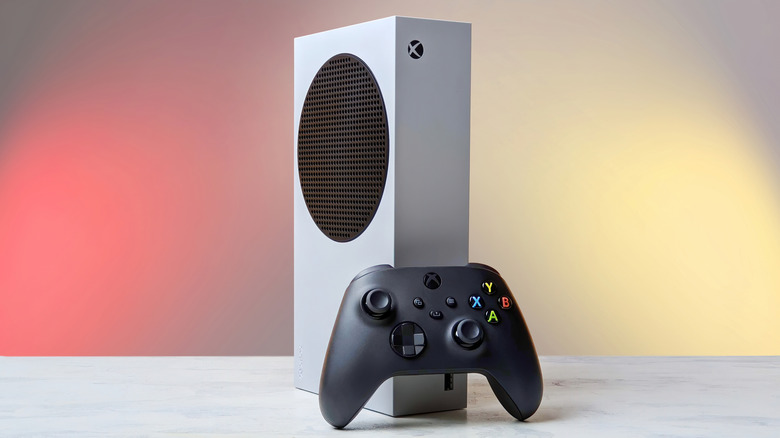
Both consoles have become more expensive since launch, but the Series S is still relatively affordable.
Why the Series X is more expensive
The most obvious difference between these two is that the Series S is a digital-only device that lacks a disc drive. Though there is a model of the Series X that also lacks a disc drive (which knocks $50 off its price), the hardware of the Series X otherwise remains the same. This lock-in to a solely digital landscape is one of the most defining features between the two, which contributes somewhat to its cheaper price tag.
Under the hood, the Series S is also a less impressive piece of hardware then the Series X. The base model of the Series S offers 512GB of storage, with a 1TB model available for $100 more. Meanwhile, the Series X comes with 1TB of space (there was a 2TB Series X model, but Microsoft discontinued it in 2026). Either model can gain more storage with an expansion card that plugs into the back of the console.
The Series X boasts 12 teraflops of processing power and targets 4K resolution, while the Series S has only 4 teraflops and can go up to 1440p in most games. However, both consoles have the capability for 120 fps. On a more technical level, both consoles utilize a custom AMD Zen 2 CPU, but the Series X CPU is clocked higher, giving it an edge in speed. Both also use an AMD RDNA 2 GPU, but the Series X version has 52 CUs (short for compute units, a measurement of processing power) while the Series S has only 20.
Similarly, the Series X has 16GB of RAM, 10GB of which can operate at 560 GB per second and 6GB that can operate at 336 GB/s. Compared to 10GB RAM in the S, with 8GB of it operating at 224 GB/s and 2GB at 56 GB/s, the Series X has much more complex and capable hardware, contributing to its higher price.
Xbox Series X vs. Series S: Which is better for you?
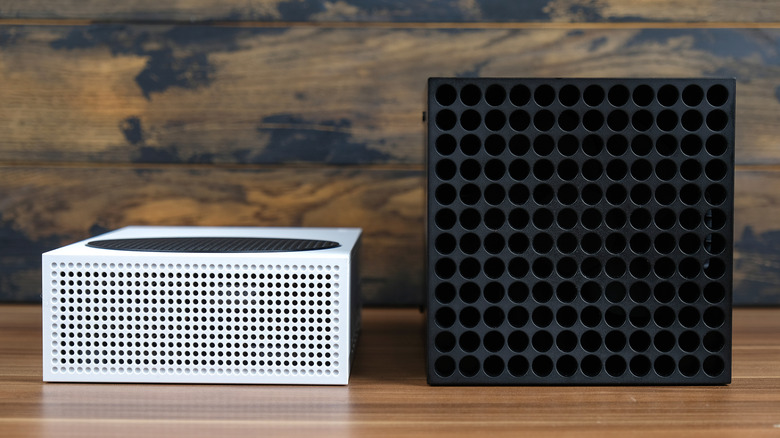
If you're set on getting an Xbox console, which Series is right for you depends on your gaming style. If you aren't someone who has a collection of physical games, or largely plan to play via Game Pass, the Series S's lack of disc drive probably won't bother you. If you prefer to take advantage of disc-based game sales or just hold a game in your hands, the Series X is the way to go.
The Series S is the more compact choice, not just from the space saved by skipping physical games, but because it's about 60 percent smaller than a Series X. It's much easier to slot a Series S into an entertainment center than its larger sibling.
Game resolution and performance will be lower with a Series S, but depending on the games you play and your tolerances, it might not be a big enough difference to matter. If you don't need to see 4K resolution all the time (the S does support 4K upscaling, just not 4K natively), or play many games that aren't graphically intensive, the Series S might be good enough, especially since it can achieve 120 fps in compatible titles. However, if you're a performance purist who wants the very best, you'll want the Series X.
Alternatively, it's worth waiting until Microsoft's Project Helix family of devices comes out if you'd rather not get a console so many years into its lifecycle. These will almost certainly be more expensive than a Series X or S, and we don't know how big the technical advancements will be between this generation and the next. Microsoft plans to start sending alpha Project Helix hardware to developers in 2027, which likely means at least another year after that before we see the final product released. But if you're willing to be patient, consider saving your money for cutting-edge technology.