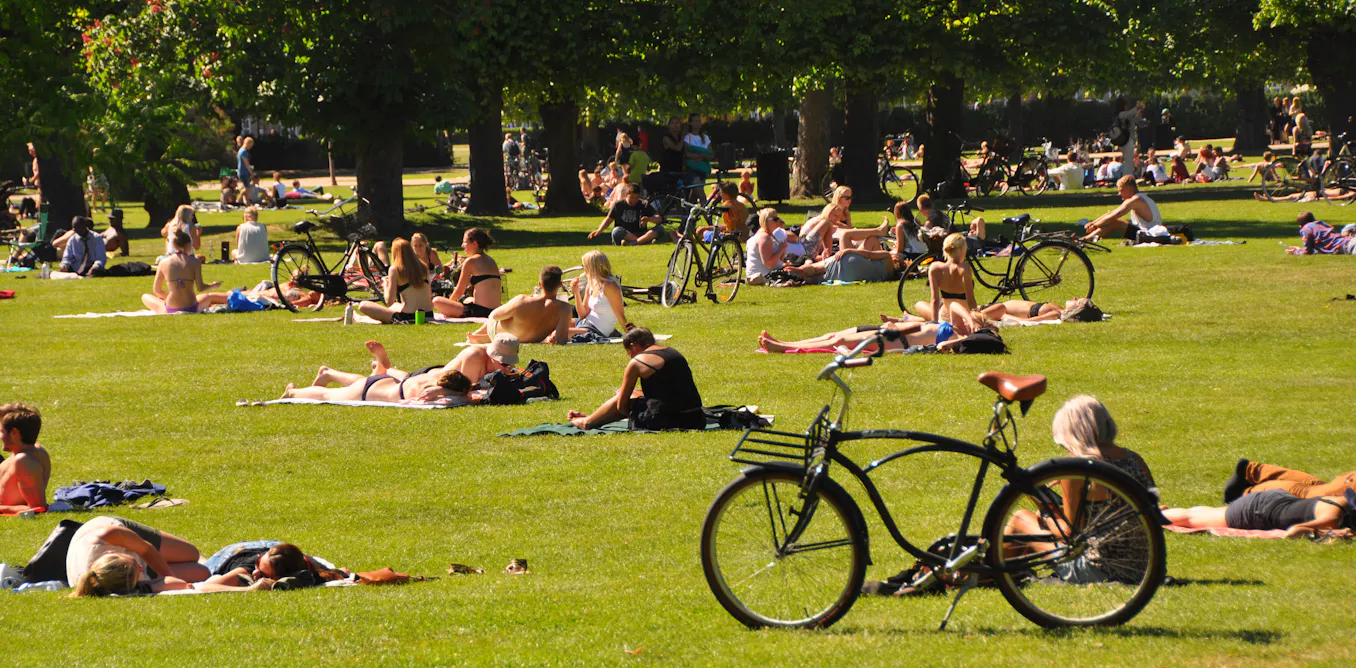
You can see it in the country’s history: Denmark was the first country in the world to legalise pornography. Alternative communities such as Christiania in Copenhagen are internationally famous for their counterculture and liberal attitudes. And Danish activists have helped push ideas about sexuality and family life in new directions.
But there is a less obvious part of this story.
Denmark did not develop its reputation for open-mindedness entirely on its own. Some of the people who helped create that image were looking at Denmark from across the border.
From the 1960s onwards, West Germany became an important audience for Denmark’s emerging reputation as a more liberal society. For young Germans frustrated with what they saw as a conservative, hierarchical and authoritarian society, Denmark looked like a place where people had more freedom to experiment with different ways of living.
West Germany in the 1960s and 1970s was still grappling with the legacy of Nazism. Many young people in the West German New Left rejected the social and political values of their parents’ generation and looked for alternatives.
The situation was also different across the German divide. In East Germany, the communist state offered its own very different model of society and controlled many aspects of public and private life.
For young West Germans seeking alternatives, Denmark seemed like something else entirely: a nearby democratic country where social experimentation seemed possible.
Research I am carrying out with my colleague Tobias Haimin de Fønss Wung-Sung into West German reactions to Denmark during this period shows how several aspects of Danish life contributed to this image.
Christiania, the self-governing community in Copenhagen, became associated with communal living and alternative lifestyles. The New Left political movement challenged established politics and social norms. Roskilde music festival grew into an important gathering place for young people and counterculture. Denmark also experimented with progressive approaches to education and pornography.
From abroad, this created an image of Denmark as a country where people were unusually free to live differently.
In 1969, when the Danish parliament legalised pornographic images , its decision was highly controversial among Danes. But it attracted considerable attention internationally, particularly in West Germany, where the new government under Chancellor Willy Brandt prepared a similar reform.
The result was not simply a change in Danish law. People, products and money began moving across the border.
Government officials travelled to Copenhagen to learn about the effects of the liberalisation. West Germans travelled to Denmark to buy pornography. Danish producers gained access to a much larger market south of the border. Denmark could even be imagined in West Germany as a kind of porn paradise.
Our research into West German reactions to Denmark’s liberalisation between 1965 and 1985 shows how the country became associated with a new kind of sexual freedom.
Danish homosexual people and activists also developed connections with larger gay communities in West Germany, particularly in Berlin and Hamburg. And Denmark developed its own naturist culture, not least inspired by the German movement of (pronounced FRY-kur-per-kul-toor) or “free body culture”. People gathered to swim, sunbathe and socialise naked.
People, ideas and practices were therefore moving in both directions across the border.
Reputation and national values
Over time, these developments helped turn Denmark’s reputation for social liberalism into something more than an international image. It became part of how Denmark could describe itself.
In 2016, for example, the Danish government asked the public to identify values considered particularly important to Danish society. The resulting Danmarkskanon, or Danish Canon, included ten such values. One was (pronounced free-sin) – a word that can mean open-mindedness, tolerance or freedom from conventional moral constraints.
The Canon described in terms of openness towards traditional moral ideas, the body and sexuality. It pointed to Denmark’s relaxed attitude towards nudity, tolerance of different forms of family and sexual life, alternative lifestyles and the legalisation of pornography.
By this point, what had once been a contested and internationally shaped reputation had become something that could be presented as part of Denmark’s cultural heritage. But that does not necessarily mean Danes have always been uniquely tolerant.
The Danish criminologist Berl Kutchinsky (1935-1995) studied the liberalisation of pornography extensively and he was sceptical of precisely this idea. He argued that Denmark’s exceptional liberalism was something of a myth.
In his view, Danes still belonged to the broadly “puritanical, post-Victorian” family of European nations. Denmark was simply among the less puritanical members of that group, alongside Sweden, the Netherlands and Germany. Compared with them, he considered Danes “slightly more liberal and permissive” when it came to sexuality.
If Kutchinsky was right, Danish is less about being uniquely liberal than about being liberal in comparison with particular neighbours.
Somewhere else
The history of Danish therefore stretches well beyond Denmark.
And while it has been shaped by changing laws and attitudes inside the country, people travelling across the border, activists building international networks and products finding new markets have also played a role.
That is easy to lose sight of once an idea becomes part of a national identity.
The Danish Canon presents as a Danish value. But its history suggests something more complicated: Denmark’s reputation for open-mindedness was, at least partly, made through its relationships with other countries.
In other words, one of the very things Denmark considers particularly Danish likely started out more as a comparison with somewhere else.
This article was commissioned as part of a partnership between Videnskab.dk and The Conversation. Articles are also published in Danish.